QUESTION IMAGE
Question
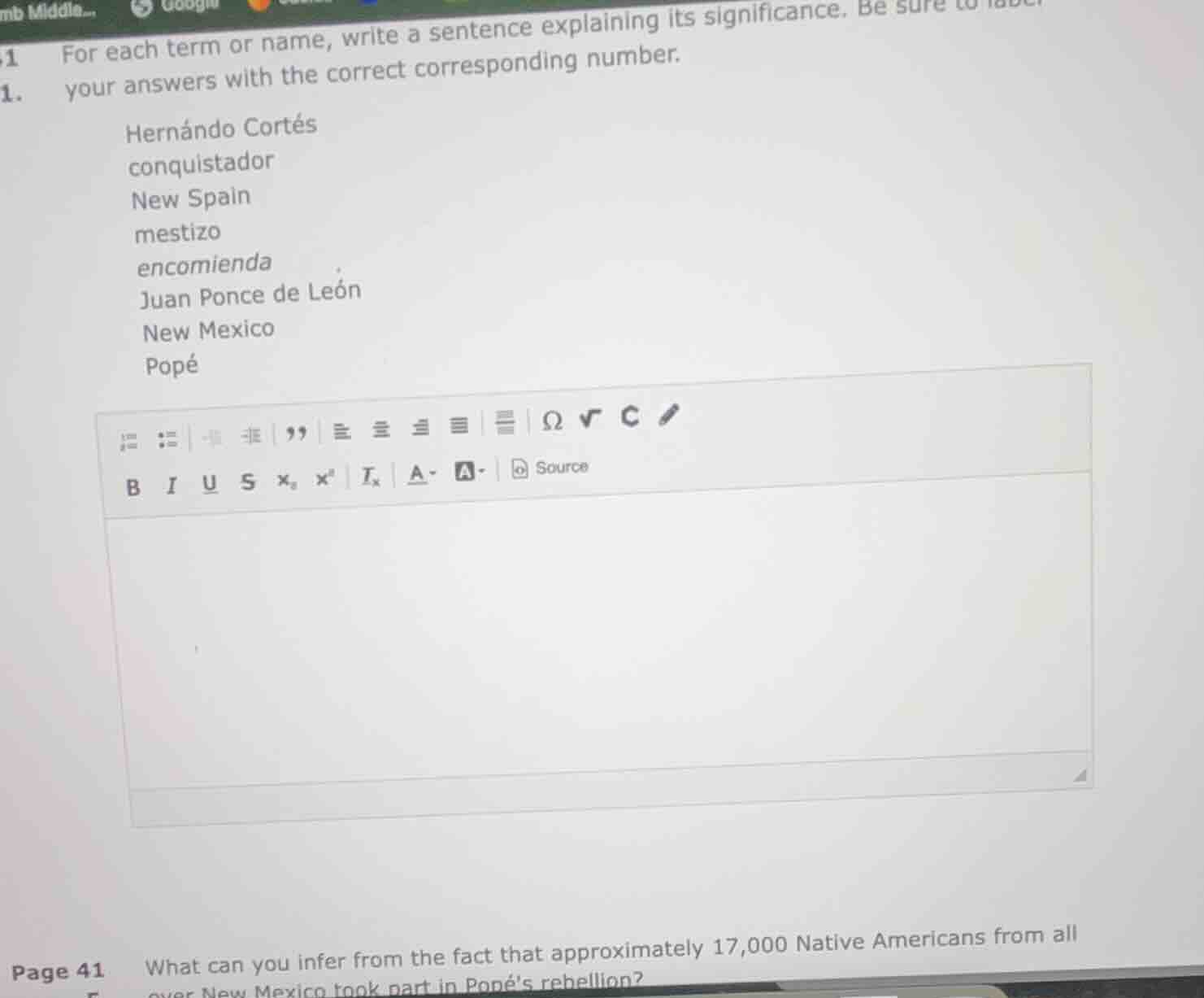
for each term or name, write a sentence explaining its significance. be sure to label your answers with the correct corresponding number.
1.
hernándo cortés
conquistador
new spain
mestizo
encomienda
juan ponce de león
new mexico
popé
page 41 what can you infer from the fact that approximately 17,000 native americans from all over new mexico took part in popé’s rebellion?
Brief Explanations
- Hernándo Cortés: A Spanish leader whose conquest of the Aztec Empire opened large parts of Mesoamerica to Spanish colonial rule.
- conquistador: Spanish/Portuguese explorers-soldiers who conquered and colonized large regions of the Americas, driving European expansion in the 15th–16th centuries.
- New Spain: The vast Spanish colonial territory in North/Central America, established after the Aztec conquest, serving as a core hub for Spanish resource extraction and governance in the Americas.
- mestizo: A term for people of mixed European and Indigenous American ancestry, a demographic group that shaped colonial and post-colonial cultural identities in the Americas.
- encomienda: A Spanish colonial labor system that granted settlers control over Indigenous peoples, forcing them to work, which was a key tool of colonial exploitation.
- Juan Ponce de León: A Spanish conquistador who explored Florida, becoming one of the first Europeans to reach and claim the region for Spain.
- New Mexico: A Spanish colonial territory in the American Southwest, a site of Indigenous-Spanish conflict and cultural interaction, including Popé's Rebellion.
- Popé: A Pueblo Indigenous leader who organized the 1680 Pueblo Revolt, driving Spanish colonizers out of New Mexico temporarily and asserting Indigenous sovereignty.
- (Inference question): The large number of participants shows widespread Indigenous anger at Spanish colonial oppression, uniting diverse Pueblo groups against shared colonial exploitation.

Snap & solve any problem in the app
Get step-by-step solutions on Sovi AI
Photo-based solutions with guided steps
Explore more problems and detailed explanations
- Hernándo Cortés: He was a Spanish conquistador whose 1521 conquest of the Aztec Empire established Spanish control over central Mexico, laying the foundation for New Spain.
- conquistador: These were Spanish and Portuguese soldier-explorers who conquered and colonized much of the Americas between the 15th and 16th centuries, enabling European imperial expansion.
- New Spain: A massive Spanish colonial empire in North and Central America, centered on Mexico, that served as a primary source of wealth (like silver) and a model for Spanish colonial administration.
- mestizo: A person of mixed European and Indigenous American ancestry, a demographic that emerged from colonial interactions and became a core part of Latin American cultural identity.
- encomienda: A Spanish colonial labor system that allowed settlers to demand labor and tribute from Indigenous peoples, a system of exploitation that defined early colonial economic life.
- Juan Ponce de León: A Spanish conquistador who led the first recorded European expedition to Florida in 1513, searching for mythic lands and claiming the region for Spain.
- New Mexico: A Spanish colonial territory in the American Southwest, known for its tense Indigenous-Spanish relations and as the site of the 1680 Pueblo Revolt.
- Popé: A Pueblo religious leader who organized the 1680 Pueblo Revolt, the most successful Indigenous uprising against colonial rule in North American history, driving the Spanish out of New Mexico for over a decade.
- From the 17,000 Native American participants in Popé's rebellion, we can infer that Spanish colonial oppression (including forced labor, religious suppression, and land seizure) was so severe that it united diverse Pueblo communities in a coordinated fight for their sovereignty.