QUESTION IMAGE
Question
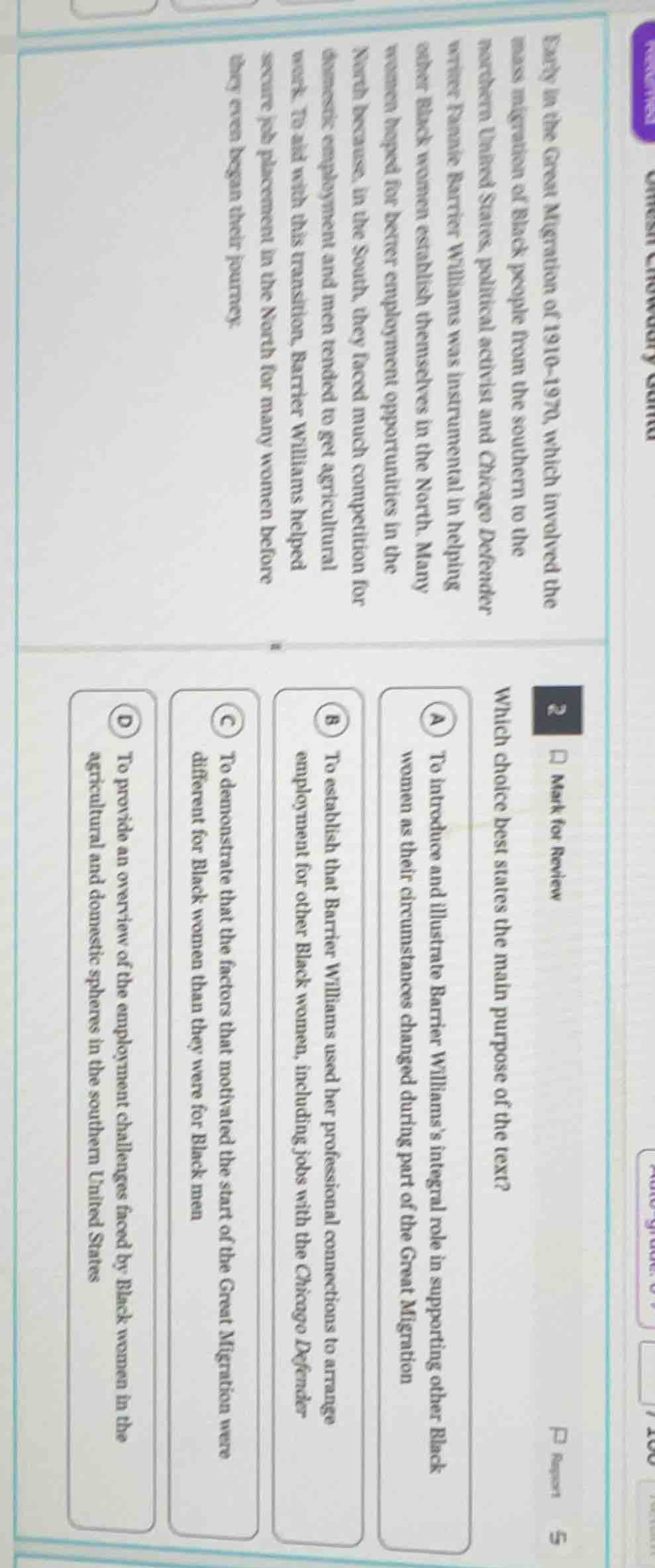
early in the great migration of 1910 - 1970, which involved the mass migration of black people from the southern to the northern united states, political activist and chicago defender writer fannie barrier williams was instrumental in helping other black women establish themselves in the north. many women hoped for better employment opportunities in the north because, in the south, they faced much competition for domestic employment and men tended to get agricultural work. to aid with this transition, barrier williams helped secure job placement in the north for many women before they even began their journey.
2 □ mark for review
which choice best states the main purpose of the text?
a to introduce and illustrate barrier williamss integral role in supporting other black women as their circumstances changed during part of the great migration
b to establish that barrier williams used her professional connections to arrange employment for other black women, including jobs with the chicago defender
c to demonstrate that the factors that motivated the start of the great migration were different for black women than they were for black men
d to provide an overview of the employment challenges faced by black women in the agricultural and domestic spheres in the southern united states
The text opens with context about the Great Migration, then centers on Fannie Barrier Williams' key role in helping Black women settle and find employment in the North, including her work with the Chicago Defender and pre-migration job placement support. Option A captures this core focus on introducing her integral supportive role during the migration. Option B is a supporting detail, not the main purpose. Options C and D do not align with the text's central focus on Williams' work.

Snap & solve any problem in the app
Get step-by-step solutions on Sovi AI
Photo-based solutions with guided steps
Explore more problems and detailed explanations
A. To introduce and illustrate Barrier Williams's integral role in supporting other Black women as their circumstances changed during part of the Great Migration