QUESTION IMAGE
Question
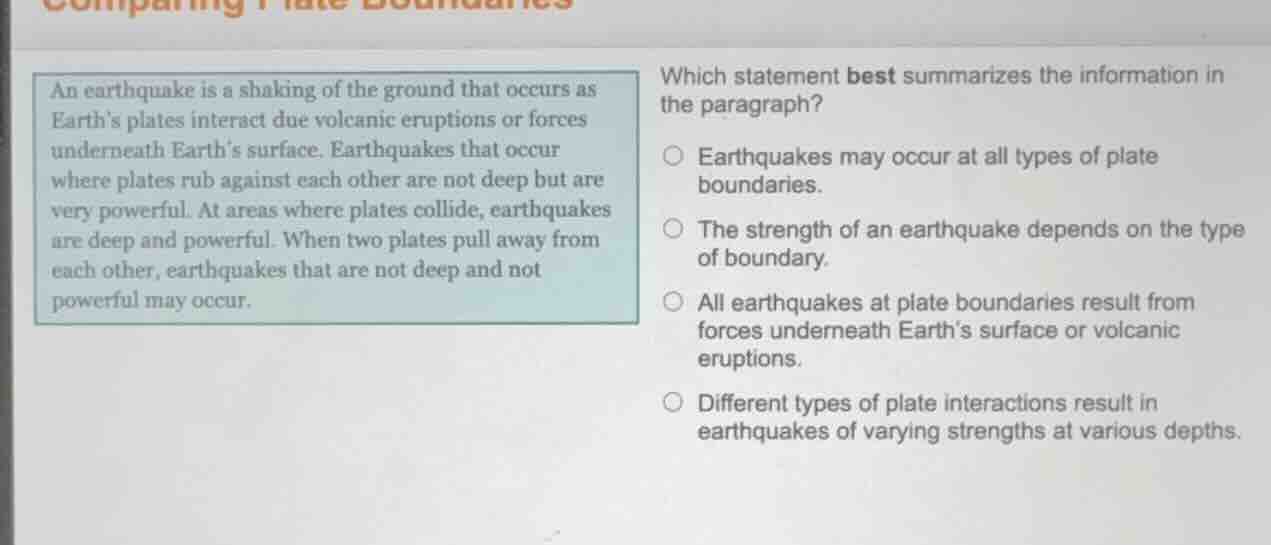
an earthquake is a shaking of the ground that occurs as earth’s plates interact due volcanic eruptions or forces underneath earth’s surface. earthquakes that occur where plates rub against each other are not deep but are very powerful. at areas where plates collide, earthquakes are deep and powerful. when two plates pull away from each other, earthquakes that are not deep and not powerful may occur. which statement best summarizes the information in the paragraph? \bigcirc earthquakes may occur at all types of plate boundaries. \bigcirc the strength of an earthquake depends on the type of boundary. \bigcirc all earthquakes at plate boundaries result from forces underneath earth’s surface or volcanic eruptions. \bigcirc different types of plate interactions result in earthquakes of varying strengths at various depths.
The paragraph explains that earthquakes form from plate interactions, then details how different plate movements (rubbing, colliding, pulling apart) create earthquakes with varying depth and strength. Option A is incorrect as the text doesn't state earthquakes happen at all boundaries. Option B is incomplete, as depth is also a variable mentioned. Option C is wrong because the text notes earthquakes come from plate interactions (not only the initial listed causes) and the specific boundary types change their traits. Option D matches the full summary of varying quake traits from different plate interactions.

Snap & solve any problem in the app
Get step-by-step solutions on Sovi AI
Photo-based solutions with guided steps
Explore more problems and detailed explanations
D. Different types of plate interactions result in earthquakes of varying strengths at various depths.