QUESTION IMAGE
Question
earthquake waves
name: alysea
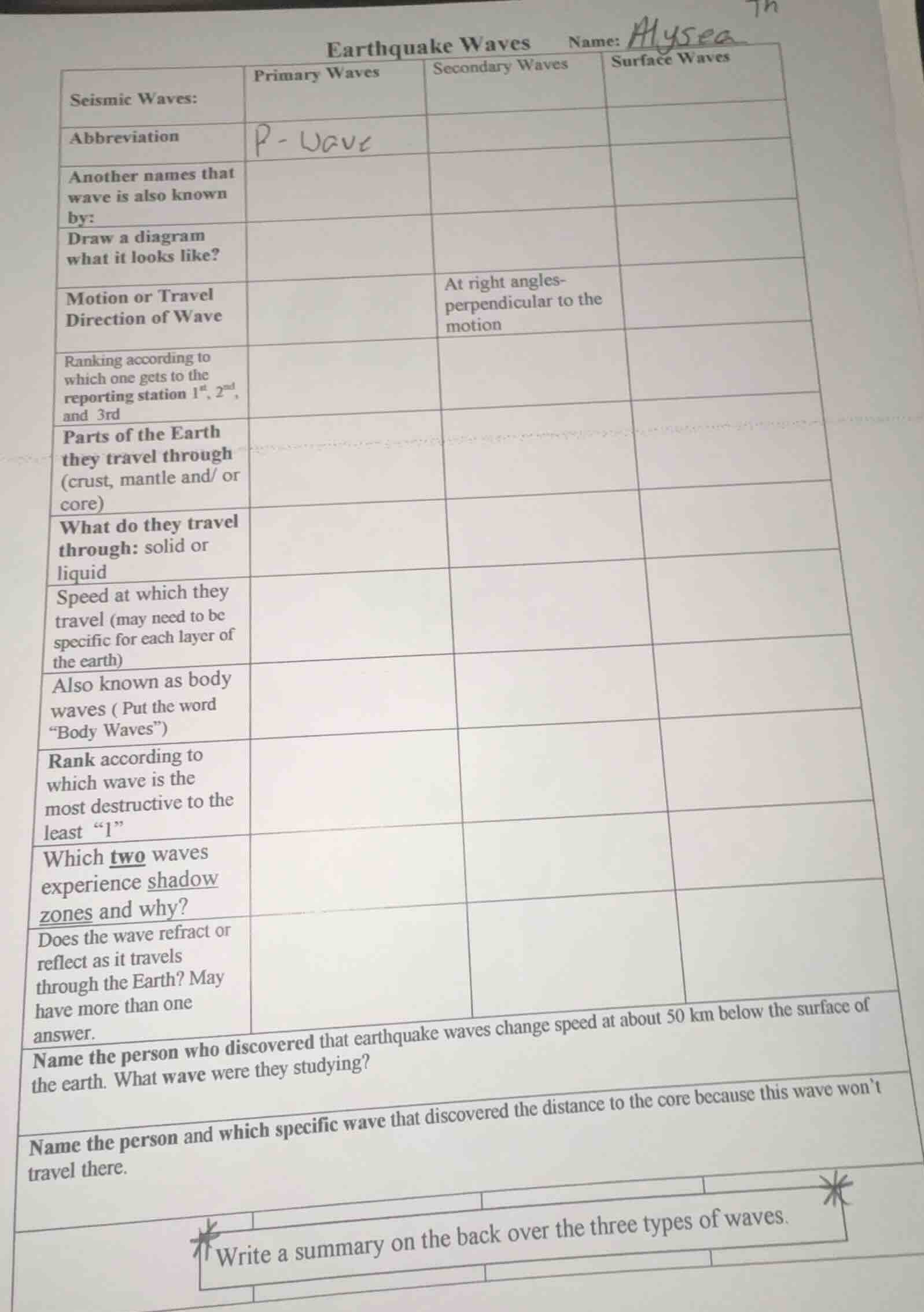
| seismic waves: | primary waves | secondary waves | surface waves |
|---|---|---|---|
| another names that wave is also known by: | |||
| draw a diagram what it looks like? | |||
| motion or travel direction of wave | at right angles - perpendicular to the motion | ||
| ranking according to which one gets to the reporting station 1st, 2nd, and 3rd | |||
| parts of the earth they travel through (crust, mantle and/or core) | |||
| what do they travel through: solid or liquid | |||
| speed at which they travel (may need to be specific for each layer of the earth) | |||
| also known as body waves (put the word \body waves\) | |||
| rank according to which wave is the most destructive to the least “1” | |||
| which two waves experience shadow zones and why? | |||
| does the wave refract or reflect as it travels through the earth? may have more than one answer. | |||
| name the person who discovered that earthquake waves change speed at about 50 km below the surface of the earth. what wave were they studying? | |||
| name the person and which specific wave that discovered the distance to the core because this wave wont travel there. | |||
| * | |||
| write a summary on the back over the three types of waves. | * |
Response
To fill the table about Earthquake (Seismic) Waves, we analyze each row for Primary Waves (P - Waves), Secondary Waves (S - Waves), and Surface Waves:
1. Seismic Waves:
- Primary Waves: Compressional waves, travel fastest, can go through solids, liquids, and gases.
- Secondary Waves: Shear waves, travel slower than P - waves, can only go through solids.
- Surface Waves: Travel along the Earth's surface, cause most destruction, slower than body waves (P and S).
2. Abbreviation:
- Primary Waves: P - Wave
- Secondary Waves: S - Wave
- Surface Waves: Usually L - Waves (Love) or R - Waves (Rayleigh), but often just referred to as Surface Waves without a single abbreviation like P/S.
3. Another names that wave is also known by:
- Primary Waves: Pressure Waves, Longitudinal Waves
- Secondary Waves: Shear Waves, Transverse Waves
- Surface Waves: Love Waves (horizontal - ground motion), Rayleigh Waves (elliptical - ground motion)
4. Draw a diagram what it looks like?
- Primary Waves: Like a slinky being pushed and pulled (compression/rarefaction), particles move in the direction of wave travel.
- Secondary Waves: Like a slinky being shaken side - to - side, particles move perpendicular to wave travel.
- Surface Waves: Like waves on the ocean, with circular or elliptical particle motion (Rayleigh) or side - to - side (Love) along the surface.
5. Motion or Travel Direction of Wave:
- Primary Waves: Parallel to the direction of wave propagation (longitudinal).
- Secondary Waves: Perpendicular to the direction of wave propagation (transverse) (as given in the table for S - Waves).
- Surface Waves: Rayleigh - elliptical motion along the surface; Love - transverse motion along the surface.
6. Ranking according to which one gets to the reporting station \(1^{st}\), \(2^{nd}\), and \(3^{rd}\):
- \(1^{st}\): Primary Waves (fastest)
- \(2^{nd}\): Secondary Waves (slower than P - waves)
- \(3^{rd}\): Surface Waves (slowest, as they travel along the surface)
7. Parts of the Earth they travel through (crust, mantle and/or core):
- Primary Waves: Crust, Mantle, Outer Core (liquid), Inner Core (solid)
- Secondary Waves: Crust, Mantle (cannot go through Outer Core - liquid)
- Surface Waves: Crust (travel along the surface)
8. What do they travel through: solid or liquid:
- Primary Waves: Solid, Liquid, Gas
- Secondary Waves: Solid only
- Surface Waves: Travel along the surface (interface of air - land or land - water), but the medium they travel through (the surface) is solid (the Earth's crust).
9. Speed at which they travel (may need to be specific for each layer of the earth):
- Primary Waves: ~5 - 8 km/s in the crust, ~10 km/s in the mantle, ~11 km/s in the inner core.
- Secondary Waves: ~3 - 4 km/s in the crust, ~6 km/s in the mantle.
- Surface Waves: ~2 - 4 km/s (slower than body waves)
10. Also known as body waves (Put the word “Body Waves”):
- Primary Waves: Body Wave (along with S - Waves, they are body waves as they travel through the Earth's interior)
- Secondary Waves: Body Wave
- Surface Waves: Not body waves (they are surface waves)
11. Rank according to which wave is the most destructive to the least “1”:
- \(1^{st}\) (most destructive): Surface Waves (cause the most ground shaking and damage)
- \(2^{nd}\): Secondary Waves
- \(3^{rd}\) (least destructive): Primary Waves
12. Which two waves experience shadow zones and why?
- Primary Waves: Have a shadow zone between \(103^{\c…
Step 1: Recall wave speeds
Primary Waves (P - Waves) are the fastest seismic waves, followed by Secondary Waves (S - Waves), and Surface Waves are the slowest.
Step 2: Assign ranks
Since speed determines arrival time (faster = earlier arrival), P - Waves arrive first, then S - Waves, then Surface Waves.

Snap & solve any problem in the app
Get step-by-step solutions on Sovi AI
Photo-based solutions with guided steps
Explore more problems and detailed explanations
- Primary Waves: \(1^{st}\)
- Secondary Waves: \(2^{nd}\)
- Surface Waves: \(3^{rd}\)