QUESTION IMAGE
Question
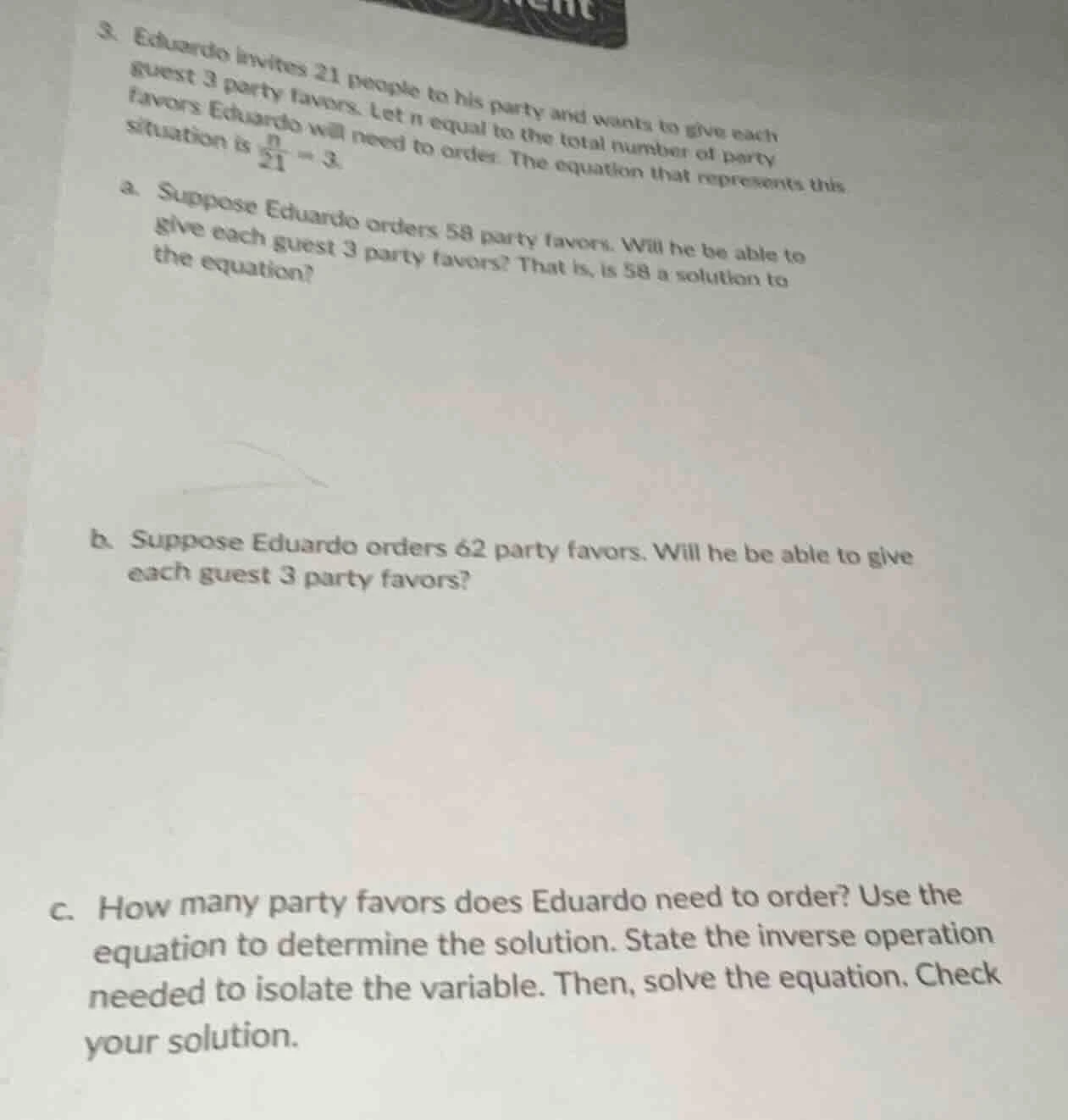
- eduardo invites 21 people to his party and wants to give each guest 3 party favors. let n equal to the total number of party favors eduardo will need to order. the equation that represents this situation is \\(\frac{n}{21}=3\\).
a. suppose eduardo orders 58 party favors. will he be able to give each guest 3 party favors? that is, is 58 a solution to the equation?
b. suppose eduardo orders 62 party favors. will he be able to give each guest 3 party favors?
c. how many party favors does eduardo need to order? use the equation to determine the solution. state the inverse operation needed to isolate the variable. then, solve the equation. check your solution.
Step1: Check if 58 is a solution
Substitute $n=58$ into $\frac{n}{21}=3$:
$\frac{58}{21} \approx 2.76$
Step2: Compare to required value
$2.76
eq 3$, so 58 is not a solution.
Step3: Check if 62 is a solution
Substitute $n=62$ into $\frac{n}{21}=3$:
$\frac{62}{21} \approx 2.95$
Step4: Compare to required value
$2.95
eq 3$, so 62 is not a solution.
Step5: Identify inverse operation
To isolate $n$, multiply both sides by 21 (inverse of division).
Step6: Solve the equation
Step7: Verify the solution
Substitute $n=63$ into $\frac{n}{21}=3$:
$\frac{63}{21}=3$, which is true.

Snap & solve any problem in the app
Get step-by-step solutions on Sovi AI
Photo-based solutions with guided steps
Explore more problems and detailed explanations
a. No, 58 is not a solution, so he cannot give each guest 3 party favors.
b. No, he cannot give each guest 3 party favors.
c. Inverse operation: Multiplication (multiply by 21). Eduardo needs to order 63 party favors.