QUESTION IMAGE
Question
el menú
observa el menú y sus características. completa las oraciones basándote en los elementos dados. usa comparativos y sup
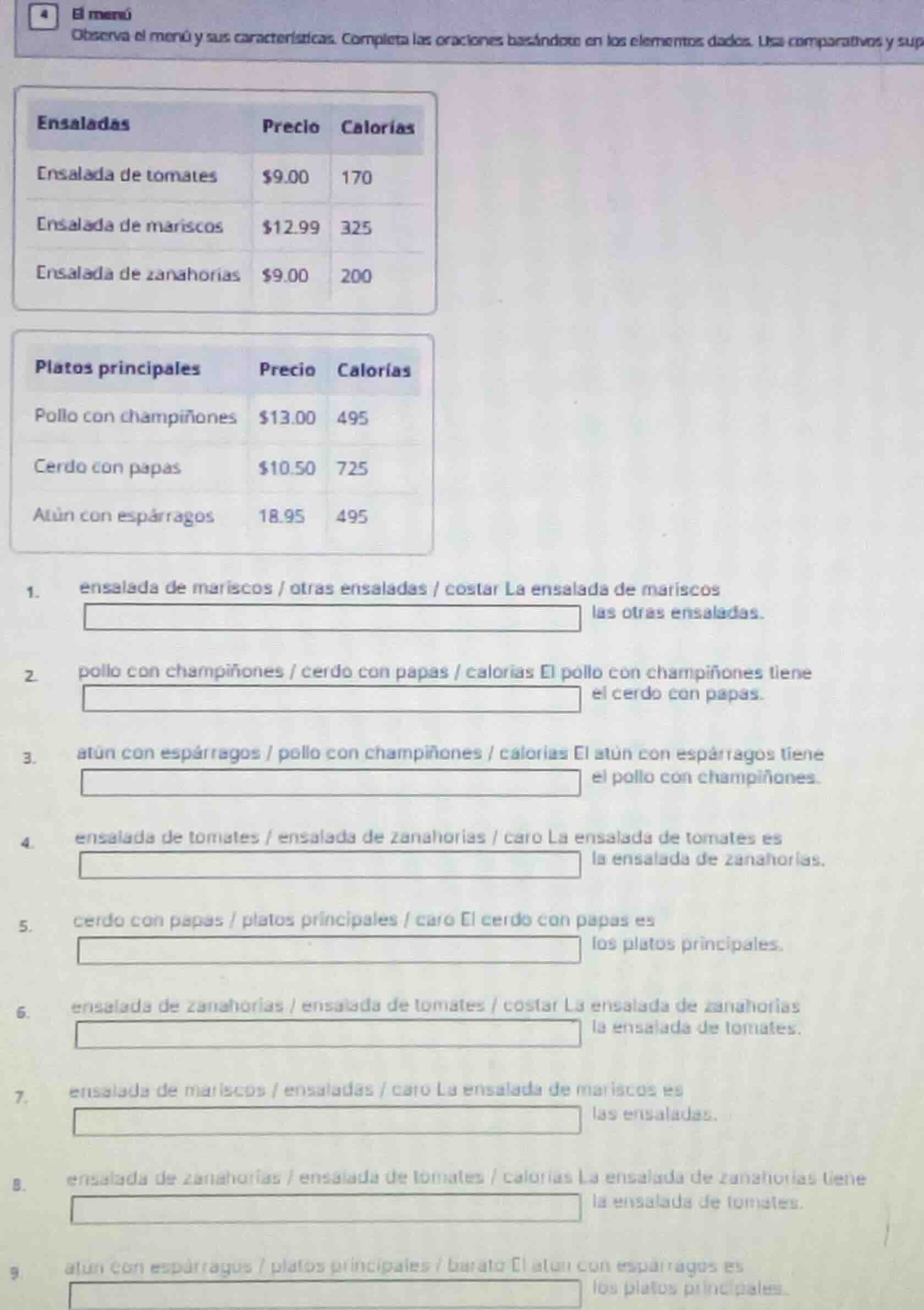
ensaladas\tprecio\tcalorías
ensalada de tomates\t$9.00\t170
ensalada de mariscos\t$12.99\t325
ensalada de zanahorias\t$9.00\t200
platos principales\tprecio\tcalorías
pollo con champiñones\t$13.00\t495
cerdo con papas\t$10.50\t725
atún con espárragos\t18.95\t495
- ensalada de mariscos / otras ensaladas / costar la ensalada de mariscos
las otras ensaladas.
- pollo con champiñones / cerdo con papas / calorías el pollo con champiñones tiene
el cerdo con papas.
- atún con espárragos / pollo con champiñones / calorías el atún con espárragos tiene
el pollo con champiñones.
- ensalada de tomates / ensalada de zanahorias / caro la ensalada de tomates es
la ensalada de zanahorias.
- cerdo con papas / platos principales / caro el cerdo con papas es
los platos principales.
- ensalada de zanahorias / ensalada de tomates / costar la ensalada de zanahorias
la ensalada de tomates.
- ensalada de mariscos / ensaladas / caro la ensalada de mariscos es
las ensaladas.
- ensalada de zanahorias / ensalada de tomates / calorías la ensalada de zanahorias tiene
la ensalada de tomates.
- atún con espárragos / platos principales / barato el atún con espárragos es
los platos principales.
To solve these fill - in - the - blank questions, we need to compare the relevant values (price or calories) of the food items and then use the appropriate Spanish comparative structures.
Question 1
- Comparison basis: Price of "Ensalada de mariscos" (\$12.99) and other salads (Ensalada de tomates: \$9.00; Ensalada de zanahorias: \$9.00).
- Comparative structure: When we want to say that something is more expensive than others, we use "cuesta más que".
- So the answer is: cuesta más que
Question 2
- Comparison basis: Calories of "Pollo con champiñones" (495) and "Cerdo con papas" (725).
- Comparative structure: To express that something has fewer calories than another thing, we use "menos calorías que".
- So the answer is: menos calorías que
Question 3
- Comparison basis: Calories of "Atún con espárragos" (495) and "Pollo con champiñones" (495).
- Comparative structure: When two things have the same number of calories, we use "la misma cantidad de calorías que".
- So the answer is: la misma cantidad de calorías que
Question 4
- Comparison basis: Price of "Ensalada de tomates" (\$9.00) and "Ensalada de zanahorias" (\$9.00).
- Comparative structure: When two things have the same price, we use "tan cara como".
- So the answer is: tan cara como
Question 5
- Comparison basis: Price of "Cerdo con papas" (\$10.50) and other main dishes (Pollo con champiñones: \$13.00; Atún con espárragos: \$18.95).
- Comparative structure: To say that something is cheaper than others, we use "más barato que".
- So the answer is: más barato que
Question 6
- Comparison basis: Price of "Ensalada de zanahorias" (\$9.00) and "Ensalada de tomates" (\$9.00).
- Comparative structure: When two things have the same price, we use "cuesta tanto como".
- So the answer is: cuesta tanto como
Question 7
- Comparison basis: Price of "Ensalada de mariscos" (\$12.99) and other salads (Ensalada de tomates: \$9.00; Ensalada de zanahorias: \$9.00).
- Comparative structure: To express that something is more expensive than others, we use "más cara que".
- So the answer is: más cara que
Question 8
- Comparison basis: Calories of "Ensalada de zanahorias" (200) and "Ensalada de tomates" (170).
- Comparative structure: To say that something has more calories than another thing, we use "más calorías que".
- So the answer is: más calorías que
Question 9
- Comparison basis: Price of "Atún con espárragos" (\$18.95) and other main dishes (Pollo con champiñones: \$13.00; Cerdo con papas: \$10.50).
- Comparative structure: To express that something is more expensive than others, we use "más caro que". But the question asks for the opposite (barato), so we use "más barato que" is wrong. Wait, no, "Atún con espárragos" is \$18.95, which is more expensive than the other two main dishes. But the question says "barato", maybe there is a mistake. Wait, no, let's re - check. "Pollo con champiñones" is \$13.00, "Cerdo con papas" is \$10.50, "Atún con espárragos" is \$18.95. So "Atún con espárragos" is more expensive, so it can't be "más barato". Wait, maybe I made a mistake. Wait, the question is "El atún con espárragos es ______ los platos principales". If we consider the price, "Atún con espárragos" is \$18.95, which is more expensive than the other two. But the word given is "barato", so maybe the intended answer is "más caro que", but the question has a wrong word? Or maybe I misread. Wait, no, let's check again. The main dishes: Pollo con champiñones (\$13), Cerdo con papas (\$10…

Snap & solve any problem in the app
Get step-by-step solutions on Sovi AI
Photo-based solutions with guided steps
Explore more problems and detailed explanations
To solve these fill - in - the - blank questions, we need to compare the relevant values (price or calories) of the food items and then use the appropriate Spanish comparative structures.
Question 1
- Comparison basis: Price of "Ensalada de mariscos" (\$12.99) and other salads (Ensalada de tomates: \$9.00; Ensalada de zanahorias: \$9.00).
- Comparative structure: When we want to say that something is more expensive than others, we use "cuesta más que".
- So the answer is: cuesta más que
Question 2
- Comparison basis: Calories of "Pollo con champiñones" (495) and "Cerdo con papas" (725).
- Comparative structure: To express that something has fewer calories than another thing, we use "menos calorías que".
- So the answer is: menos calorías que
Question 3
- Comparison basis: Calories of "Atún con espárragos" (495) and "Pollo con champiñones" (495).
- Comparative structure: When two things have the same number of calories, we use "la misma cantidad de calorías que".
- So the answer is: la misma cantidad de calorías que
Question 4
- Comparison basis: Price of "Ensalada de tomates" (\$9.00) and "Ensalada de zanahorias" (\$9.00).
- Comparative structure: When two things have the same price, we use "tan cara como".
- So the answer is: tan cara como
Question 5
- Comparison basis: Price of "Cerdo con papas" (\$10.50) and other main dishes (Pollo con champiñones: \$13.00; Atún con espárragos: \$18.95).
- Comparative structure: To say that something is cheaper than others, we use "más barato que".
- So the answer is: más barato que
Question 6
- Comparison basis: Price of "Ensalada de zanahorias" (\$9.00) and "Ensalada de tomates" (\$9.00).
- Comparative structure: When two things have the same price, we use "cuesta tanto como".
- So the answer is: cuesta tanto como
Question 7
- Comparison basis: Price of "Ensalada de mariscos" (\$12.99) and other salads (Ensalada de tomates: \$9.00; Ensalada de zanahorias: \$9.00).
- Comparative structure: To express that something is more expensive than others, we use "más cara que".
- So the answer is: más cara que
Question 8
- Comparison basis: Calories of "Ensalada de zanahorias" (200) and "Ensalada de tomates" (170).
- Comparative structure: To say that something has more calories than another thing, we use "más calorías que".
- So the answer is: más calorías que
Question 9
- Comparison basis: Price of "Atún con espárragos" (\$18.95) and other main dishes (Pollo con champiñones: \$13.00; Cerdo con papas: \$10.50).
- Comparative structure: To express that something is more expensive than others, we use "más caro que". But the question asks for the opposite (barato), so we use "más barato que" is wrong. Wait, no, "Atún con espárragos" is \$18.95, which is more expensive than the other two main dishes. But the question says "barato", maybe there is a mistake. Wait, no, let's re - check. "Pollo con champiñones" is \$13.00, "Cerdo con papas" is \$10.50, "Atún con espárragos" is \$18.95. So "Atún con espárragos" is more expensive, so it can't be "más barato". Wait, maybe I made a mistake. Wait, the question is "El atún con espárragos es ______ los platos principales". If we consider the price, "Atún con espárragos" is \$18.95, which is more expensive than the other two. But the word given is "barato", so maybe the intended answer is "más caro que", but the question has a wrong word? Or maybe I misread. Wait, no, let's check again. The main dishes: Pollo con champiñones (\$13), Cerdo con papas (\$10.5), Atún con espárragos (\$18.95). So Atún con espárragos is more expensive, so if the question is about "barato", it's wrong. But maybe the question is "más caro que". So the answer is: más caro que (assuming a typo in the question, maybe it should be "caro" instead of "barato")
Final Answers
- cuesta más que
- menos calorías que
- la misma cantidad de calorías que
- tan cara como
- más barato que
- cuesta tanto como
- más cara que
- más calorías que
- más caro que (assuming a typo in the question)