QUESTION IMAGE
Question
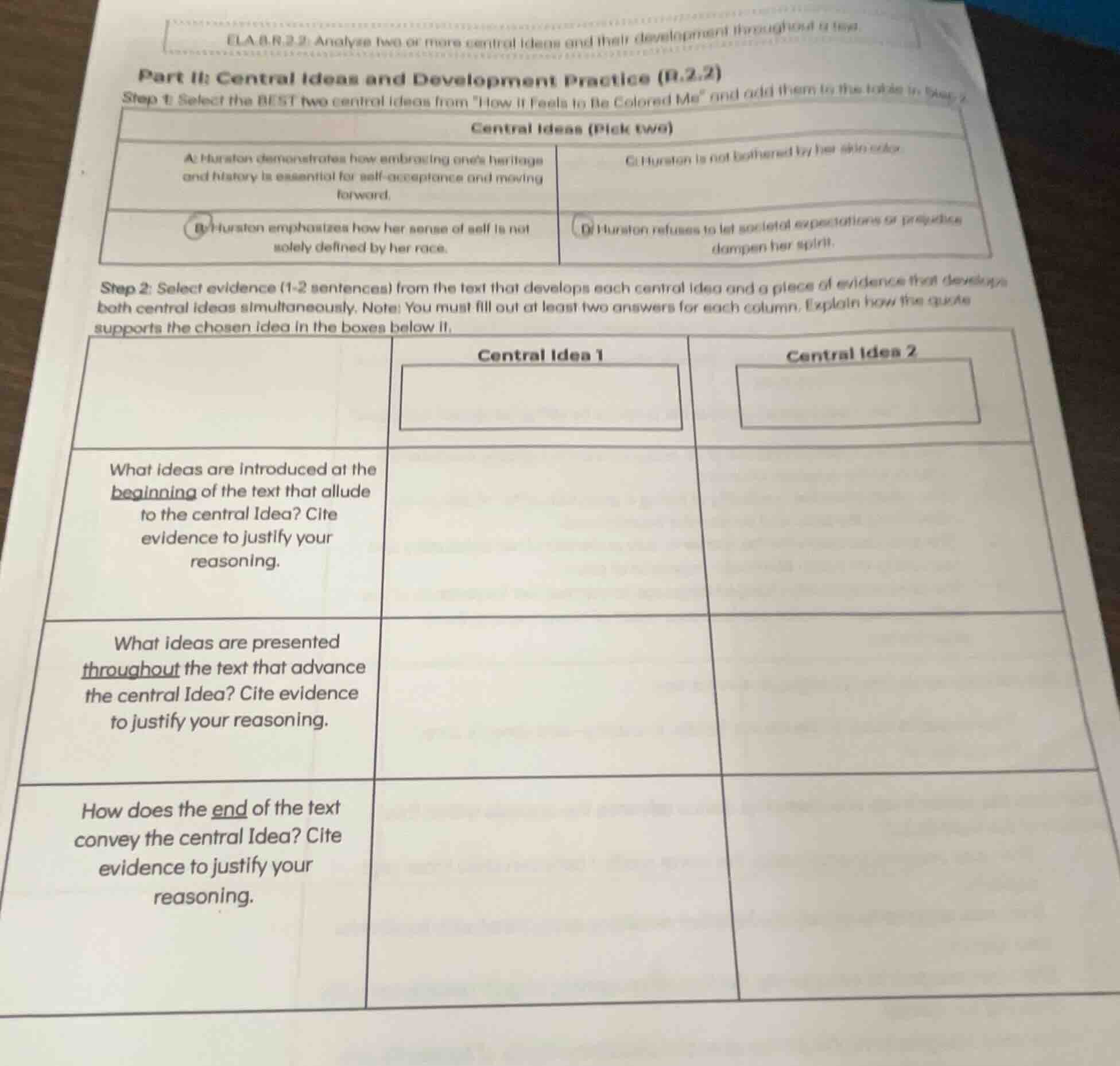
ela.8.r.2.2: analyse two or more central ideas and their development throughout a text.part ii: central ideas and development practice (r.2.2)step 1: select the best two central ideas from \how it feels to be colored me\ and add them to the table in step 2central ideas (pick two)a: hurston demonstrates how embracing ones heritage and history is essential for self-acceptance and moving forward.c: huraton is not bothered by her skin color.b: hurston emphasizes how her sense of self is not solely defined by her race.d: hurston refuses to let societal expectations or prejudice dampen her spirit.step 2: select evidence (1-2 sentences) from the text that develops each central idea and a piece of evidence that develops both central ideas simultaneously. note: you must fill out at least two answers for each column. explain how the quote supports the chosen idea in the boxes below it.central idea 1 central idea 2what ideas are introduced at the beginning of the text that allude to the central idea? cite evidence to justify your reasoning.what ideas are presented throughout the text that advance the central idea? cite evidence to justify your reasoning.how does the end of the text convey the central idea? cite evidence to justify your reasoning.
First, two closely interconnected central ideas are selected from the options. Then, text evidence from How It Feels to Be Colored Me is paired with each stage of the text (beginning, throughout, end) to explain how the ideas develop, plus a shared piece of evidence linking both ideas.

Snap & solve any problem in the app
Get step-by-step solutions on Sovi AI
Photo-based solutions with guided steps
Explore more problems and detailed explanations
Selected Central Ideas:
Central Idea 1: B: Hurston emphasizes how her sense of self is not solely defined by her race.
Central Idea 2: D: Hurston refuses to let societal expectations or prejudice dampen her spirit.
---
Central Idea 1 (Self not defined by race)
- Beginning of Text
- Evidence: "I am colored but I offer nothing in the way of extenuating circumstances except the fact that I am the only Negro in the United States whose grandfather on the mother's side was not an Indian chief."
- Explanation: Hurston opens with a playful, dismissive take on common racial tropes for Black people, immediately framing her identity as separate from stereotypical racial narratives.
- Throughout Text
- Evidence: "At certain times I have no race, I am me."
- Explanation: She explicitly states her identity transcends race, prioritizing her individual self over racial categorization.
- End of Text
- Evidence: "But in the main, I feel like a brown bag of miscellany propped against a wall. Against a wall in company with other bags, white, red, and yellow."
- Explanation: The bag metaphor positions race as just one surface-level detail of identity, with shared human experiences (the "miscellany" inside) being more core to self.
---
Central Idea 2 (Rejects societal prejudice/expectations)
- Beginning of Text
- Evidence: "I remember the very day that I became colored. Up to my thirteenth year I lived in the little Negro town of Eatonville, Florida. It is exclusively colored. The only white people I knew passed through the town going to or coming from Orlando."
- Explanation: Her childhood in a self-determining Black community lets her form an identity unshaped by white prejudice, setting up her resistance to later societal pressures.
- Throughout Text
- Evidence: "I dance wildly inside myself; I yell within, I whoop and holler and make peace with the world. The jazz of the jungle is in me. I am unashamed."
- Explanation: She fully embraces Black cultural expression without apology, rejecting the idea that Black joy or culture should be suppressed for white comfort.
- End of Text
- Evidence: "I have no separate feeling about being an American citizen and colored. I am merely a fragment of the Great Soul that surges within the boundaries. My country, right or wrong."
- Explanation: She claims full American identity, refusing to let prejudice exclude her from belonging to her nation.
---
Evidence Developing Both Ideas Simultaneously
- Evidence: "Someone is always at my elbow reminding me that I am the granddaughter of slaves. It fails to register depression with me. Slavery is sixty years in the past. The operation was successful and the patient is doing well, thank you."
- Explanation: She rejects the societal expectation that Black people should be defined by trauma/slavery (supporting Idea 1: self not tied to race's painful history) and refuses to let this constant, prejudicial framing make her feel defeated (supporting Idea 2: resisting prejudice's impact).