QUESTION IMAGE
Question
3.4 electron configurations
define
electron configuration
pauli exclusion principle
aufbau principle
hund’s rule
core electrons
valence electrons
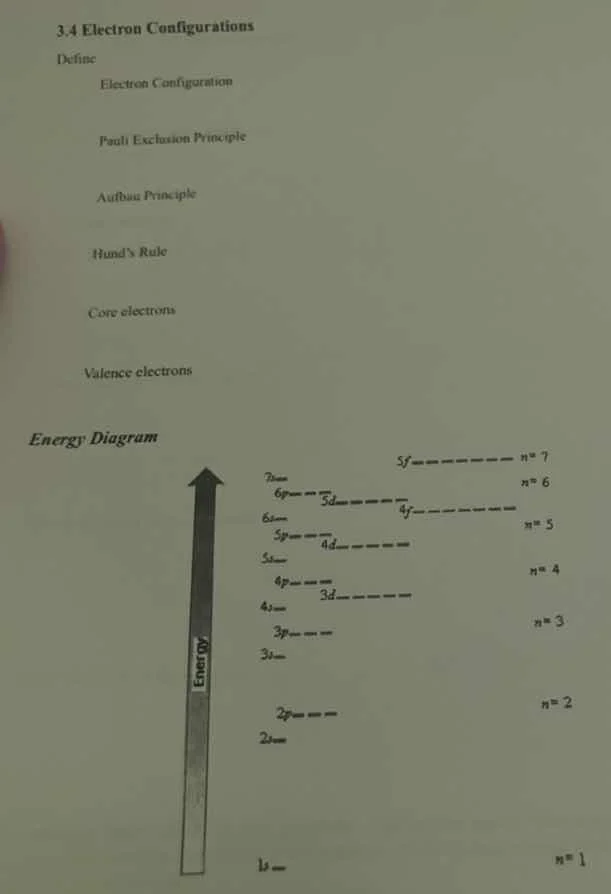
energy diagram
Brief Explanations
- Electron Configuration: Describes the arrangement of electrons in an atom's orbitals, following specific rules to minimize energy.
- Pauli Exclusion Principle: No two electrons in an atom can have identical sets of all four quantum numbers; each orbital holds max 2 electrons with opposite spins.
- Aufbau Principle: Electrons fill lower-energy orbitals first before occupying higher-energy ones, following the order shown in the energy diagram.
- Hund's Rule: When filling degenerate orbitals (same energy), electrons occupy separate orbitals with parallel spins first before pairing up.
- Core electrons: Inner-shell electrons that are not involved in chemical bonding; they are in filled, lower-energy orbitals.
- Valence electrons: Outer-shell electrons in the highest energy level, responsible for an atom's chemical properties and bonding behavior.

Snap & solve any problem in the app
Get step-by-step solutions on Sovi AI
Photo-based solutions with guided steps
Explore more problems and detailed explanations
- Electron Configuration: The specific arrangement of electrons in the atomic orbitals of an atom or ion.
- Pauli Exclusion Principle: No two electrons in a single atom can have the same four quantum numbers; each orbital can hold at most 2 electrons with opposite spin states.
- Aufbau Principle: Electrons occupy the lowest-energy atomic orbitals first before filling higher-energy orbitals.
- Hund's Rule: For degenerate orbitals (equal energy), electrons occupy each orbital singly with parallel spins before any orbital gets a second electron.
- Core electrons: The inner electrons of an atom that are not in the outermost valence shell and do not participate in chemical reactions.
- Valence electrons: The electrons in the outermost occupied shell of an atom that determine the atom's chemical reactivity and bonding potential.