QUESTION IMAGE
Question
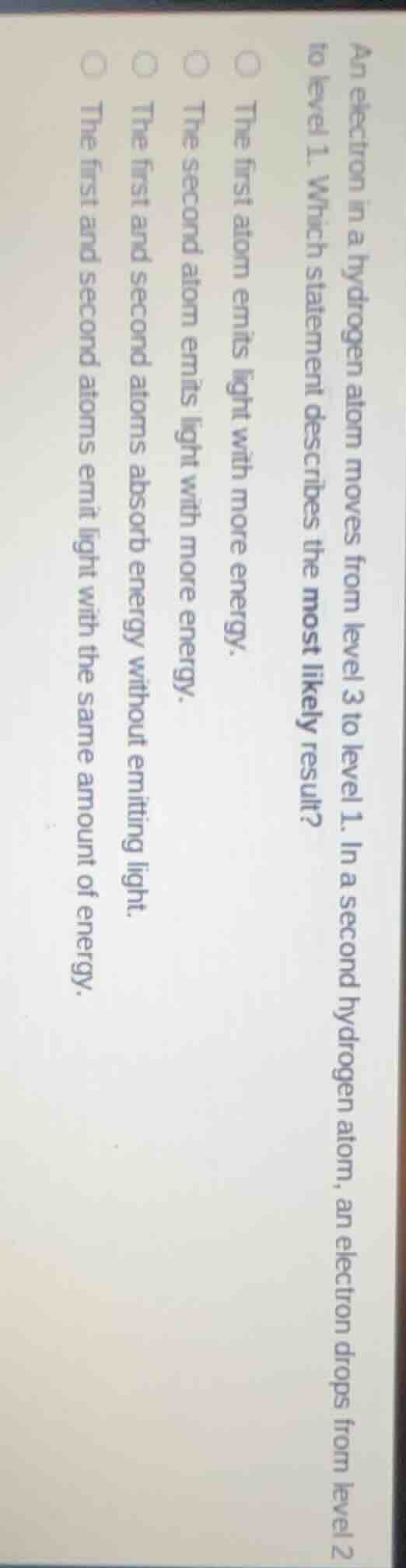
an electron in a hydrogen atom moves from level 3 to level 1. in a second hydrogen atom, an electron drops from level 2 to level 1. which statement describes the most likely result?
the first atom emits light with more energy.
the second atom emits light with more energy.
the first and second atoms absorb energy without emitting light.
the first and second atoms emit light with the same amount of energy.
In a hydrogen atom, the energy difference between energy levels determines the energy of the emitted light (given by \( \Delta E = E_{final}-E_{initial} \), and for emission, \( \Delta E \) is negative, with the magnitude related to photon energy \( E = hf \)). For the first atom, electron moves from level 3 to 1: \( \Delta E_1 = E_1 - E_3 \) (magnitude \( |E_1 - E_3| \)). For the second atom, electron moves from level 2 to 1: \( \Delta E_2 = E_1 - E_2 \) (magnitude \( |E_1 - E_2| \)). Since energy levels in hydrogen are such that \( E_n=-\frac{13.6}{n^2}\text{ eV} \), the difference \( |E_1 - E_3|=| -13.6 - (-\frac{13.6}{9})|=\frac{13.6\times8}{9}\approx12.09\text{ eV} \), and \( |E_1 - E_2|=| -13.6 - (-\frac{13.6}{4})|=\frac{13.6\times3}{4} = 10.2\text{ eV} \). So \( |\Delta E_1|>|\Delta E_2| \), meaning the first atom emits light with more energy. The other options are incorrect: the second atom does not emit more energy (opposite), atoms emit light when electrons drop (so absorption without emission is wrong), and energy emitted differs (so same energy is wrong).

Snap & solve any problem in the app
Get step-by-step solutions on Sovi AI
Photo-based solutions with guided steps
Explore more problems and detailed explanations
The first atom emits light with more energy.