QUESTION IMAGE
Question
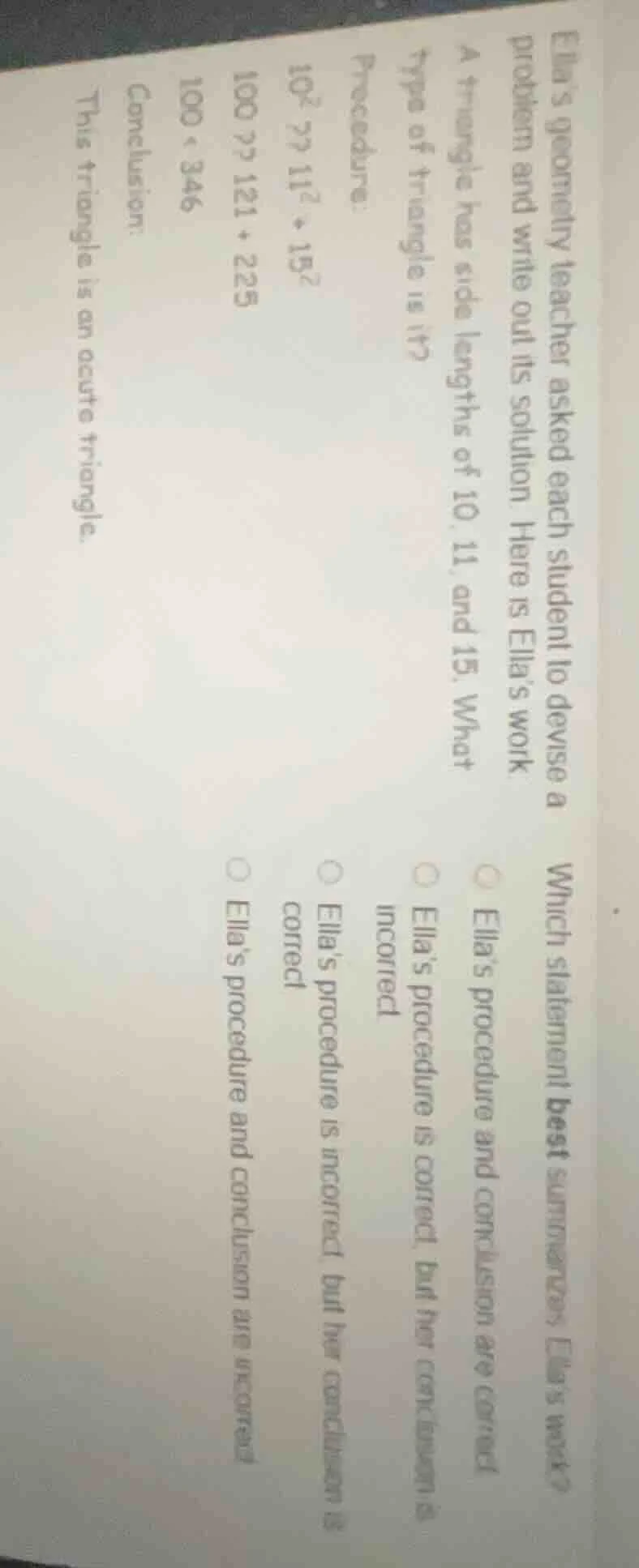
ella’s geometry teacher asked each student to devise a problem and write out its solution. here is ella’s work: a triangle has side lengths of 10, 11, and 15. what type of triangle is it? procedure: (10^2)? (11^2 + 15^2) (100)? (121 + 225) (100 < 346) conclusion: this triangle is an acute triangle. which statement best summarizes ella’s work? (\bigcirc) ella’s procedure and conclusion are correct. (\bigcirc) ella’s procedure is correct, but her conclusion is incorrect. (\bigcirc) ella’s procedure is incorrect, but her conclusion is correct. (\bigcirc) ella’s procedure and conclusion are incorrect.
To determine the type of triangle (acute, right, obtuse), we use the Pythagorean inequality theorem. For a triangle with side lengths \(a\), \(b\), and \(c\) (where \(c\) is the longest side), we check:
- If \(a^{2}+b^{2}=c^{2}\), it's a right triangle.
- If \(a^{2}+b^{2}>c^{2}\), it's an acute triangle.
- If \(a^{2}+b^{2}
Step 1: Identify the longest side
The side lengths are 10, 11, and 15. The longest side \(c = 15\), so \(a = 10\) and \(b = 11\).
Step 2: Calculate \(a^{2}+b^{2}\) and \(c^{2}\)
Calculate \(a^{2}\): \(10^{2}=100\)
Calculate \(b^{2}\): \(11^{2}=121\)
So, \(a^{2}+b^{2}=100 + 121=221\)
Calculate \(c^{2}\): \(15^{2}=225\)
Step 3: Compare \(a^{2}+b^{2}\) and \(c^{2}\)
We have \(221<225\) (i.e., \(a^{2}+b^{2}

Snap & solve any problem in the app
Get step-by-step solutions on Sovi AI
Photo-based solutions with guided steps
Explore more problems and detailed explanations
Ella's procedure is correct, but her conclusion is incorrect