QUESTION IMAGE
Question
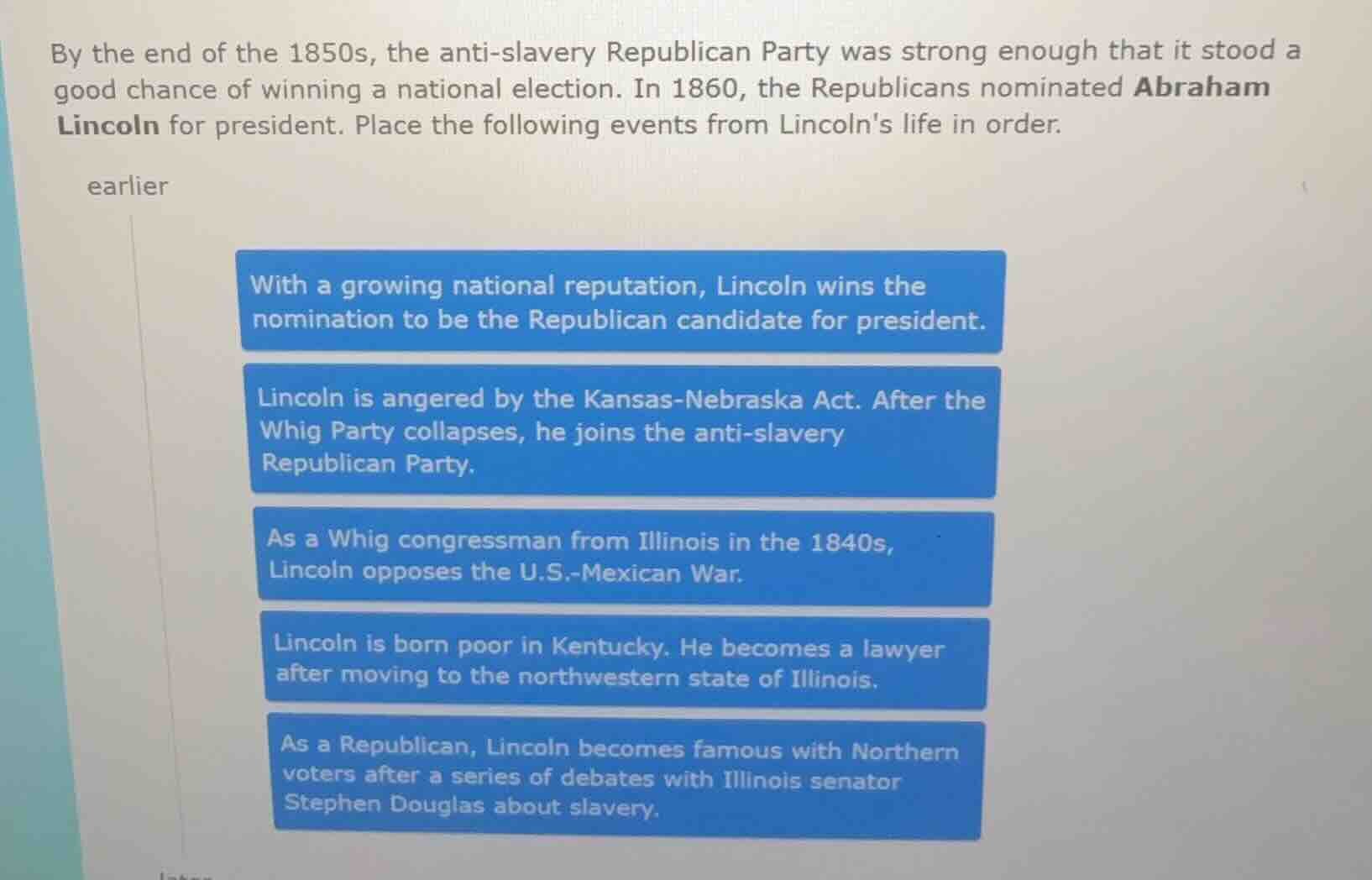
by the end of the 1850s, the anti-slavery republican party was strong enough that it stood a good chance of winning a national election. in 1860, the republicans nominated abraham lincoln for president. place the following events from lincolns life in order.earlierwith a growing national reputation, lincoln wins the nomination to be the republican candidate for president.lincoln is angered by the kansas-nebraska act. after the whig party collapses, he joins the anti-slavery republican party.as a whig congressman from illinois in the 1840s, lincoln opposes the u.s.-mexican war.lincoln is born poor in kentucky. he becomes a lawyer after moving to the northwestern state of illinois.as a republican, lincoln becomes famous with northern voters after a series of debates with illinois senator stephen douglas about slavery.
The events are ordered by their historical timeline, starting with Lincoln's early life and progressing through his political career milestones:
- Lincoln's birth and early career as a lawyer is the earliest event.
- His service as a Whig congressman opposing the U.S.-Mexican War occurred in the 1840s.
- The Kansas-Nebraska Act (1854) led to his anger and his switch to the Republican Party after the Whig collapse.
- The Lincoln-Douglas debates (1858) brought him national fame among Northern Republicans.
- Finally, he won the Republican presidential nomination in 1860.

Snap & solve any problem in the app
Get step-by-step solutions on Sovi AI
Photo-based solutions with guided steps
Explore more problems and detailed explanations
- Lincoln is born poor in Kentucky. He becomes a lawyer after moving to the northwestern state of Illinois.
- As a Whig congressman from Illinois in the 1840s, Lincoln opposes the U.S.-Mexican War.
- Lincoln is angered by the Kansas-Nebraska Act. After the Whig Party collapses, he joins the anti-slavery Republican Party.
- As a Republican, Lincoln becomes famous with Northern voters after a series of debates with Illinois senator Stephen Douglas about slavery.
- With a growing national reputation, Lincoln wins the nomination to be the Republican candidate for president.