QUESTION IMAGE
Question
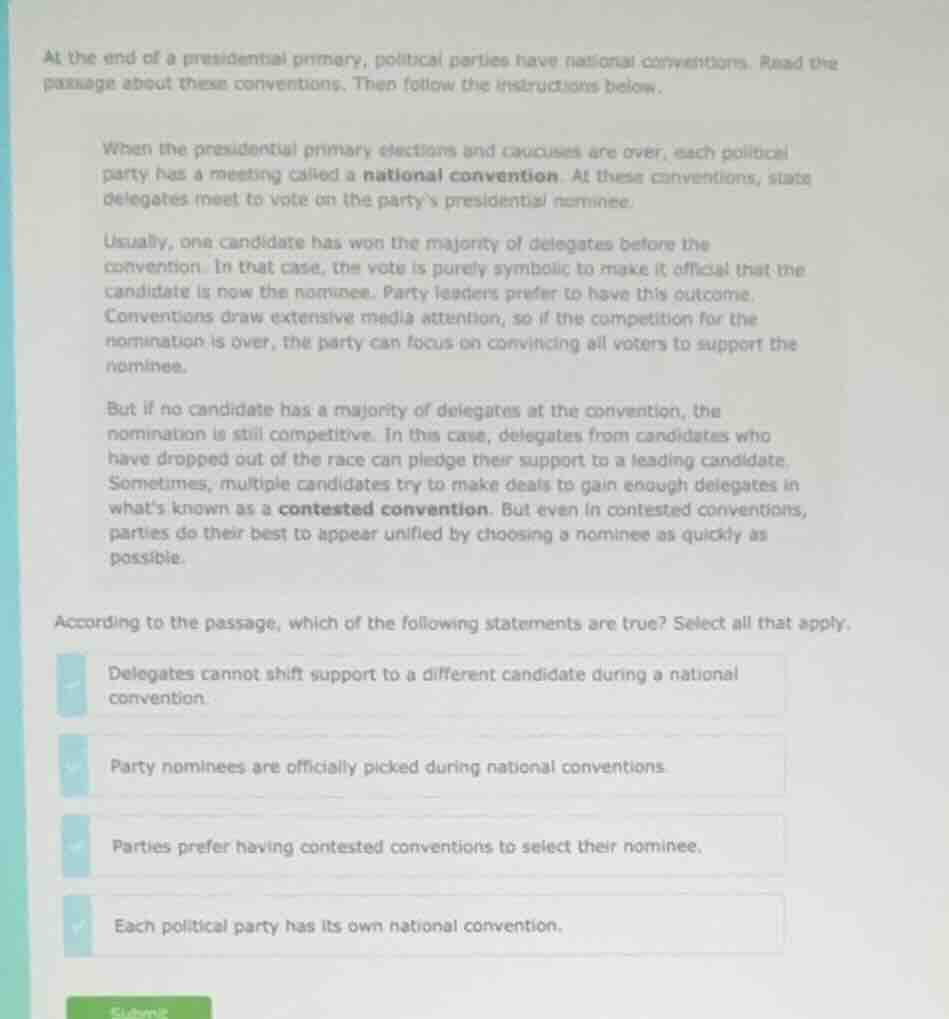
at the end of a presidential primary, political parties have national conventions. read the passage about these conventions. then follow the instructions below.
when the presidential primary elections and caucuses are over, each political party has a meeting called a national convention. at these conventions, state delegates meet to vote on the partys presidential nominee.
usually, one candidate has won the majority of delegates before the convention. in that case, the vote is purely symbolic to make it official that the candidate is now the nominee. party leaders prefer to have this outcome. conventions draw extensive media attention, so if the competition for the nomination is over, the party can focus on convincing all voters to support the nominee.
but if no candidate has a majority of delegates at the convention, the nomination is still competitive. in this case, delegates from candidates who have dropped out of the race can pledge their support to a leading candidate. sometimes, multiple candidates try to make deals to gain enough delegates in whats known as a contested convention. but even in contested conventions, parties do their best to appear unified by choosing a nominee as quickly as possible.
according to the passage, which of the following statements are true? select all that apply.
- delegates cannot shift support to a different candidate during a national convention.
- party nominees are officially picked during national conventions.
- parties prefer having contested conventions to select their nominee.
- each political party has its own national convention.
- For "Delegates cannot shift support to a different candidate during a national convention": The passage says "delegates from candidates who have dropped out of the race can pledge their support to a leading candidate", so this is false.
- For "Party nominees are officially picked during national conventions": The passage states "the vote is purely symbolic to make it official that the candidate is now the nominee", so this is true.
- For "Parties prefer having contested conventions to select their nominee": The passage says "Party leaders prefer to have this outcome" (where one candidate has majority before convention), so they don't prefer contested conventions, this is false.
- For "Each political party has its own national convention": The passage says "each political party has a meeting called a national convention", so this is true.

Snap & solve any problem in the app
Get step-by-step solutions on Sovi AI
Photo-based solutions with guided steps
Explore more problems and detailed explanations
B. Party nominees are officially picked during national conventions, D. Each political party has its own national convention