QUESTION IMAGE
Question
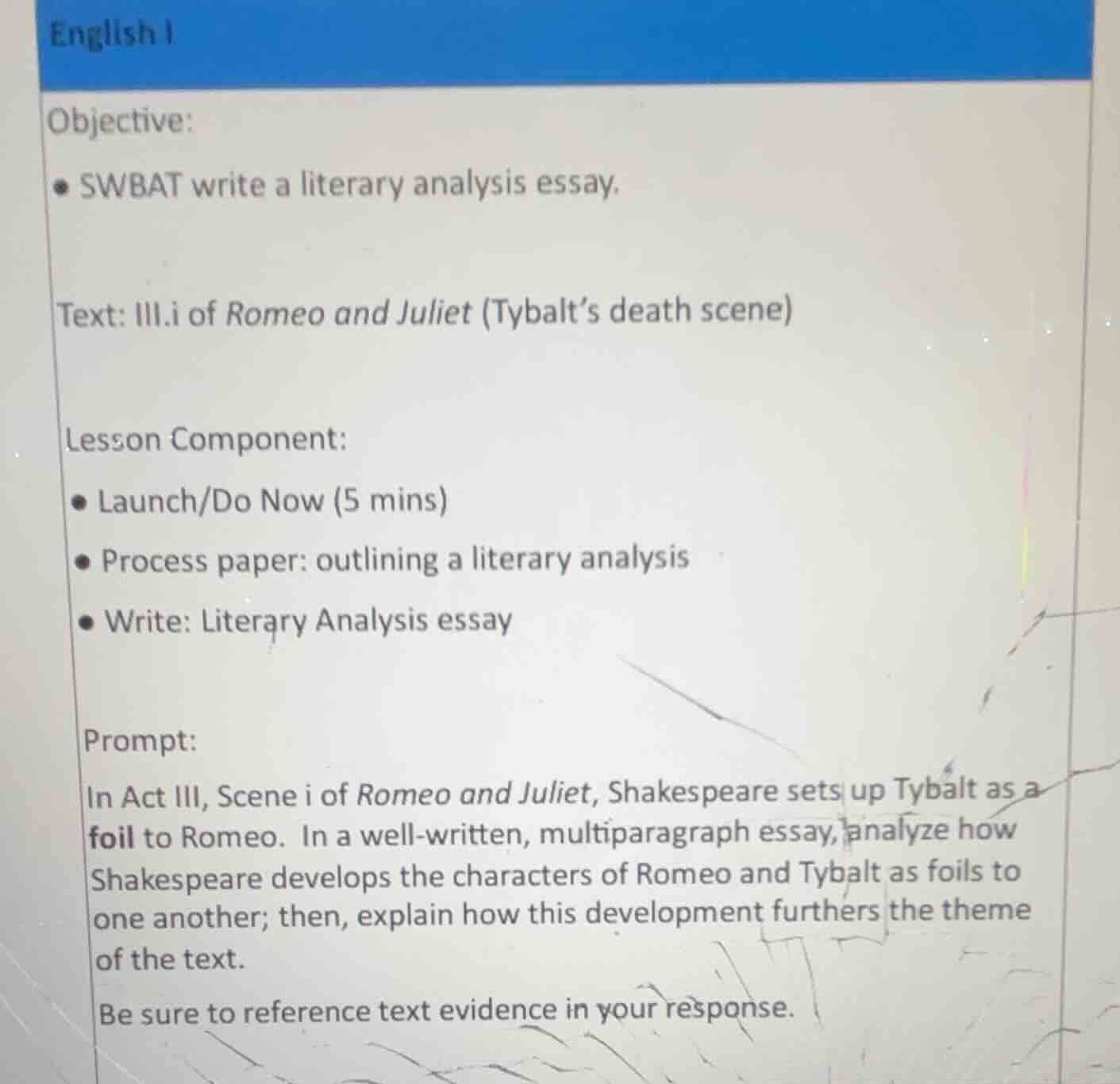
english i
objective:
- swbat write a literary analysis essay.
text: iii.i of romeo and juliet (tybalt’s death scene)
lesson component:
- launch/do now (5 mins)
- process paper: outlining a literary analysis
- write: literary analysis essay
prompt:
in act iii, scene i of romeo and juliet, shakespeare sets up tybalt as a foil to romeo. in a well - written, multiparagraph essay, analyze how shakespeare develops the characters of romeo and tybalt as foils to one another; then, explain how this development furthers the theme of the text.
be sure to reference text evidence in your response.
- Define the foil dynamic: Establish that foils are characters with contrasting traits that highlight each other's core qualities. For Romeo and Tybalt, this centers on their approaches to honor, emotion, and conflict.
- Analyze Tybalt's characterization: Use text evidence like his line "What, art thou drawn among these heartless hinds? Turn thee, Benvolio, look upon thy death" (III.i.6-7) to show his aggressive, hot-headed nature tied to familial honor and violence.
- Analyze Romeo's contrasting characterization: Reference Romeo's refusal to fight Tybalt: "I do protest I never injured thee, But love thee better than thou canst devise" (III.i.65-66) to demonstrate his prioritization of love (for Juliet, Tybalt's cousin) over traditional masculine honor and conflict.
- Connect foil dynamic to theme: Explain how this contrast emphasizes the play's central theme of destructive, toxic honor vs. redemptive love. Tybalt's adherence to violent family pride drives the tragedy, while Romeo's rejection of it (until Mercutio's death) shows the possibility of breaking the cycle—making his eventual fall into violence more tragic, as it dooms both him and Juliet.
- Structure as a multi-paragraph essay: Organize the above points into an introduction (with thesis), body paragraphs (each focusing on a contrasting trait with text evidence), and a conclusion that ties the foil dynamic to the play's overarching message.

Snap & solve any problem in the app
Get step-by-step solutions on Sovi AI
Photo-based solutions with guided steps
Explore more problems and detailed explanations
Example Literary Analysis Essay Outline (with core content):
Introduction
Thesis: In Act III, Scene i of Romeo and Juliet, Shakespeare frames Tybalt as a foil to Romeo by contrasting their attitudes toward honor, conflict, and love; this dynamic amplifies the play's tragic theme of how toxic familial pride destroys the potential for redemptive love.
Body Paragraph 1: Contrasting Views of Honor
- Tybalt: Honor = violent defense of the Capulet name. Evidence: "Thou, wretched boy, that didst consort him here, Shalt with him hence" (III.i.115-116) – he sees Romeo's presence at the Capulet ball as an unforgivable insult requiring death.
- Romeo: Honor = loyalty to his new love (Juliet), not family rivalry. Evidence: "I have reason to love thee, And therefore thou must needs know that I am gentle" (III.i.70-71) – he rejects the expected violent response to Tybalt's provocation.
Body Paragraph 2: Contrasting Responses to Conflict
- Tybalt: Seeks out conflict, escalates tension. Evidence: He actively searches for Romeo after the ball, and ignores Benvolio's plea for peace: "What, drawn, and talk of peace? I hate the word, As I hate hell, all Montagues, and thee" (III.i.65-66).
- Romeo: Avoids conflict until pushed to his breaking point. Evidence: He refuses to fight Tybalt, even as Mercutio mocks him for being "cowardly" (III.i.73). Only when Mercutio dies does he abandon his peaceful stance.
Body Paragraph 3: Foil Dynamic and the Play's Tragic Theme
- The contrast highlights the tragedy: Romeo's choice to prioritize love over pride offers a way out of the Montague-Capulet feud, but Tybalt's unyielding violence (and Mercutio's death) forces Romeo back into the cycle of destruction.
- Evidence: Romeo's cry after killing Tybalt: "O, I am fortune's fool!" (III.i.133) – he recognizes he has succumbed to the same toxic honor that Tybalt embodies, dooming his love with Juliet.
Conclusion
Shakespeare's use of Tybalt as Romeo's foil in Act III, Scene i underscores the play's core message: the rigid, violent honor of the feud is a destructive force that destroys even the most hopeful acts of love. The contrast between the two characters makes the tragedy feel inevitable, as the feud's power overwhelms Romeo's attempt to break free.