QUESTION IMAGE
Question
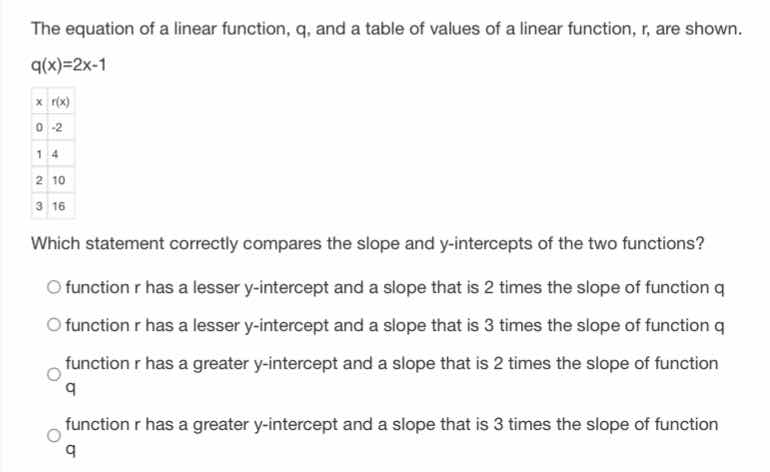
the equation of a linear function, q, and a table of values of a linear function, r, are shown.
q(x)=2x - 1
| x | r(x) |
|---|---|
| 1 | 4 |
| 2 | 10 |
| 3 | 16 |
which statement correctly compares the slope and y - intercepts of the two functions?
○ function r has a lesser y - intercept and a slope that is 2 times the slope of function q
○ function r has a lesser y - intercept and a slope that is 3 times the slope of function q
○ function r has a greater y - intercept and a slope that is 2 times the slope of function q
○ function r has a greater y - intercept and a slope that is 3 times the slope of function q
Step1: Find slope and y-intercept of q(x)
The function \( q(x) = 2x - 1 \) is in slope - intercept form \( y=mx + b \), where \( m \) is the slope and \( b \) is the y - intercept. For \( q(x)=2x - 1 \), the slope \( m_q=2 \) and the y - intercept \( b_q=- 1 \).
Step2: Find slope and y-intercept of r(x)
For a linear function \( r(x) \) with a table of values, we can use the formula for slope \( m=\frac{y_2 - y_1}{x_2 - x_1} \). Let's take two points from the table of \( r(x) \), say \( (x_1,y_1)=(0,-2) \) and \( (x_2,y_2)=(1,4) \).
The slope \( m_r=\frac{4-(-2)}{1 - 0}=\frac{4 + 2}{1}=6 \).
The y - intercept of a linear function is the value of \( y \) when \( x = 0 \). From the table, when \( x = 0 \), \( r(0)=-2 \), so the y - intercept \( b_r=-2 \).
Step3: Compare slopes and y-intercepts
- Compare slopes: We know \( m_q = 2 \) and \( m_r=6 \). Let's find the ratio of \( m_r \) to \( m_q \): \( \frac{m_r}{m_q}=\frac{6}{2}=3 \), so the slope of \( r(x) \) is 3 times the slope of \( q(x) \).
- Compare y - intercepts: \( b_q=-1 \) and \( b_r=-2 \). Since \( - 2<-1 \), the y - intercept of \( r(x) \) is lesser than the y - intercept of \( q(x) \).

Snap & solve any problem in the app
Get step-by-step solutions on Sovi AI
Photo-based solutions with guided steps
Explore more problems and detailed explanations
function r has a lesser y - intercept and a slope that is 3 times the slope of function q