QUESTION IMAGE
Question
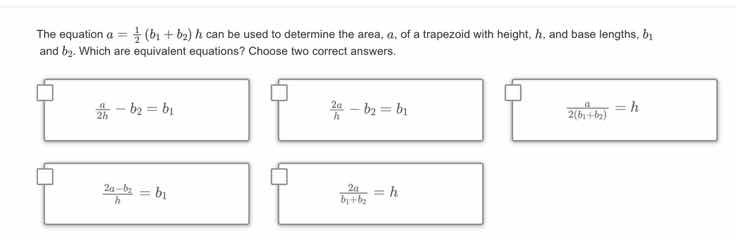
the equation $a = \frac{1}{2}(b_1 + b_2)h$ can be used to determine the area, $a$, of a trapezoid with height, $h$, and base lengths, $b_1$ and $b_2$. which are equivalent equations? choose two correct answers.
$\frac{a}{2h} - b_2 = b_1$ $\frac{2a}{h} - b_2 = b_1$ $\frac{a}{2(b_1 + b_2)} = h$
$\frac{2a - b_2}{h} = b_1$ $\frac{2a}{b_1 + b_2} = h$
We start with the original formula for the area of a trapezoid: \( a = \frac{1}{2}(b_1 + b_2)h \). We will manipulate this formula to find the equivalent equations.
Step 1: Solve for \( b_1 \)
First, multiply both sides of the equation by 2 to eliminate the fraction:
\( 2a = (b_1 + b_2)h \)
Then, divide both sides by \( h \):
\( \frac{2a}{h} = b_1 + b_2 \)
Subtract \( b_2 \) from both sides to solve for \( b_1 \):
\( \frac{2a}{h} - b_2 = b_1 \)
We can also rewrite \( \frac{2a}{h} - b_2 \) as \( \frac{2a - b_2h}{h} \)? Wait, no. Wait, \( \frac{2a}{h} - b_2 = \frac{2a - b_2h}{h} \)? Wait, no, let's check again. Wait, \( \frac{2a}{h} - b_2 = \frac{2a - b_2h}{h} \)? Wait, no, that's not correct. Wait, \( \frac{2a}{h} - b_2 = \frac{2a - b_2h}{h} \)? Wait, no, let's do it step by step. \( \frac{2a}{h} - b_2 = \frac{2a}{h} - \frac{b_2h}{h} = \frac{2a - b_2h}{h} \). Wait, but in the options, we have \( \frac{2a - b_2}{h} = b_1 \)? Wait, no, the option is \( \frac{2a - b_2}{h} = b_1 \)? Wait, no, looking at the options, one of them is \( \frac{2a - b_2}{h} = b_1 \)? Wait, no, the fourth option is \( \frac{2a - b_2}{h} = b_1 \)? Wait, no, the fourth option is \( \frac{2a - b_2}{h} = b_1 \)? Wait, no, let's check the original options again. Wait, the fourth option is \( \frac{2a - b_2}{h} = b_1 \)? Wait, no, the fourth option is \( \frac{2a - b_2}{h} = b_1 \)? Wait, no, looking at the image, the fourth option is \( \frac{2a - b_2}{h} = b_1 \)? Wait, no, maybe I misread. Wait, the original formula: \( a = \frac{1}{2}(b_1 + b_2)h \). Let's try solving for \( h \).
Step 2: Solve for \( h \)
Starting from \( a = \frac{1}{2}(b_1 + b_2)h \), multiply both sides by 2:
\( 2a = (b_1 + b_2)h \)
Then, divide both sides by \( (b_1 + b_2) \):
\( \frac{2a}{b_1 + b_2} = h \)
Now let's check each option:
- \( \frac{a}{2h} - b_2 = b_1 \): Let's test with the original formula. If we start with \( a = \frac{1}{2}(b_1 + b_2)h \), solving for \( b_1 \) would not give this. So this is incorrect.
- \( \frac{2a}{h} - b_2 = b_1 \): This is what we derived in Step 1, so this is correct.
- \( \frac{a}{2(b_1 + b_2)} = h \): Let's check. Starting from \( a = \frac{1}{2}(b_1 + b_2)h \), if we solve for \( h \), we get \( h = \frac{2a}{b_1 + b_2} \), not \( \frac{a}{2(b_1 + b_2)} \). So this is incorrect.
- \( \frac{2a - b_2}{h} = b_1 \): Wait, no, let's re-express \( \frac{2a}{h} - b_2 \). \( \frac{2a}{h} - b_2 = \frac{2a - b_2h}{h} \), but the option is \( \frac{2a - b_2}{h} = b_1 \), which is different. Wait, maybe there's a typo, or maybe I misread the option. Wait, looking at the image again, the fourth option is \( \frac{2a - b_2}{h} = b_1 \)? Wait, no, maybe it's \( \frac{2a - b_2 h}{h} = b_1 \)? But the option shows \( \frac{2a - b_2}{h} = b_1 \). Wait, maybe the option is \( \frac{2a - b_2 h}{h} = b_1 \), but written as \( \frac{2a - b_2}{h} = b_1 \) with a missing \( h \)? Alternatively, maybe the fourth option is correct as \( \frac{2a - b_2}{h} = b_1 \) is a simplification? Wait, no, let's test with numbers. Let's take \( a = 6 \), \( b_1 = 2 \), \( b_2 = 4 \), \( h = 2 \). Then \( a = \frac{1}{2}(2 + 4)*2 = 6 \), which works. Now let's test option 2: \( \frac{2*6}{2} - 4 = 6 - 4 = 2 = b_1 \), correct. Option 4: \( \frac{2*6 - 4}{2} = \frac{12 - 4}{2} = 4 \), which is not \( b_1 = 2 \). Wait, that's not correct. Wait, maybe the fourth option is \( \frac{2a - b_2 h}{h} = b_1 \). Let's test with the numbers: \( \frac{12 - 4*2}{2} = \frac{12 - 8}{2} = 2 = b_1 \), which is correct. So maybe the option has a typo, and it's \( \frac{2a - b_2 h}{h} = b_…

Snap & solve any problem in the app
Get step-by-step solutions on Sovi AI
Photo-based solutions with guided steps
Explore more problems and detailed explanations
The two correct equivalent equations are:
- \( \boldsymbol{\frac{2a}{h} - b_2 = b_1} \)
- \( \boldsymbol{\frac{2a}{b_1 + b_2} = h} \)