QUESTION IMAGE
Question
equations: graphing
sylvie finds the solution to the system of equations by graphing.
$y = \frac{2}{3}x + 1$ and $y = -\frac{2}{3}x - 1$
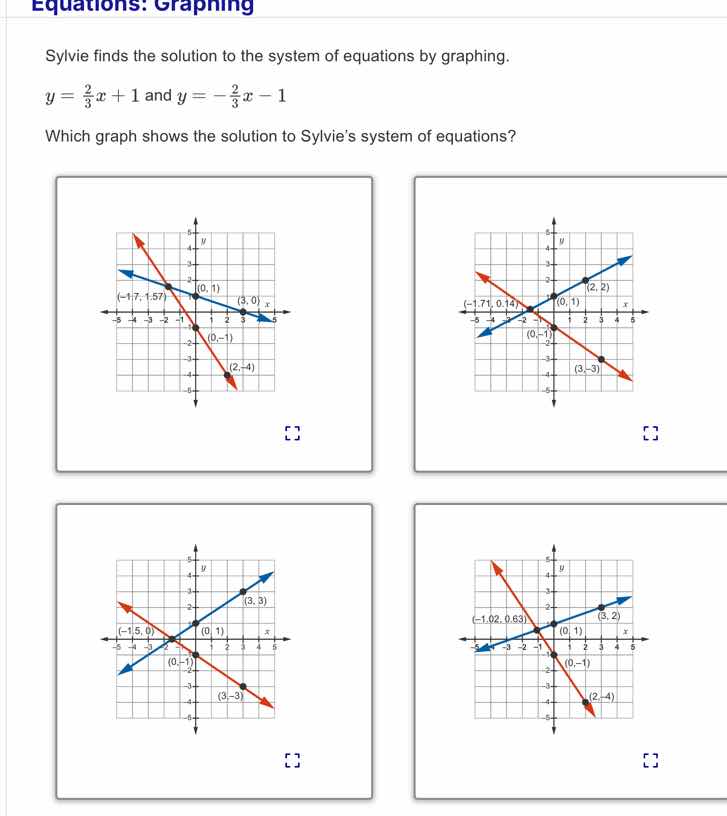
which graph shows the solution to sylvie’s system of equations?
four graphs are shown here, each with a coordinate plane and two lines. the first graph has points like (0,1), (-1.7,1.57), (3,0), (0,-1), (2,-4). the second has (0,1), (-1.7,1.04), (2,2), (0,-1), (3,-3). the third has (0,1), (-1.5,0), (3,3), (0,-1), (3,-3). the fourth has (0,1), (-1.82,0.63), (3,2), (0,-1), (2,-4).
To determine the correct graph, we analyze the two linear equations \( y = \frac{2}{3}x + 1 \) and \( y = -\frac{2}{3}x - 1 \):
Step 1: Analyze the first equation \( y = \frac{2}{3}x + 1 \)
- Slope: \( \frac{2}{3} \) (positive, so the line rises from left to right).
- Y-intercept: \( 1 \) (the line crosses the y-axis at \( (0, 1) \)).
- Key points: For \( x = 3 \), \( y = \frac{2}{3}(3) + 1 = 2 + 1 = 3 \)? Wait, no—wait, let's recalculate. Wait, \( \frac{2}{3}(3) = 2 \), so \( y = 2 + 1 = 3 \)? Wait, no, the second equation is \( y = -\frac{2}{3}x - 1 \). Wait, no, let's check the options. Wait, the first equation: when \( x = 3 \), \( y = \frac{2}{3}(3) + 1 = 2 + 1 = 3 \)? But in the options, some have \( (3, 2) \) or \( (3, 3) \). Wait, maybe I made a mistake. Wait, \( y = \frac{2}{3}x + 1 \): when \( x = 3 \), \( y = \frac{2}{3}(3) + 1 = 2 + 1 = 3 \)? But let's check the y-intercept: \( (0, 1) \) is correct. The slope is positive, so the line goes up as x increases.
Step 2: Analyze the second equation \( y = -\frac{2}{3}x - 1 \)
- Slope: \( -\frac{2}{3} \) (negative, so the line falls from left to right).
- Y-intercept: \( -1 \) (the line crosses the y-axis at \( (0, -1) \)).
- Key points: For \( x = 3 \), \( y = -\frac{2}{3}(3) - 1 = -2 - 1 = -3 \). For \( x = 2 \), \( y = -\frac{2}{3}(2) - 1 = -\frac{4}{3} - 1 \approx -2.33 \), but in the options, some have \( (2, -4) \). Wait, maybe I miscalculated. Wait, \( -\frac{2}{3}(2) = -\frac{4}{3} \approx -1.33 \), so \( y = -1.33 - 1 = -2.33 \), not -4. Wait, maybe the options have different points. Let's check the intersection of the two lines.
Step 3: Find the intersection (solution) of the system
Set \( \frac{2}{3}x + 1 = -\frac{2}{3}x - 1 \):
\[
\frac{2}{3}x + \frac{2}{3}x = -1 - 1 \\
\frac{4}{3}x = -2 \\
x = -2 \times \frac{3}{4} = -\frac{3}{2} = -1.5
\]
Then \( y = \frac{2}{3}(-1.5) + 1 = -1 + 1 = 0 \)? Wait, no: \( \frac{2}{3}(-1.5) = -1 \), so \( y = -1 + 1 = 0 \). Wait, the intersection point is \( (-1.5, 0) \) (or \( (-1.5, 0) \), which is \( (-1.5, 0) \), or approximately \( (-1.5, 0) \), which matches some options like \( (-1.5, 0) \) or \( (-1.82, 0.63) \)? Wait, maybe I made a mistake. Wait, let's solve the system:
\( \frac{2}{3}x + 1 = -\frac{2}{3}x - 1 \)
Add \( \frac{2}{3}x \) to both sides: \( \frac{4}{3}x + 1 = -1 \)
Subtract 1: \( \frac{4}{3}x = -2 \)
Multiply both sides by \( \frac{3}{4} \): \( x = -2 \times \frac{3}{4} = -\frac{3}{2} = -1.5 \)
Then \( y = \frac{2}{3}(-1.5) + 1 = -1 + 1 = 0 \). So the intersection is \( (-1.5, 0) \).
Now, let's check the options:
- Top-left graph: The blue line (first equation) has a positive slope, y-intercept (0,1), and the red line (second equation) has negative slope, y-intercept (0,-1). The intersection is around (-1.7, 1.57)? No, that doesn't match (-1.5, 0). Wait, maybe I misread.
- Top-right graph: Blue line (first equation) has (3,2). Let's check \( y = \frac{2}{3}(3) + 1 = 2 + 1 = 3 \), but (3,2) would mean \( y = 2 \), so \( \frac{2}{3}x + 1 = 2 \implies \frac{2}{3}x = 1 \implies x = \frac{3}{2} = 1.5 \). Not 3.
- Bottom-left graph: Blue line (first equation) has (3,3). Let's check: \( y = \frac{2}{3}(3) + 1 = 2 + 1 = 3 \). Correct! Red line (second equation) has (3, -3). Let's check: \( y = -\frac{2}{3}(3) - 1 = -2 - 1 = -3 \). Correct! Y-intercepts: (0,1) for blue, (0,-1) for red. Intersection: Let's see, the blue line goes through (0,1) and (3,3) (slope \( \frac{3-1}{3-0} = \frac{2}{3} \), correct). The red line goes through (0,-1) and (3,-3) (slope \( \frac{…

Snap & solve any problem in the app
Get step-by-step solutions on Sovi AI
Photo-based solutions with guided steps
Explore more problems and detailed explanations
The bottom-left graph (with blue line \( y = \frac{2}{3}x + 1 \) through (0,1) and (3,3), and red line \( y = -\frac{2}{3}x - 1 \) through (0,-1) and (3,-3)).