QUESTION IMAGE
Question
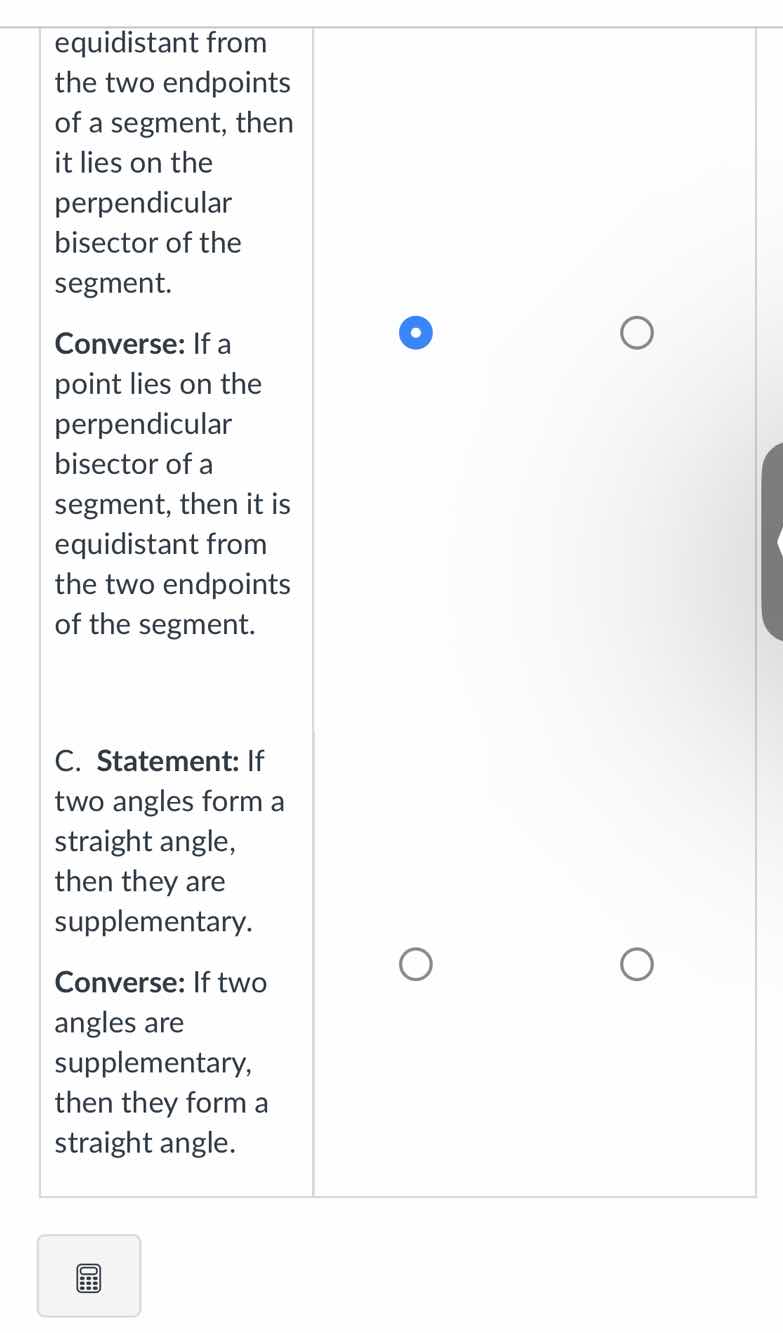
equidistant from
the two endpoints
of a segment, then
it lies on the
perpendicular
bisector of the
segment.
converse: if a
point lies on the
perpendicular
bisector of a
segment, then it is
equidistant from
the two endpoints
of the segment.
c. statement: if
two angles form a
straight angle,
then they are
supplementary.
converse: if two
angles are
supplementary,
then they form a
straight angle.
To determine the validity of the converse statements, we analyze each:
For the first (perpendicular bisector) converse:
- Statement: If a point is equidistant from the endpoints of a segment, it lies on the perpendicular bisector.
- Converse: If a point lies on the perpendicular bisector, it is equidistant from the endpoints.
This converse is true (by the Perpendicular Bisector Theorem’s converse, a fundamental result in geometry: any point on the perpendicular bisector of a segment is equidistant from the segment’s endpoints).
For the second (supplementary angles) converse:
- Statement: If two angles form a straight angle, they are supplementary (since a straight angle is \( 180^\circ \), and supplementary angles sum to \( 180^\circ \)).
- Converse: If two angles are supplementary, they form a straight angle.
This converse is false (supplementary angles only need to sum to \( 180^\circ \); they do not have to be adjacent or form a straight angle. For example, two non - adjacent angles (e.g., one \( 100^\circ \) and one \( 80^\circ \) in different parts of a diagram) can be supplementary without forming a straight angle).
If the question is to identify which converse is true, the answer is the converse of the perpendicular bisector statement (the first one with the blue - filled circle). If it is to identify which is false, it is the converse of the supplementary angles statement (the one with the empty circles for option C).
Assuming the question is to find the true converse, the answer is the converse of the perpendicular bisector statement (the first converse: “If a point lies on the perpendicular bisector of a segment, then it is equidistant from the two endpoints of the segment”).

Snap & solve any problem in the app
Get step-by-step solutions on Sovi AI
Photo-based solutions with guided steps
Explore more problems and detailed explanations
To determine the validity of the converse statements, we analyze each:
For the first (perpendicular bisector) converse:
- Statement: If a point is equidistant from the endpoints of a segment, it lies on the perpendicular bisector.
- Converse: If a point lies on the perpendicular bisector, it is equidistant from the endpoints.
This converse is true (by the Perpendicular Bisector Theorem’s converse, a fundamental result in geometry: any point on the perpendicular bisector of a segment is equidistant from the segment’s endpoints).
For the second (supplementary angles) converse:
- Statement: If two angles form a straight angle, they are supplementary (since a straight angle is \( 180^\circ \), and supplementary angles sum to \( 180^\circ \)).
- Converse: If two angles are supplementary, they form a straight angle.
This converse is false (supplementary angles only need to sum to \( 180^\circ \); they do not have to be adjacent or form a straight angle. For example, two non - adjacent angles (e.g., one \( 100^\circ \) and one \( 80^\circ \) in different parts of a diagram) can be supplementary without forming a straight angle).
If the question is to identify which converse is true, the answer is the converse of the perpendicular bisector statement (the first one with the blue - filled circle). If it is to identify which is false, it is the converse of the supplementary angles statement (the one with the empty circles for option C).
Assuming the question is to find the true converse, the answer is the converse of the perpendicular bisector statement (the first converse: “If a point lies on the perpendicular bisector of a segment, then it is equidistant from the two endpoints of the segment”).