QUESTION IMAGE
Question
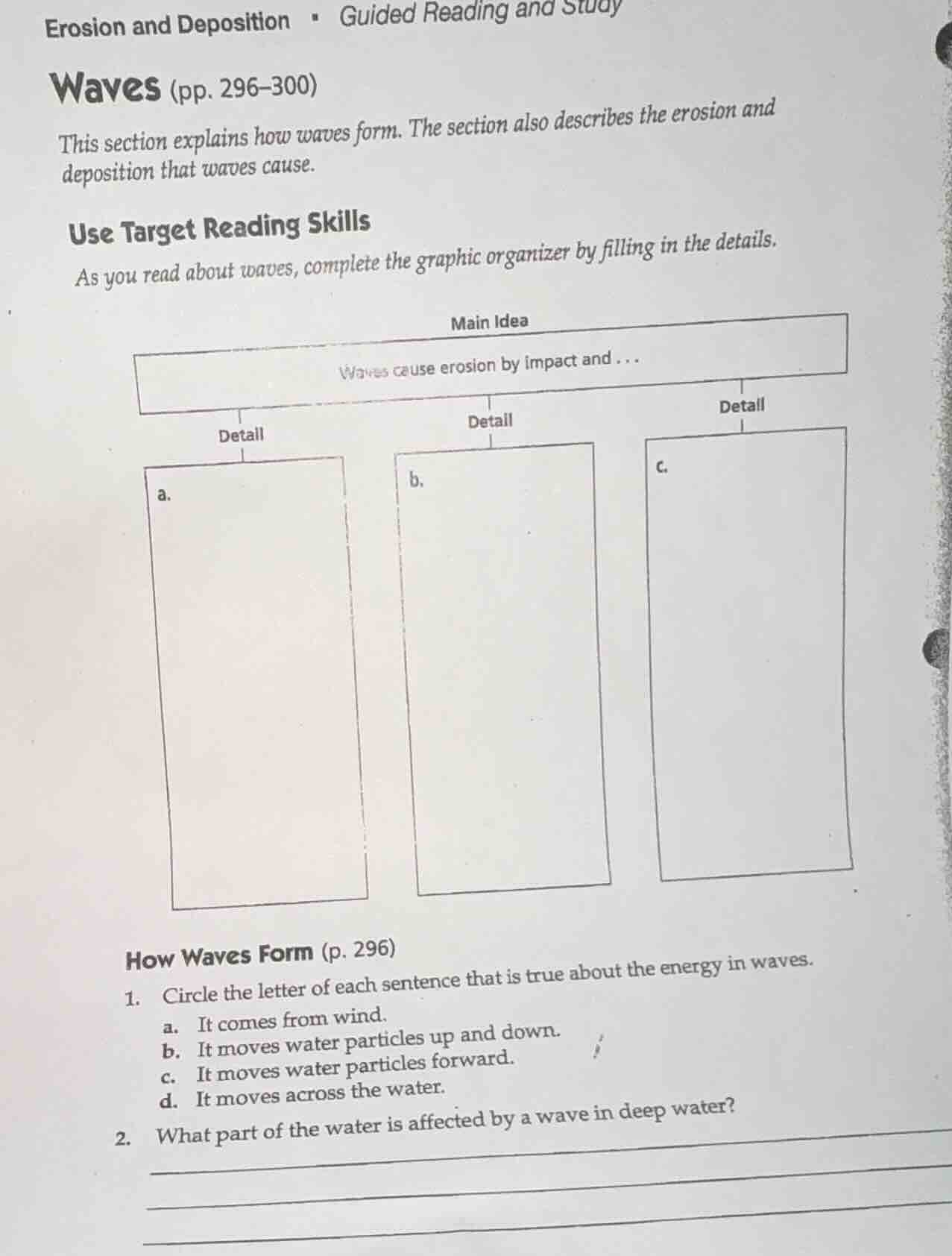
erosion and deposition · guided reading and study
waves (pp. 296–300)
this section explains how waves form. the section also describes the erosion and
deposition that waves cause.
use target reading skills
as you read about waves, complete the graphic organizer by filling in the details.
how waves form (p. 296)
- circle the letter of each sentence that is true about the energy in waves.
a. it comes from wind.
b. it moves water particles up and down.
c. it moves water particles forward.
d. it moves across the water.
- what part of the water is affected by a wave in deep water?
Step1: Answer wave erosion details
Main Idea: Waves cause erosion by impact and...
a. Abrasion (wave-borne particles scraping rock)
b. Hydraulic action (water forcing into cracks)
c. Attrition (rocks hitting each other, breaking down)
Step2: Solve true wave energy statements
- Evaluate each option:
- a. Wave energy primarily comes from wind.
- b. Wave energy makes water particles move in circular (up/down, side-to-side) motions, so this is true.
- c. Water particles do not move forward with the wave (only energy moves forward), so this is false.
- d. Wave energy travels horizontally across the water surface, so this is true.
Step3: Answer deep water wave effect
- In deep water, waves only affect the surface layer (the top portion of the water column, where water particles move in circular orbits that decrease in size with depth, and are negligible below a depth of half the wavelength).

Snap & solve any problem in the app
Get step-by-step solutions on Sovi AI
Photo-based solutions with guided steps
Explore more problems and detailed explanations
Graphic Organizer:
Main Idea: Waves cause erosion by impact and abrasion, hydraulic action, attrition
a. Abrasion (scraping by sediment)
b. Hydraulic action (water pressure in cracks)
c. Attrition (rock breakdown from collision)
How Waves Form:
- a. It comes from wind.
b. It moves water particles up and down.
d. It moves across the water.
- Only the surface layer (top portion of the water column, down to a depth equal to half the wave's wavelength) is affected; water particles in deeper areas do not move with the wave.