QUESTION IMAGE
Question
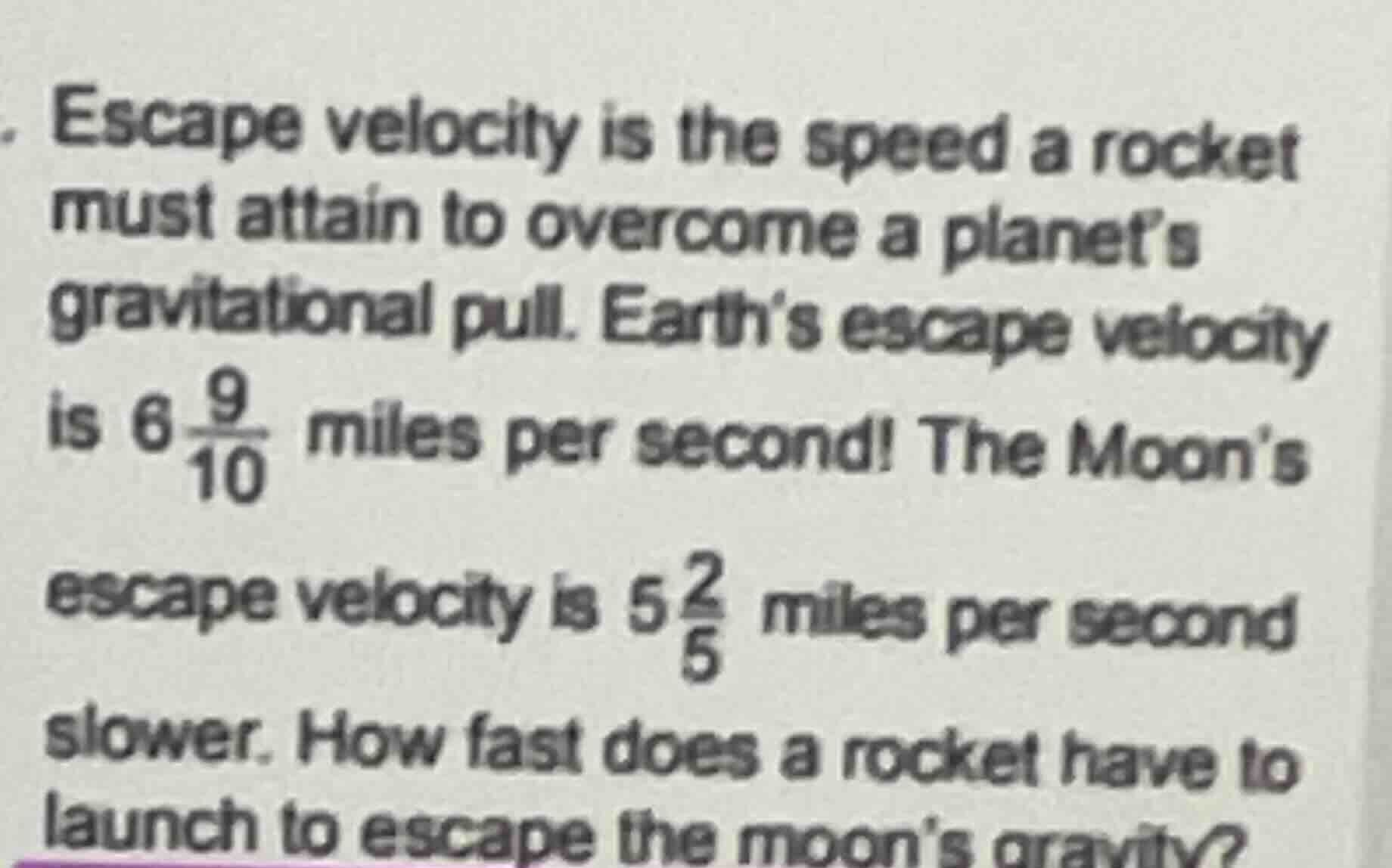
escape velocity is the speed a rocket must attain to overcome a planet’s gravitational pull. earth’s escape velocity is $6\frac{9}{10}$ miles per second! the moon’s escape velocity is $5\frac{2}{5}$ miles per second slower. how fast does a rocket have to launch to escape the moon’s gravity?
Step1: Convert mixed numbers to improper fractions
Earth's escape velocity: \(6\frac{9}{10}=\frac{6\times10 + 9}{10}=\frac{69}{10}\)
Moon's escape velocity is \(5\frac{2}{5}\) miles per second slower, so \(5\frac{2}{5}=\frac{5\times5+2}{5}=\frac{27}{5}\)
Step2: Subtract the two fractions
We need to find \(\frac{69}{10}-\frac{27}{5}\). First, make the denominators the same. The common denominator of 10 and 5 is 10. So \(\frac{27}{5}=\frac{27\times2}{5\times2}=\frac{54}{10}\)
Then subtract: \(\frac{69}{10}-\frac{54}{10}=\frac{69 - 54}{10}=\frac{15}{10}\)
Step3: Simplify the result
Simplify \(\frac{15}{10}\) to a mixed number. \(\frac{15}{10}=1\frac{5}{10}=1\frac{1}{2}\)? Wait, no, wait. Wait, Earth's escape velocity is \(6\frac{9}{10}\), Moon's is slower by \(5\frac{2}{5}\), so we do \(6\frac{9}{10}-5\frac{2}{5}\). Let's do it as mixed numbers.
\(6\frac{9}{10}-5\frac{2}{5}=6\frac{9}{10}-5\frac{4}{10}=(6 - 5)+(\frac{9}{10}-\frac{4}{10})=1+\frac{5}{10}=1\frac{1}{2}\)? Wait, that can't be right. Wait, no, wait the problem says "The Moon’s escape velocity is \(5\frac{2}{5}\) miles per second slower". So Moon's escape velocity = Earth's - \(5\frac{2}{5}\). Wait, Earth's is \(6\frac{9}{10}\), so \(6\frac{9}{10}-5\frac{2}{5}\). Let's convert to improper fractions: \(6\frac{9}{10}=\frac{69}{10}\), \(5\frac{2}{5}=\frac{27}{5}=\frac{54}{10}\). Then \(\frac{69}{10}-\frac{54}{10}=\frac{15}{10}=\frac{3}{2}=1\frac{1}{2}\)? Wait, that seems too slow. Wait, maybe I misread. Wait, Earth's escape velocity is 6.9 miles per second, Moon's is slower by 5.4 miles per second? Wait, no, \(5\frac{2}{5}\) is 5.4, \(6\frac{9}{10}\) is 6.9. 6.9 - 5.4 = 1.5, which is \(1\frac{1}{2}\) miles per second. Wait, but that seems correct? Wait, no, wait the Moon's escape velocity is actually about 2.38 km/s, which is about 1.48 miles per second. Oh, maybe the numbers in the problem are simplified. So according to the problem's numbers, let's proceed.
Wait, let's redo the subtraction as mixed numbers:
\(6\frac{9}{10}-5\frac{2}{5}\)
First, subtract the whole numbers: 6 - 5 = 1
Then subtract the fractions: \(\frac{9}{10}-\frac{2}{5}=\frac{9}{10}-\frac{4}{10}=\frac{5}{10}=\frac{1}{2}\)
Then add the whole number and the fraction: 1 + \(\frac{1}{2}\)= \(1\frac{1}{2}\)? Wait, no, 6 - 5 is 1, and \(\frac{9}{10}-\frac{4}{10}\) is \(\frac{5}{10}\), so total is \(1\frac{5}{10}=1\frac{1}{2}\). But that seems low, but maybe the problem uses simplified numbers. So according to the problem's calculation, the Moon's escape velocity is \(1\frac{1}{2}\) miles per second? Wait, no, wait I think I made a mistake. Wait, \(5\frac{2}{5}\) is 5.4, \(6\frac{9}{10}\) is 6.9. 6.9 - 5.4 = 1.5, which is \(1\frac{1}{2}\). So that's correct according to the problem's numbers.

Snap & solve any problem in the app
Get step-by-step solutions on Sovi AI
Photo-based solutions with guided steps
Explore more problems and detailed explanations
\(1\frac{1}{2}\) miles per second (or \(\frac{3}{2}\) or 1.5)