QUESTION IMAGE
Question
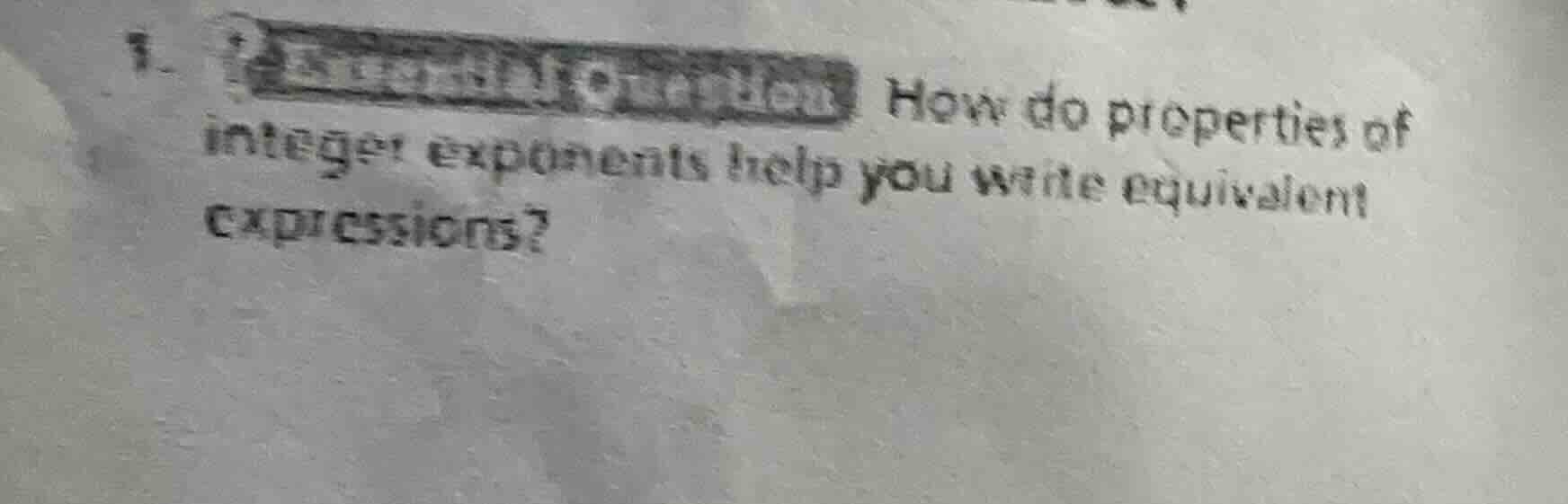
- essential question how do properties of integer exponents help you write equivalent expressions?
Properties of integer exponents (like product rule \(a^m \cdot a^n = a^{m + n}\), quotient rule \(\frac{a^m}{a^n}=a^{m - n}\), power rule \((a^m)^n = a^{mn}\), negative exponent rule \(a^{-n}=\frac{1}{a^n}\), and zero exponent rule \(a^0 = 1\) for \(a
eq0\)) allow us to manipulate exponential expressions. For example, using the product rule, \(x^2\cdot x^3=x^{2 + 3}=x^5\), so we can rewrite a product of powers with the same base as a single power. The negative exponent rule helps rewrite expressions with negative exponents as positive - exponent fractions (e.g., \(x^{-2}=\frac{1}{x^2}\)). The zero exponent rule simplifies expressions like \(5^0 = 1\). By applying these properties, we can transform an exponential expression into another form that is equivalent (has the same value for all valid values of the variable) but may be simpler, more convenient for calculation, or better - suited for further algebraic operations.

Snap & solve any problem in the app
Get step-by-step solutions on Sovi AI
Photo-based solutions with guided steps
Explore more problems and detailed explanations
Properties of integer exponents (e.g., product \(a^m\cdot a^n = a^{m + n}\), quotient \(\frac{a^m}{a^n}=a^{m - n}\), power \((a^m)^n=a^{mn}\), negative \(a^{-n}=\frac{1}{a^n}\), zero \(a^0 = 1\) (\(a
eq0\))) let us rewrite exponential expressions (e.g., \(x^2\cdot x^3=x^5\), \(x^{-2}=\frac{1}{x^2}\)) into equivalent forms, simplifying or re - expressing them for easier use.