QUESTION IMAGE
Question
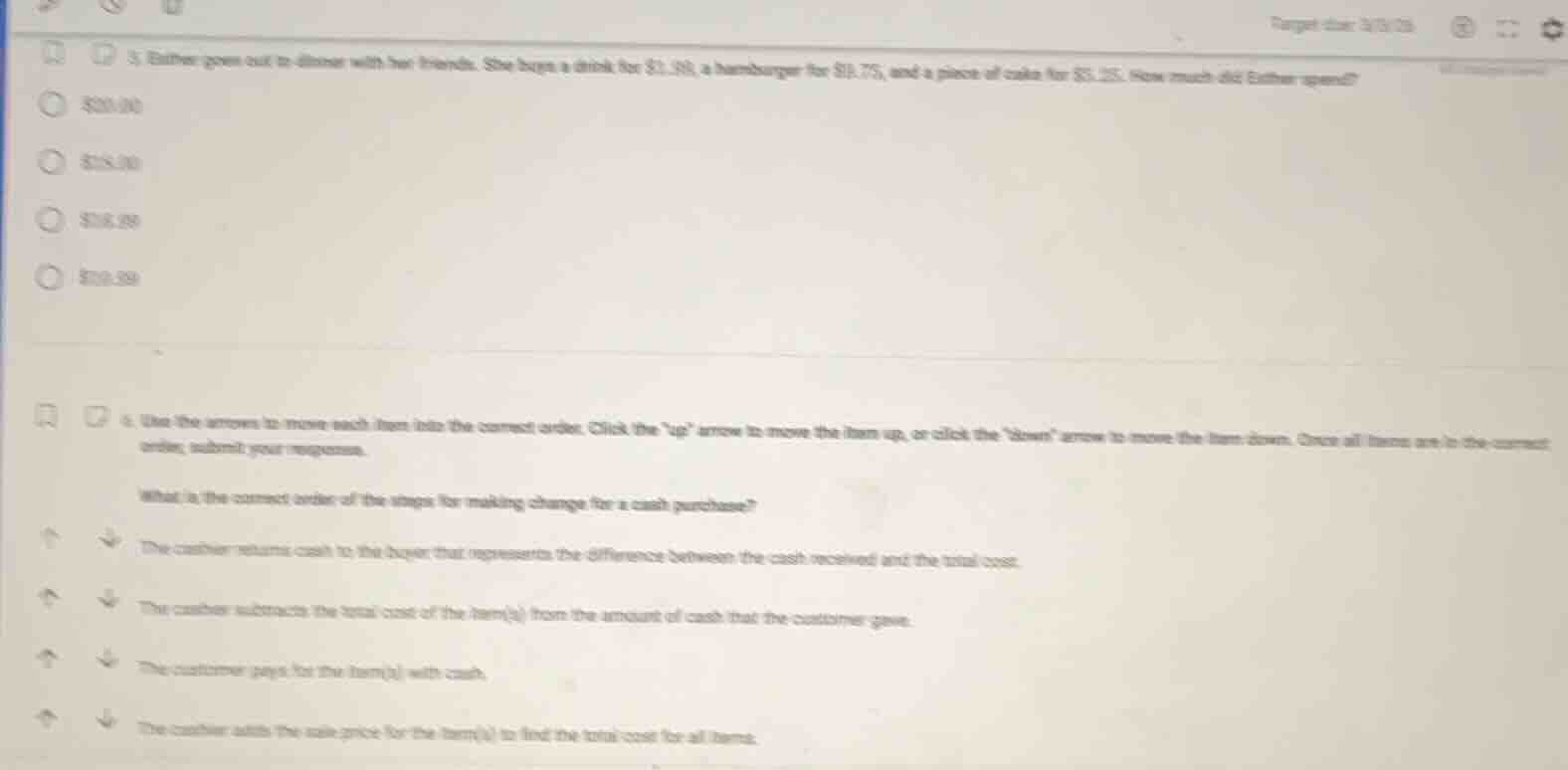
- esther goes out to dinner with her friends. she buys a drink for $1.99, a hamburger for $9.75, and a piece of cake for $5.25. how much did esther spend?
$20.00
$18.00
$16.99
$15.99
- use the arrows to move each item into the correct order. click the up arrow to move the item up, or click the down arrow to move the item down. once all items are in the correct order, submit your response.
what is the correct order of the steps for making change for a cash purchase?
the cashier returns cash to the buyer that represents the difference between the cash received and the total cost.
the cashier subtracts the total cost of the item(s) from the amount of cash that the customer gave.
the customer pays for the item(s) with cash.
the cashier adds the sale price for the item(s) to find the total cost for all items.
Question 5
Step1: Identify the costs
Drink: $\$1.99$, Hamburger: $\$9.75$, Cake: $\$5.25$
Step2: Add the costs
Total = $1.99 + 9.75 + 5.25$
First, add $9.75 + 5.25 = 15$
Then, add $1.99 + 15 = 16.99$? Wait, no, wait the options have $16.99$? Wait the options: $20.00$, $18.00$, $16.99$, $19.99$. Wait let's recalculate: $1.99 + 9.75 = 11.74$; $11.74 + 5.25 = 16.99$. So the total is $\$16.99$.
- First, the cashier adds the sale price for the item(s) to find the total cost for all items (calculate total cost).
- Then, the customer pays for the item(s) with cash (customer pays).
- Then, the cashier subtracts the total cost of the item(s) from the amount of cash that the customer gave (calculate change).
- Finally, the cashier returns cash to the buyer that represents the difference between the cash received and the total cost (give change).
So the correct order is:
- The cashier adds the sale price for the item(s) to find the total cost for all items.
- The customer pays for the item(s) with cash.
- The cashier subtracts the total cost of the item(s) from the amount of cash that the customer gave.
- The cashier returns cash to the buyer that represents the difference between the cash received and the total cost.
To order them:
- Move "The cashier adds the sale price for the item(s) to find the total cost for all items" to the top (first step).
- Then "The customer pays for the item(s) with cash" (second step).
- Then "The cashier subtracts the total cost of the item(s) from the amount of cash that the customer gave" (third step).
- Then "The cashier returns cash to the buyer that represents the difference between the cash received and the total cost" (fourth step).
So the order from top to bottom (first to last) is:
- The cashier adds the sale price for the item(s) to find the total cost for all items.
- The customer pays for the item(s) with cash.
- The cashier subtracts the total cost of the item(s) from the amount of cash that the customer gave.
- The cashier returns cash to the buyer that represents the difference between the cash received and the total cost.

Snap & solve any problem in the app
Get step-by-step solutions on Sovi AI
Photo-based solutions with guided steps
Explore more problems and detailed explanations
$\$16.99$ (the option with $\$16.99$)