QUESTION IMAGE
Question
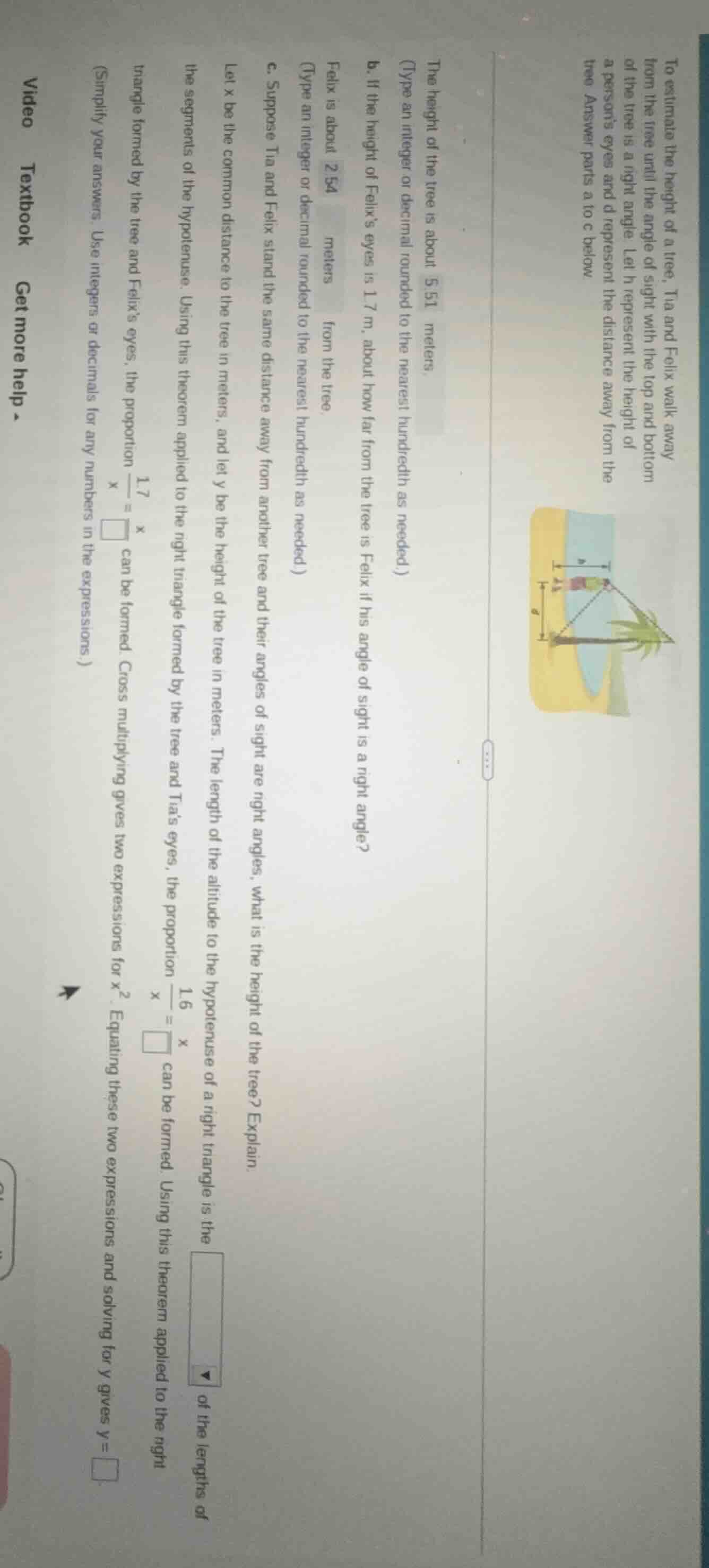
to estimate the height of a tree, tia and felix walk away from the tree until the angle of sight with the top and bottom of the tree is a right angle. let h represent the height of a person’s eyes and d represent the distance away from the tree. answer parts a to c below.
the height of the tree is about 5.51 meters. (type an integer or decimal rounded to the nearest hundredth as needed.)
b. if the height of felix’s eyes is 1.7 m, about how far from the tree is felix if his angle of sight is a right angle? felix is about 2.54 meters from the tree. (type an integer or decimal rounded to the nearest hundredth as needed.)
c. suppose tia and felix stand the same distance away from another tree and their angles of sight are right angles, what is the height of the tree? explain.
let x be the common distance to the tree in meters, and let y be the height of the tree in meters. the length of the altitude to the hypotenuse of a right triangle is the geometric mean of the lengths of the segments of the hypotenuse. using this theorem applied to the right triangle formed by the tree and tia’s eyes, the proportion \\(\frac{1.6}{x} = \frac{x}{\square}\\) can be formed. using this theorem applied to the right triangle formed by the tree and felix’s eyes, the proportion \\(\frac{1.7}{x} = \frac{x}{\square}\\) can be formed. cross multiplying gives two expressions for \\(x^2\\). equating these two expressions and solving for y gives y = \square. (simplify your answers. use integers or decimals for any numbers in the expressions.)
Part b:
Step1: Identify the problem type
This is a right - triangle problem where we can use the geometric mean (or altitude - on - hypotenuse) theorem. The height of the tree is \(h = 5.51\) m, and the height of Felix's eyes is \(a=1.7\) m. Let the distance from Felix to the tree be \(x\), and the height from Felix's eyes to the top of the tree be \(b=h - a\). First, calculate \(b\):
\(b=5.51 - 1.7=3.81\) m
Step2: Apply the geometric mean theorem
The geometric mean theorem states that in a right triangle, the length of the altitude drawn to the hypotenuse is the geometric mean of the lengths of the two segments of the hypotenuse. Also, the leg of the right triangle is the geometric mean of the hypotenuse and the adjacent segment. Here, if we consider the right triangle formed by Felix's line of sight (hypotenuse), the distance to the tree (\(x\)) and the height from his eyes to the top of the tree (\(b\)), and the right triangle with the tree height (\(h\)) and the distance to the tree (\(x\)), we can use the proportion \(\frac{a}{x}=\frac{x}{b + a}\)? Wait, no, actually, from the problem's context, since the angle of sight is a right angle, we have similar triangles. The large right triangle (tree height \(h\), distance \(x\)) and the small right triangle (height from Felix's eyes \(a = 1.7\), distance \(x\)) and the other triangle? Wait, maybe a better way: We know that the height of the tree is \(h\), Felix's eye height is \(a = 1.7\), and the distance from Felix to the tree is \(x\). The height from Felix's eyes to the top of the tree is \(h - a=5.51 - 1.7 = 3.81\). Since the angle of sight is a right angle, we have \(\frac{1.7}{x}=\frac{x}{5.51}\) (by the geometric mean theorem, where the altitude to the hypotenuse of the large right triangle (with height \(h\) and base \(x\)) is related to the segments of the hypotenuse). Wait, no, the geometric mean theorem: In a right triangle, if an altitude is drawn to the hypotenuse, then \(leg_1^2=segment_1\times hypotenuse\) and \(leg_2^2 = segment_2\times hypotenuse\), and \(altitude^2=segment_1\times segment_2\).
Wait, maybe the problem is using the proportion \(\frac{1.7}{x}=\frac{x}{5.51}\)? No, let's re - read. The height of the tree is about \(5.51\) m. Felix's eye height is \(1.7\) m. The angle of sight is a right angle. So we have two similar right triangles: One with height \(1.7\) and base \(x\), and one with height \(5.51\) and base \(x\)? No, that doesn't make sense. Wait, the problem says "the angle of sight is a right angle", so the triangle formed by Felix's eyes, the base of the tree, and the top of the tree is a right triangle with right angle at Felix's eyes. So the height of the tree \(H = 5.51\), Felix's eye height \(h = 1.7\), and the distance from Felix to the tree \(x\). Then, by the Pythagorean theorem, but no, since it's a right angle at Felix's eyes, we have \(x^2+1.7^2=(5.51)^2\)? No, that would be if the hypotenuse is the tree height, but the tree height is vertical. Wait, I think I made a mistake. Let's look at the problem statement again: "If the height of Felix's eyes is 1.7 m, about how far from the tree is Felix if his angle of sight is a right angle?" and "The height of the tree is about 5.51 meters".
Ah, the geometric mean (altitude - on - hypotenuse) theorem: In a right triangle, the altitude to the hypotenuse is the geometric mean of the segments into which it divides the hypotenuse. Let the tree height be \(h = 5.51\) (the hypotenuse of the large right triangle), and the altitude (Felix's eye height) is \(a = 1.7\), and the distance from Felix to th…
Step1: Analyze the similar triangles
Tia and Felix are at the same distance \(x\) from the tree. Let Felix's eye height be \(a = 1.7\) m, Tia's eye height be \(b = 1.6\) m, and the tree height be \(h\). Since their angles of sight are right angles, we have two similar right - triangle proportions: \(\frac{a}{x}=\frac{x}{h}\) (for Felix) and \(\frac{b}{x}=\frac{x}{h}\) (for Tia)? No, that can't be. Wait, actually, from the geometric mean theorem, for Felix: \(x^2=a\times h_1\) (where \(h_1\) is the height from Felix's eyes to the top of the tree plus his eye height? No, better: Since both are at the same distance \(x\) from the tree and their angles of sight are right angles, the tree height \(h\) satisfies \(h=\frac{x^2}{a}=\frac{x^2}{b}\)? Which would imply \(a = b\), but Tia's eye height is \(1.6\) and Felix's is \(1.7\). Wait, no, the problem says "Suppose Tia and Felix stand the same distance away from another tree and their angles of sight are right angles, what is the height of the tree? Explain." and the proportion \(\frac{1.7}{x}=\frac{x}{y}\) (Felix) and \(\frac{1.6}{x}=\frac{x}{y}\) (Tia), where \(y\) is the height from their eyes to the top of the tree plus their eye height (the tree height). Wait, if we set the two proportions equal: \(\frac{1.7}{x}=\frac{x}{h}\) and \(\frac{1.6}{x}=\frac{x}{h}\), which is a contradiction unless \(1.7 = 1.6\), so maybe the tree height is the same as the product of the eye heights? No, wait, the problem says "the proportion \(\frac{1.7}{x}=\frac{x}{y}\) can be formed. Cross multiplying gives two expressions for \(x^2\). Equating these two expressions and solving for \(y\)". Wait, maybe Tia's eye height is \(1.6\), so we have \(\frac{1.7}{x}=\frac{x}{h}\) (Felix) and \(\frac{1.6}{x}=\frac{x}{h}\) (Tia) is wrong. Actually, it's \(\frac{1.7}{x}=\frac{x}{h}\) (Felix) and \(\frac{1.6}{x}=\frac{x}{h}\) is for Tia, but since \(x\) is the same, we have \(1.7\times h=x^2\) and \(1.6\times h=x^2\), which is impossible. So maybe the tree height is the geometric mean of the two eye heights? No, that doesn't make sense. Wait, the problem says "the proportion \(\frac{1.7}{x}=\frac{x}{\square}\) can be formed. Cross multiplying gives two expressions for \(x^2\). Equating these two expressions and solving for \(y\) (the tree height)".
Wait, let's assume that for Felix, the proportion is \(\frac{1.7}{x}=\frac{x}{h}\) (so \(x^2 = 1.7h\)) and for Tia, the proportion is \(\frac{1.6}{x}=\frac{x}{h}\) (so \(x^2=1.6h\)) is wrong. So maybe the tree height \(h\) is such that \(x^2 = 1.7\times h_1\) and \(x^2=1.6\times h_2\), and \(h=h_1 + 1.7=h_2+1.6\). But this

Snap & solve any problem in the app
Get step-by-step solutions on Sovi AI
Photo-based solutions with guided steps
Explore more problems and detailed explanations
Step1: Analyze the similar triangles
Tia and Felix are at the same distance \(x\) from the tree. Let Felix's eye height be \(a = 1.7\) m, Tia's eye height be \(b = 1.6\) m, and the tree height be \(h\). Since their angles of sight are right angles, we have two similar right - triangle proportions: \(\frac{a}{x}=\frac{x}{h}\) (for Felix) and \(\frac{b}{x}=\frac{x}{h}\) (for Tia)? No, that can't be. Wait, actually, from the geometric mean theorem, for Felix: \(x^2=a\times h_1\) (where \(h_1\) is the height from Felix's eyes to the top of the tree plus his eye height? No, better: Since both are at the same distance \(x\) from the tree and their angles of sight are right angles, the tree height \(h\) satisfies \(h=\frac{x^2}{a}=\frac{x^2}{b}\)? Which would imply \(a = b\), but Tia's eye height is \(1.6\) and Felix's is \(1.7\). Wait, no, the problem says "Suppose Tia and Felix stand the same distance away from another tree and their angles of sight are right angles, what is the height of the tree? Explain." and the proportion \(\frac{1.7}{x}=\frac{x}{y}\) (Felix) and \(\frac{1.6}{x}=\frac{x}{y}\) (Tia), where \(y\) is the height from their eyes to the top of the tree plus their eye height (the tree height). Wait, if we set the two proportions equal: \(\frac{1.7}{x}=\frac{x}{h}\) and \(\frac{1.6}{x}=\frac{x}{h}\), which is a contradiction unless \(1.7 = 1.6\), so maybe the tree height is the same as the product of the eye heights? No, wait, the problem says "the proportion \(\frac{1.7}{x}=\frac{x}{y}\) can be formed. Cross multiplying gives two expressions for \(x^2\). Equating these two expressions and solving for \(y\)". Wait, maybe Tia's eye height is \(1.6\), so we have \(\frac{1.7}{x}=\frac{x}{h}\) (Felix) and \(\frac{1.6}{x}=\frac{x}{h}\) (Tia) is wrong. Actually, it's \(\frac{1.7}{x}=\frac{x}{h}\) (Felix) and \(\frac{1.6}{x}=\frac{x}{h}\) is for Tia, but since \(x\) is the same, we have \(1.7\times h=x^2\) and \(1.6\times h=x^2\), which is impossible. So maybe the tree height is the geometric mean of the two eye heights? No, that doesn't make sense. Wait, the problem says "the proportion \(\frac{1.7}{x}=\frac{x}{\square}\) can be formed. Cross multiplying gives two expressions for \(x^2\). Equating these two expressions and solving for \(y\) (the tree height)".
Wait, let's assume that for Felix, the proportion is \(\frac{1.7}{x}=\frac{x}{h}\) (so \(x^2 = 1.7h\)) and for Tia, the proportion is \(\frac{1.6}{x}=\frac{x}{h}\) (so \(x^2=1.6h\)) is wrong. So maybe the tree height \(h\) is such that \(x^2 = 1.7\times h_1\) and \(x^2=1.6\times h_2\), and \(h=h_1 + 1.7=h_2+1.6\). But this