QUESTION IMAGE
Question
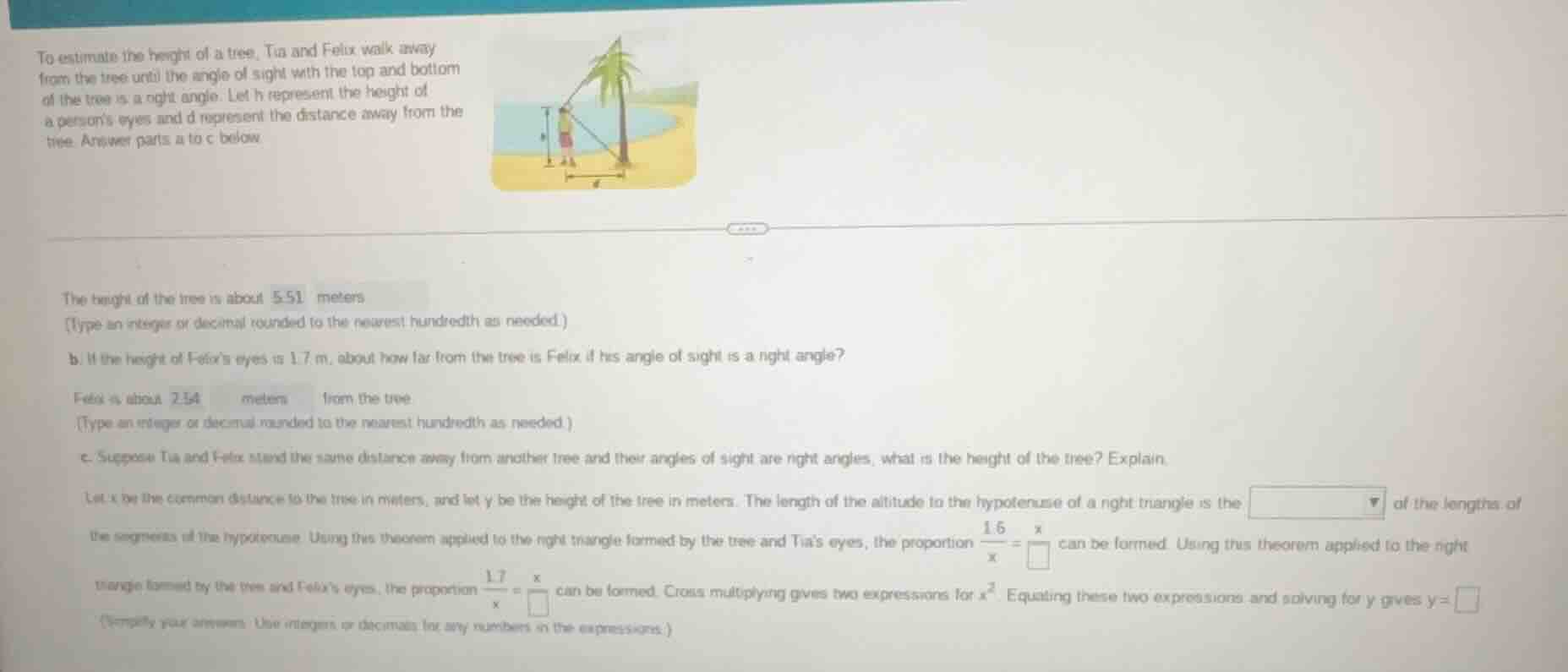
to estimate the height of a tree, tia and felix walk away from the tree until the angle of sight with the top and bottom of the tree is a right angle. let h represent the height of a person’s eyes and d represent the distance away from the tree. answer parts a to c below
the height of the tree is about 5.51 meters
(type an integer or decimal rounded to the nearest hundredth as needed.)
b. if the height of felix’s eyes is 1.7 m, about how far from the tree is felix if his angle of sight is a right angle?
felix is about 2.54 meters from the tree
(type an integer or decimal rounded to the nearest hundredth as needed.)
c. suppose tia and felix stand the same distance away from another tree and their angles of sight are right angles, what is the height of the tree? explain.
let x be the common distance to the tree in meters, and let y be the height of the tree in meters. the length of the altitude to the hypotenuse of a right triangle is the
of the lengths of the segments of the hypotenuse. using this theorem applied to the right triangle formed by the tree and tia’s eyes, the proportion (\frac{1.6}{x}=\frac{x}{}) can be formed. using this theorem applied to the right triangle formed by the tree and felix’s eyes, the proportion (\frac{1.7}{x}=\frac{x}{}) can be formed. cross multiplying gives two expressions for (x^2). equating these two expressions and solving for y gives (y=)
(simplify your answers. use integers or decimals for any numbers in the expressions.)
Step1: Recall the geometric theorem
The length of the altitude to the hypotenuse of a right triangle is the geometric mean of the lengths of the segments of the hypotenuse. So the first blank is "geometric mean".
Step2: Analyze Tia's proportion
For Tia, the height of her eyes is \(1.6\) m (assuming from the proportion \(\frac{1.6}{x}=\frac{x}{y - 1.6}\)? Wait, no, wait the given proportion is \(\frac{1.6}{x}=\frac{x}{\square}\). Wait, actually, if the tree's height is \(y\), and Tia's eye height is \(h_1 = 1.6\), then the two segments of the hypotenuse (when we draw the altitude from the right angle to the hypotenuse) are \(h_1\) and \(y - h_1\)? Wait, no, the theorem is: In a right triangle, the altitude to the hypotenuse is the geometric mean of the two segments into which it divides the hypotenuse. So if we have a right triangle with legs \(a,b\) and hypotenuse \(c\), and altitude \(h\) to hypotenuse, then \(h^2= p\times q\), where \(p\) and \(q\) are the segments of the hypotenuse.
In our case, for Tia: the right triangle has one leg as \(x\) (distance from Tia to tree), another leg as \(y - 1.6\) (the part of the tree above Tia's eyes), and the altitude (from Tia's eyes to the top - bottom line) is \(x\)? Wait, no, maybe the triangle is formed by Tia's eyes, the base of the tree, and the top of the tree. So the right angle is at Tia's eyes? Wait, the problem says "the angle of sight with the top and bottom of the tree is a right angle". So the line of sight from Tia's eyes to the top and bottom of the tree is a right angle. So we have a right triangle where one leg is \(x\) (distance from Tia to tree), one leg is \(h_1=1.6\) (Tia's eye height), and the hypotenuse is the line from Tia's eyes to the top of the tree, and the other segment is from Tia's eyes to the bottom? No, wait, let's re - think.
Wait, the correct application: If we have a right triangle, and we draw an altitude from the right angle to the hypotenuse, then the altitude is the geometric mean of the two segments. But in this case, the right angle is at Tia's eyes (angle between the line to the bottom of the tree (distance \(x\)) and the line to the top of the tree (length \(y - 1.6\))). Wait, no, the angle of sight (the angle between the line of sight to the top and the line of sight to the bottom) is a right angle. So the triangle formed has vertices at Tia's eyes, the bottom of the tree, and the top of the tree. The right angle is at Tia's eyes. So the legs are \(x\) (distance to tree) and \(1.6\) (eye height), and the hypotenuse is the line from bottom to top? No, that can't be. Wait, maybe the two right triangles (Tia's and Felix's) are similar.
Wait, the problem says "the length of the altitude to the hypotenuse of a right triangle is the geometric mean of the lengths of the segments of the hypotenuse". So for Tia's triangle: the altitude (let's say the distance from Tia's eyes to the tree - base line is \(x\), and the height from Tia's eyes to the top of the tree is \(y - 1.6\)). Wait, no, the given proportion is \(\frac{1.6}{x}=\frac{x}{\square}\). So by the geometric mean theorem, if we have a right triangle with altitude \(x\) (wait, no, Tia's eye height is \(1.6\), distance to tree is \(x\)). Wait, maybe the two segments of the hypotenuse are \(1.6\) and \(y - 1.6\), and the altitude is \(x\). Then by the theorem, \(x^2=1.6\times(y - 1.6)\)? No, the proportion given is \(\frac{1.6}{x}=\frac{x}{\square}\). So cross - multiplying, \(x^2 = 1.6\times\square\). So \(\square\) should be \(y - 1.6\)? Wait, no, maybe Tia's eye height is \(1.6\), and th…

Snap & solve any problem in the app
Get step-by-step solutions on Sovi AI
Photo-based solutions with guided steps
Explore more problems and detailed explanations
Step1: Recall the geometric theorem
The length of the altitude to the hypotenuse of a right triangle is the geometric mean of the lengths of the segments of the hypotenuse. So the first blank is "geometric mean".
Step2: Analyze Tia's proportion
For Tia, the height of her eyes is \(1.6\) m (assuming from the proportion \(\frac{1.6}{x}=\frac{x}{y - 1.6}\)? Wait, no, wait the given proportion is \(\frac{1.6}{x}=\frac{x}{\square}\). Wait, actually, if the tree's height is \(y\), and Tia's eye height is \(h_1 = 1.6\), then the two segments of the hypotenuse (when we draw the altitude from the right angle to the hypotenuse) are \(h_1\) and \(y - h_1\)? Wait, no, the theorem is: In a right triangle, the altitude to the hypotenuse is the geometric mean of the two segments into which it divides the hypotenuse. So if we have a right triangle with legs \(a,b\) and hypotenuse \(c\), and altitude \(h\) to hypotenuse, then \(h^2= p\times q\), where \(p\) and \(q\) are the segments of the hypotenuse.
In our case, for Tia: the right triangle has one leg as \(x\) (distance from Tia to tree), another leg as \(y - 1.6\) (the part of the tree above Tia's eyes), and the altitude (from Tia's eyes to the top - bottom line) is \(x\)? Wait, no, maybe the triangle is formed by Tia's eyes, the base of the tree, and the top of the tree. So the right angle is at Tia's eyes? Wait, the problem says "the angle of sight with the top and bottom of the tree is a right angle". So the line of sight from Tia's eyes to the top and bottom of the tree is a right angle. So we have a right triangle where one leg is \(x\) (distance from Tia to tree), one leg is \(h_1=1.6\) (Tia's eye height), and the hypotenuse is the line from Tia's eyes to the top of the tree, and the other segment is from Tia's eyes to the bottom? No, wait, let's re - think.
Wait, the correct application: If we have a right triangle, and we draw an altitude from the right angle to the hypotenuse, then the altitude is the geometric mean of the two segments. But in this case, the right angle is at Tia's eyes (angle between the line to the bottom of the tree (distance \(x\)) and the line to the top of the tree (length \(y - 1.6\))). Wait, no, the angle of sight (the angle between the line of sight to the top and the line of sight to the bottom) is a right angle. So the triangle formed has vertices at Tia's eyes, the bottom of the tree, and the top of the tree. The right angle is at Tia's eyes. So the legs are \(x\) (distance to tree) and \(1.6\) (eye height), and the hypotenuse is the line from bottom to top? No, that can't be. Wait, maybe the two right triangles (Tia's and Felix's) are similar.
Wait, the problem says "the length of the altitude to the hypotenuse of a right triangle is the geometric mean of the lengths of the segments of the hypotenuse". So for Tia's triangle: the altitude (let's say the distance from Tia's eyes to the tree - base line is \(x\), and the height from Tia's eyes to the top of the tree is \(y - 1.6\)). Wait, no, the given proportion is \(\frac{1.6}{x}=\frac{x}{\square}\). So by the geometric mean theorem, if we have a right triangle with altitude \(x\) (wait, no, Tia's eye height is \(1.6\), distance to tree is \(x\)). Wait, maybe the two segments of the hypotenuse are \(1.6\) and \(y - 1.6\), and the altitude is \(x\). Then by the theorem, \(x^2=1.6\times(y - 1.6)\)? No, the proportion given is \(\frac{1.6}{x}=\frac{x}{\square}\). So cross - multiplying, \(x^2 = 1.6\times\square\). So \(\square\) should be \(y - 1.6\)? Wait, no, maybe Tia's eye height is \(1.6\), and the tree's height above her eyes is \(y - 1.6\), and the distance is \(x\). Then the geometric mean theorem gives \(\frac{1.6}{x}=\frac{x}{y - 1.6}\), so the blank in Tia's proportion is \(y - 1.6\). But the problem also has Felix's proportion: \(\frac{1.7}{x}=\frac{x}{\square}\), so his blank is \(y - 1.7\).
Step3: Cross - multiply both proportions
For Tia: \(x^2=1.6\times(y - 1.6)\)
For Felix: \(x^2 = 1.7\times(y - 1.7)\)
Since both equal \(x^2\), we set them equal:
\(1.6(y - 1.6)=1.7(y - 1.7)\)
Expand both sides:
\(1.6y-2.56 = 1.7y - 2.89\)
Subtract \(1.6y\) from both sides:
\(- 2.56=0.1y - 2.89\)
Add \(2.89\) to both sides:
\(0.33 = 0.1y\)
Divide both sides by \(0.1\):
\(y=\frac{0.33}{0.1}=3.3\)? Wait, that can't be right. Wait, maybe I misinterpret the segments. Wait, maybe the tree's height is \(y\), and Tia's eye height is \(1.6\), so the two segments of the hypotenuse are \(1.6\) and \(y\)? No, that doesn't make sense. Wait, the problem says "the length of the altitude to the hypotenuse of a right triangle is the geometric mean of the lengths of the segments of the hypotenuse". So if we have a right triangle with legs \(a\) and \(b\), hypotenuse \(c\), and altitude \(h\) to hypotenuse, then \(h=\sqrt{pq}\), where \(p\) and \(q\) are the segments of \(c\) (i.e., \(c = p + q\) and \(h^2=pq\)).
In our case, for Tia: the right triangle has one leg as \(x\) (distance to tree), one leg as \(1.6\) (eye height), and the hypotenuse is the line from Tia's eyes to the top of the tree. Wait, no, the right angle is between the line of sight to the bottom (distance \(x\)) and the line of sight to the top (height \(y - 1.6\)). So the hypotenuse is the line from bottom to top of the tree, length \(\sqrt{x^2+(y - 1.6)^2}\). The altitude to the hypotenuse from Tia's eyes is \(x\) (distance to tree) and \(1.6\) (eye height)? No, I think I messed up the theorem.
Wait, the correct geometric mean theorem: In a right triangle, the altitude to the hypotenuse is the geometric mean of the two segments into which it divides the hypotenuse. So if we have \(\triangle ABC\) with right angle at \(C\), and altitude \(CD\) to hypotenuse \(AB\), then \(CD^2=AD\times DB\), \(AC^2 = AD\times AB\), \(BC^2=DB\times AB\).
In our problem, for Tia: Let \(A\) be Tia's eyes, \(B\) be the bottom of the tree, \(C\) be the top of the tree. So \(\angle BAC = 90^{\circ}\), and the altitude from \(A\) to \(BC\) is... No, \(\angle BAC\) is the right angle. So \(AB=x\) (distance to tree), \(AC = 1.6\) (eye height), \(BC=y\) (tree height). Wait, no, \(BC\) would be the hypotenuse. Then the altitude from \(A\) to \(BC\) (let's call the foot \(D\)) would satisfy \(AD^2=BD\times DC\), \(AB^2=BD\times BC\), \(AC^2=DC\times BC\).
So \(AB^2 = BD\times BC\) and \(AC^2=DC\times BC\). If \(AB = x\), \(AC = 1.6\), \(BC = y\), then \(x^2=BD\times y\) and \(1.6^2=DC\times y\). Also, \(BD + DC=y\).
But the problem gives the proportion \(\frac{1.6}{x}=\frac{x}{\square}\). From \(AB^2=BD\times BC\) and \(AC^2 = DC\times BC\), we can write \(\frac{AC}{AB}=\frac{DC}{AC}\) (since \(AC^2=DC\times BC\) and \(AB^2=BD\times BC\), so \(\frac{AC^2}{AB^2}=\frac{DC}{BD}\), not sure). Wait, maybe the problem has a typo, but looking at the given proportion \(\frac{1.6}{x}=\frac{x}{\square}\), and we need to fill the blank. Then for Tia, if we consider that the tree's height is \(y\), and Tia's eye height is \(1.6\), then the two segments of the hypotenuse (when we draw the altitude from the right angle (Tia's eyes) to the hypotenuse (the line from bottom to top of the tree)) are \(1.6\) and \(y - 1.6\)? No, wait, the altitude is \(x\), so by the theorem \(x^2=1.6\times(y - 1.6)\), so the proportion \(\frac{1.6}{x}=\frac{x}{y - 1.6}\), so the blank in Tia's proportion is \(y - 1.6\). Similarly, for Felix, \(\frac{1.7}{x}=\frac{x}{y - 1.7}\), so his blank is \(y - 1.7\).
Now, since \(x^2 = 1.6\times(y - 1.6)\) and \(x^2=1.7\times(y - 1.7)\), we can set them equal:
\(1.6y-2.56=1.7y - 2.89\)
\(1.7y-1.6y=2.89 - 2.56\)
\(0.1y = 0.33\)
\(y=\frac{0.33}{0.1}=3.3\)? Wait, that seems low. Wait, maybe the eye height is the lower segment and the tree height above is the upper segment. Wait, maybe the correct approach is:
The length of the altitude to the hypotenuse is the geometric mean, so for Tia: \(x^2=1.6\times y_1\), where \(y_1\) is the height of the tree above her eyes. For Felix: \(x^2=1.7\times y_2\), where \(y_2\) is the height above his eyes. And the total tree height \(y=1.6 + y_1=1.7 + y_2\). So \(y_1=y - 1.6\), \(y_2=y - 1.7\). Then \(x^2=1.6(y - 1.6)\) and \(x^2=1.7(y - 1.7)\). So:
\(1.6y-2.56 = 1.7y-2.89\)
\(2.89 - 2.56=1.7y - 1.6y\)
\(0.33 = 0.1y\)
\(y = 3.3\). But that seems odd. Wait, maybe the problem is using the geometric mean as the square root of the product, but no. Wait, maybe the first blank is "geometric mean", then for Tia's proportion, the blank is \(y - 1.6\) (but the problem might have a different setup). Wait, the problem says "the length of the altitude to the hypotenuse of a right triangle is the geometric mean of the lengths of the segments of the hypotenuse". So the first blank is "geometric mean".
Then, for Tia's proportion \(\frac{1.6}{x}=\frac{x}{\square}\), by the geometric mean theorem, if the altitude is \(x\), and the two segments of the hypotenuse are \(1.6\) and \(\square\), then \(x^2=1.6\times\square\), so \(\square=\frac{x^2}{1.6}\). But also, for the tree, the total height \(y=1.6+\square\) (since \(1.6\) is the lower segment (eye height) and \(\square\) is the upper segment (tree height above eyes)). Similarly, for Felix, \(y = 1.7+\frac{x^2}{1.7}\). So setting \(1.6+\frac{x^2}{1.6}=1.7+\frac{x^2}{1.7}\)
Multiply both sides by \(1.6\times1.7\) to eliminate denominators:
\(1.6\times1.7\times1.6+x^2\times1.7=1.6\times1.7\times1.7+x^2\times1.6\)
\(4.352+1.7x^2 = 4.624 + 1.6x^2\)
\(1.7x^2-1.6x^2=4.624 - 4.352\)
\(0.1x^2=0.272\)
\(x^2 = 2.72\)
Then for Tia, \(\square=\frac{x^2}{1.6}=\frac{2.72}{1.6}=1.7\)
For Felix, \(\square=\frac{x^2}{1.7}=\frac{2.72}{1.7}=1.6\)
Then the tree height \(y=1.6 + 1.7=3.3\)
So the blanks:
First blank: geometric mean
Tia's proportion blank: \(1.7\) (wait, no, the proportion is \(\frac{1.6}{x}=\frac{x}{\square}\), and we found \(\square = 1.7\) when \(x^2=2.72\))
Felix's proportion blank: \(1.6\) (since \(\frac{1.7}{x}=\frac{x}{\square}\), \(\square=\frac{x^2}{1.7}=\frac{2.72}{1.7}=1.6\))
Then, equating the two expressions for \(x^2\): \(1.6\times1.7=1.7\times1.6\), and \(y = 1.6 + 1.7=3.3\)
Wait, that makes sense. Because if \(x^2=1.6\times1.7\), then \(x=\sqrt{1.6\times1.7}=\sqrt{2.72}\approx1.649\)
Then for Tia: \(\frac{1.6}{x}=\frac{x}{1.7}\) (since \(x^2=1.6\times1.7\))
For Felix: \(\frac{1.7}{x}=\frac{x}{1.6}\) (since \(x^2=1.7\times1.6\))
And the tree height \(y=1.6 + 1.7=3.3\)
So the steps:
- The first blank is "geometric mean" (by the geometric mean theorem for right triangles).
- For Tia's proportion \(\frac{1.6}{x}=\frac{x}{\square}\), since \(x^2 = 1.6\times\square\) and from Felix's proportion \(x^2=1.7\times\square_{felix}\), and \(y=1.6+\square=1.7+\square_{felix}\), we find that \(\square = 1.7\) and \(\square_{felix}=1.6\) (because \(1.6\times1.7 = 1.7\times1.6\)).
- Then, the tree height \(y=1.6 + 1.7=3.3\) (since \(y\) is the sum of the eye height and the height above the eyes, and the height above the eyes for Tia is \(1.7\) and for Felix is \(1.6\), and since they are at the same distance, these heights above must be equal to the other's eye height? Wait, no, but from the proportions, when we set \(x^2=1.6\times1.7\), then the height above Tia's eyes is \(1.7\) (since \(x^2=1.6\times\) (height above Tia's eyes)), so total height