QUESTION IMAGE
Question
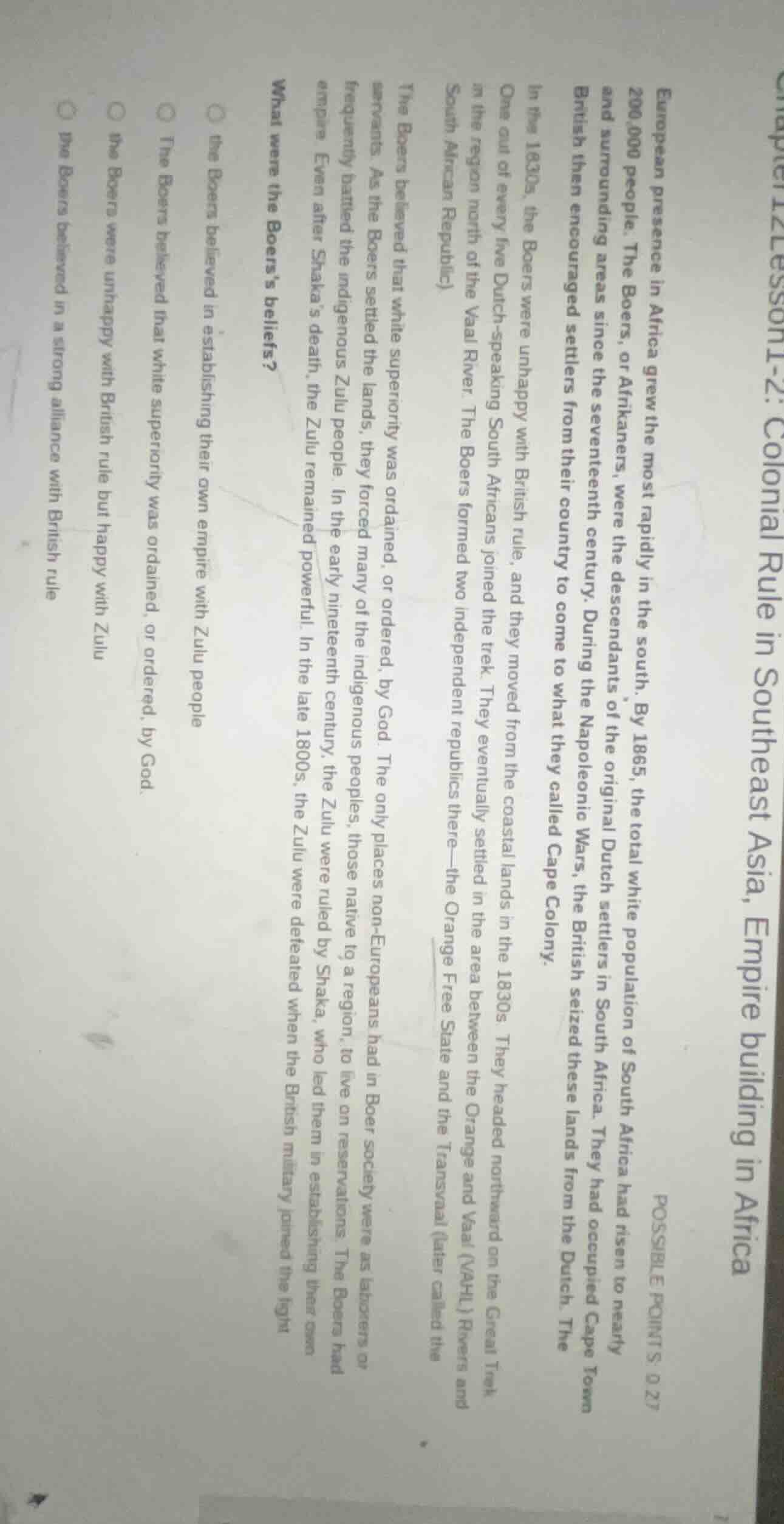
european presence in africa grew the most rapidly in the south. by 1865, the total white population of south africa had risen to nearly 200,000 people. the boers, or afrikaners, were the descendants of the original dutch settlers in south africa. they had occupied cape town and surrounding areas since the seventeenth century. during the napoleonic wars, the british seized these lands from the dutch. the british then encouraged settlers from their country to come to what they called cape colony.
in the 1830s, the boers were unhappy with british rule, and they moved from the coastal lands in the 1830s. they headed northward on the great trek in the region north of the vaal river. the boers formed two independent republics there—the orange free state and the transvaal (later called the south african republic)
the boers believed that white superiority was ordained, or ordered, by god. the only places non - europeans had in boer society were as laborers or servants. as the boers settled the lands, they forced many of the indigenous peoples, those native to a region, to live on reservations. the boers had an empire. even after shaka’s death, the zulu remained powerful. in the late 1800s, the zulu were defeated when the british military joined the fight.
what were the boers’s beliefs?
○ the boers believed in establishing their own empire with zulu people
○ the boers believed that white superiority was ordained, or ordered, by god.
○ the boers were unhappy with british rule but happy with zulu
○ the boers believed in a strong alliance with british rule
The text explicitly states the Boers' core belief about white superiority being ordained by God, while other options are incorrect: the Boers fought the Zulu (so no alliance/empire with them) and were unhappy with British rule, not happy.

Snap & solve any problem in the app
Get step-by-step solutions on Sovi AI
Photo-based solutions with guided steps
Explore more problems and detailed explanations
The Boers believed that white superiority was ordained, or ordered, by God.