QUESTION IMAGE
Question
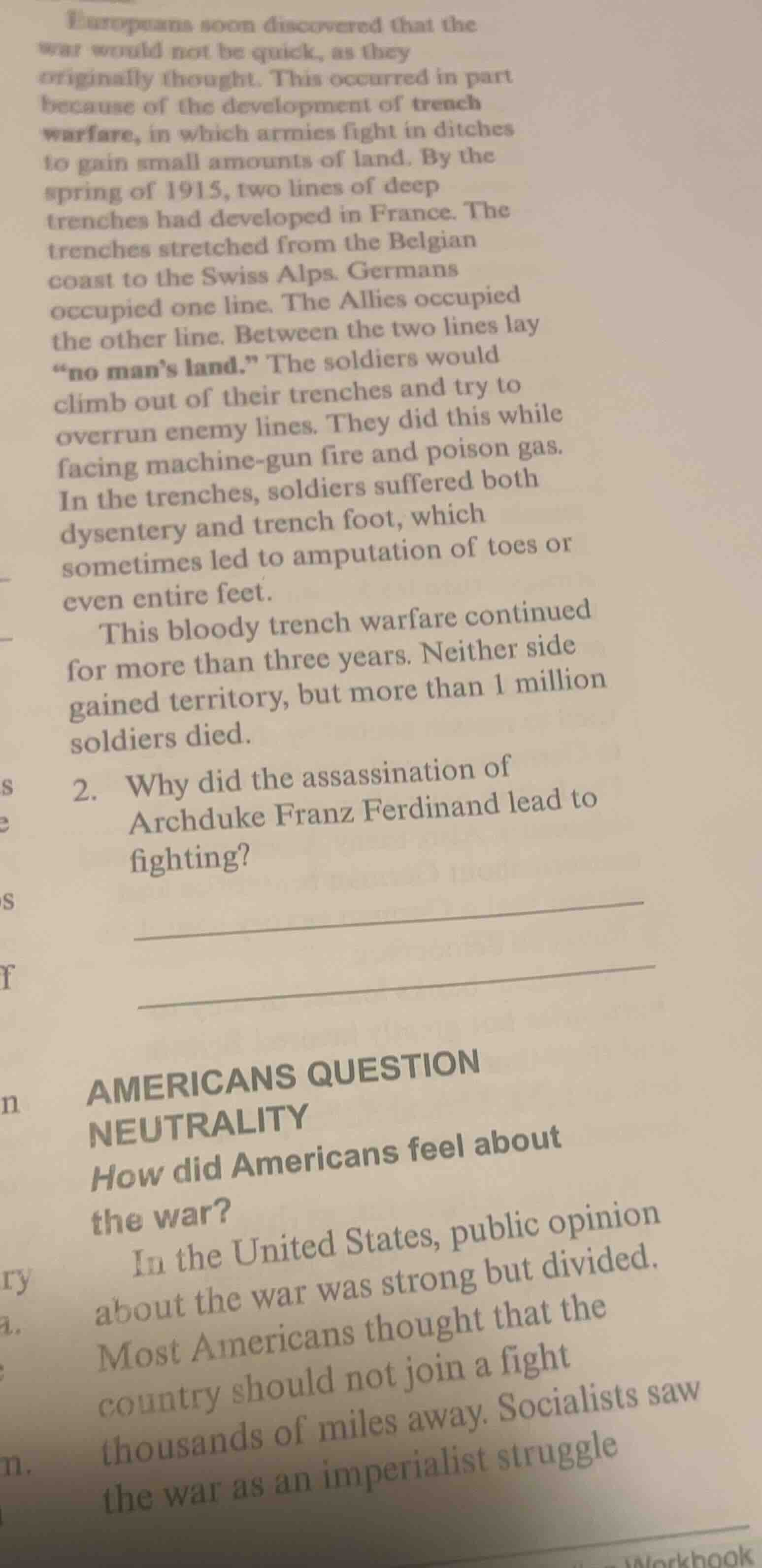
europeans soon discovered that the war would not be quick, as they originally thought. this occurred in part because of the development of trench warfare, in which armies fight in ditches to gain small amounts of land. by the spring of 1915, two lines of deep trenches had developed in france. the trenches stretched from the belgian coast to the swiss alps. germans occupied one line. the allies occupied the other line. between the two lines lay
o mans land.\ the soldiers would climb out of their trenches and try to overrun enemy lines. they did this while facing machine-gun fire and poison gas. in the trenches, soldiers suffered both dysentery and trench foot, which sometimes led to amputation of toes or even entire feet.
this bloody trench warfare continued for more than three years. neither side gained territory, but more than 1 million soldiers died.
- why did the assassination of archduke franz ferdinand lead to fighting?
americans question neutrality
how did americans feel about the war?
in the united states, public opinion about the war was strong but divided. most americans thought that the country should not join a fight thousands of miles away. socialists saw the war as an imperialist struggle
The assassination of Archduke Franz Ferdinand was the immediate trigger, but the fighting escalated because of pre-WWI European alliance systems. Austria-Hungary blamed Serbia for the assassination and declared war; then mutual defense pacts pulled in other major powers (like Russia, Germany, France, and Britain) into the conflict, turning a regional crisis into a full-scale war.

Snap & solve any problem in the app
Get step-by-step solutions on Sovi AI
Photo-based solutions with guided steps
Explore more problems and detailed explanations
The assassination triggered war because of Europe's complex pre-war alliance system: Austria-Hungary declared war on Serbia, and allied nations were obligated to join their respective allies, quickly expanding the conflict into a large-scale European war.