QUESTION IMAGE
Question
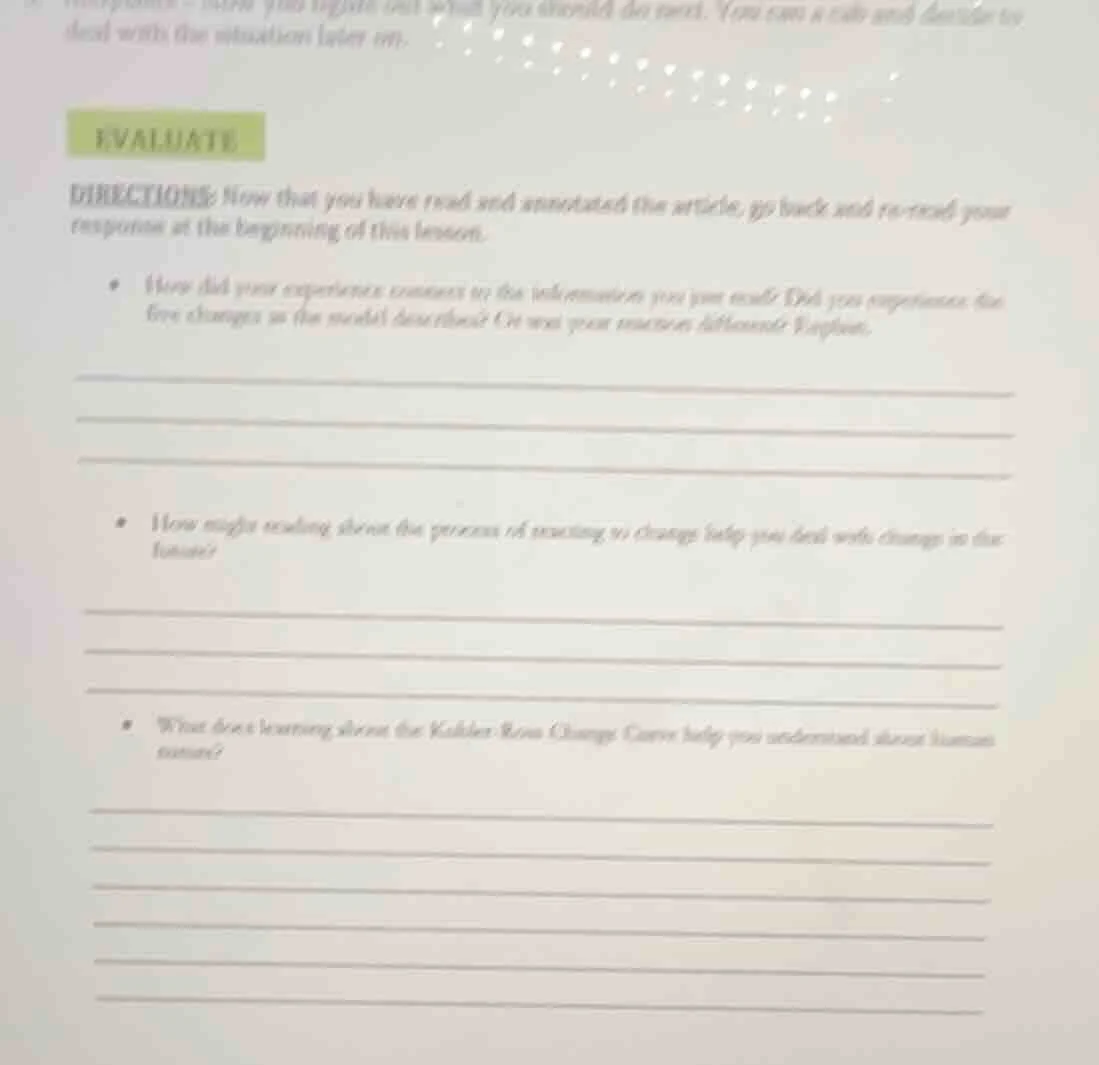
evaluate directions: now that you have read and annotated the article, go back and re - read your response at the beginning of this lesson. - how did your experience connect to the information you just read? did you experience the five changes in the model described? or was your reaction different? explain. - how might reading about the process of reacting to change help you deal with change in the future? - what does learning about the kubler - ross change curve help you understand about human nature?
Brief Explanations
- For the first question: You need to draw a direct link between a personal change experience (like a move, job shift, or loss) and the Kubler-Ross model's stages (denial, anger, bargaining, depression, acceptance). Explain if you moved through these stages in order, skipped some, or experienced them out of sequence, with a short example of one stage you faced.
- For the second question: Focus on how foreknowledge of the emotional stages of change lets you recognize when you're in a reactive phase, reduce self-criticism, and intentionally take steps to move toward acceptance instead of feeling overwhelmed by unrecognized emotions.
- For the third question: Highlight that the model shows emotional responses to change are universal, predictable, and non-linear; it demonstrates that grief and emotional upheaval are natural human reactions to loss or disruption, not personal failures.

Snap & solve any problem in the app
Get step-by-step solutions on Sovi AI
Photo-based solutions with guided steps
Explore more problems and detailed explanations
- When I moved across the country for college, I followed the model closely: first I felt denial ("This won't feel real for weeks"), then anger at leaving my friends, then bargaining ("What if I transfer after a semester?"), then brief sadness about missing family events, and finally acceptance as I settled into my new routine. I did not skip any stages, though I spent more time in anger than the model might outline for some people.
- Reading about this process will help me recognize when I'm in an early emotional stage of a future change (like a new job) instead of feeling confused by my reactions. I can remind myself these feelings are temporary and take small steps to work toward acceptance, rather than getting stuck in frustration or denial.
- The Kubler-Ross Change Curve helps me understand that emotional responses to change and loss are a fundamental part of human nature—these predictable, often painful stages are not signs of weakness, but universal, adaptive reactions to disruption that show how deeply humans connect to their circumstances and routines.