QUESTION IMAGE
Question
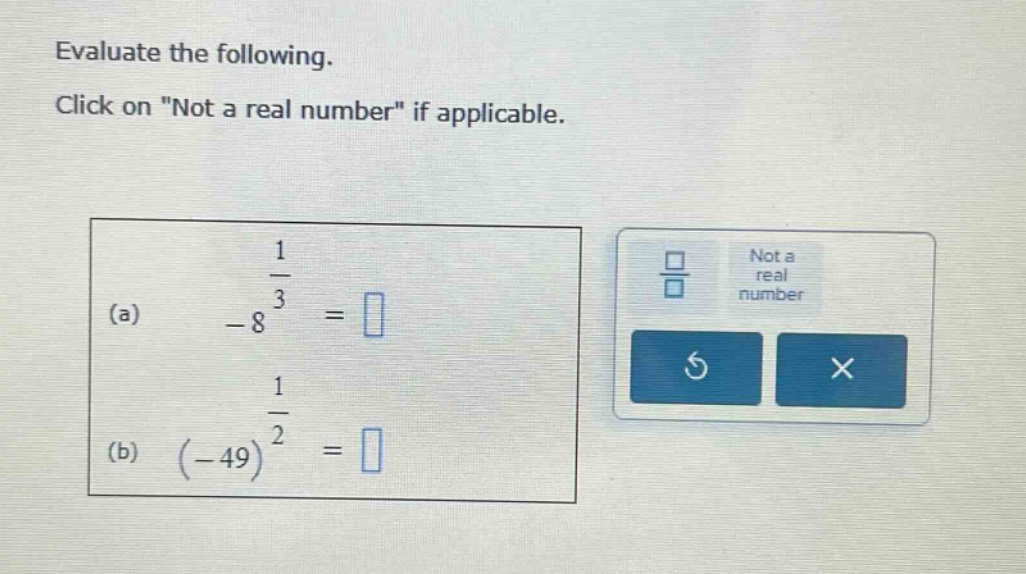
evaluate the following.
click on
ot a real number\ if applicable.
(a) (-8^{\frac{1}{3}} = square)
(b) ((-49)^{\frac{1}{2}} = square)
Response
Part (a)
Step1: Recall the exponent rule \(a^{\frac{1}{n}}=\sqrt[n]{a}\)
So, \(-8^{\frac{1}{3}}=-\sqrt[3]{8}\)
Step2: Calculate the cube root of 8
We know that \(2\times2\times2 = 8\), so \(\sqrt[3]{8}=2\)
Thus, \(-\sqrt[3]{8}=- 2\)
Step1: Recall the exponent rule \(a^{\frac{1}{n}}=\sqrt[n]{a}\)
So, \((-49)^{\frac{1}{2}}=\sqrt{-49}\)
Step2: Analyze the square root of a negative number
In the set of real numbers, the square root of a negative number is not defined because for any real number \(x\), \(x^{2}\geq0\). So \(\sqrt{-49}\) is not a real number.

Snap & solve any problem in the app
Get step-by-step solutions on Sovi AI
Photo-based solutions with guided steps
Explore more problems and detailed explanations
\(-2\)