QUESTION IMAGE
Question
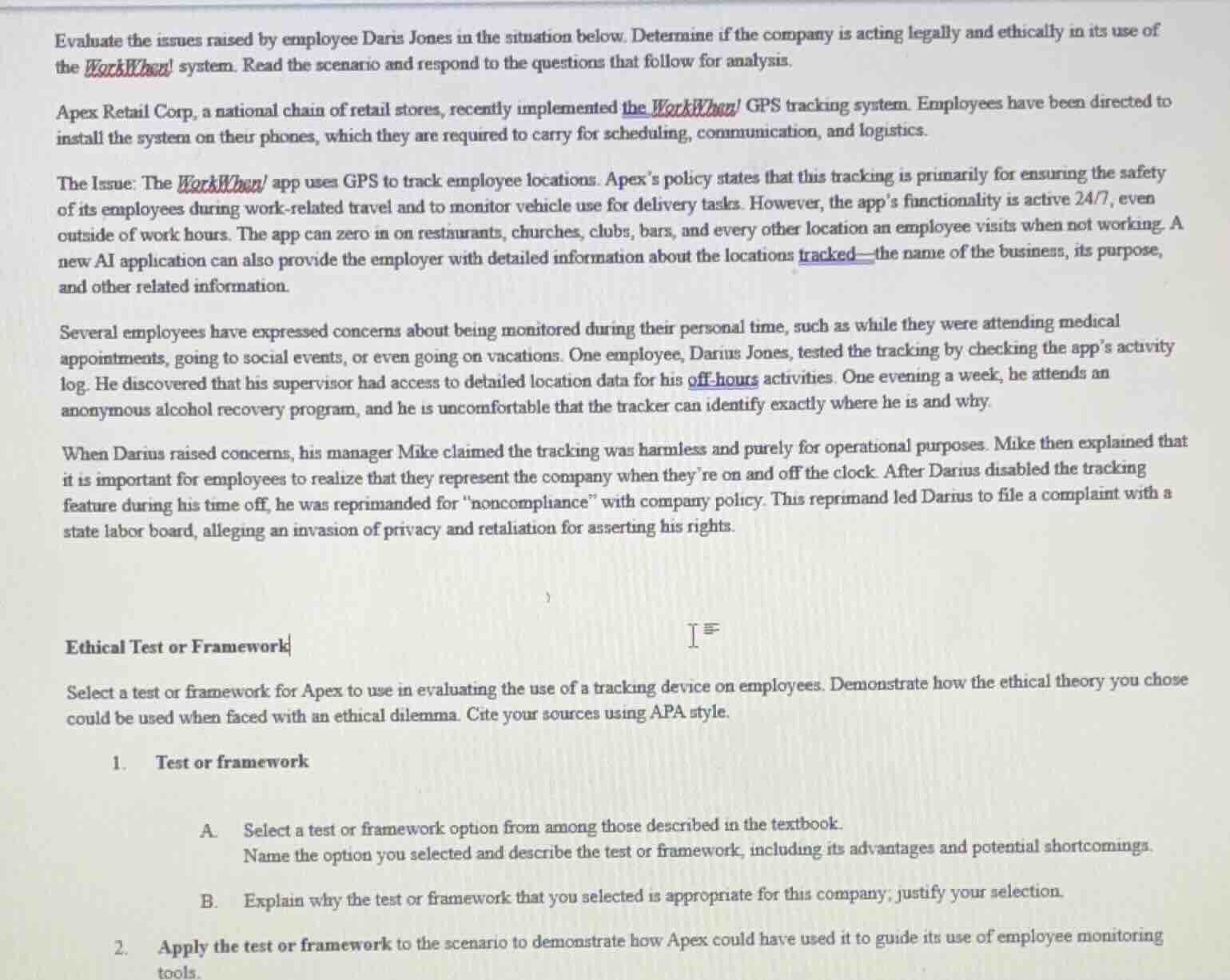
evaluate the issues raised by employee darius jones in the situation below. determine if the company is acting legally and ethically in its use of the workwhen! system. read the scenario and respond to the questions that follow for analysis. apex retail corp, a national chain of retail stores, recently implemented the workwhen! gps tracking system. employees have been directed to install the system on their phones, which they are required to carry for scheduling, communication, and logistics. the issue: the workwhen! app uses gps to track employee locations. apex’s policy states that this tracking is primarily for ensuring the safety of its employees during work - related travel and to monitor vehicle use for delivery tasks. however, the app’s functionality is active 24/7, even outside of work hours. the app can zero in on restaurants, churches, clubs, bars, and every other location an employee visits when not working. a new ai application can also provide the employer with detailed information about the locations tracked—the name of the business, its purpose, and other related information. several employees have expressed concerns about being monitored during their personal time, such as while they were attending medical appointments, going to social events, or even going on vacations. one employee, darius jones, tested the tracking by checking the app’s activity log. he discovered that his supervisor had access to detailed location data for his off - hours activities. one evening a week, he attends an anonymous alcohol recovery program, and he is uncomfortable that the tracker can identify exactly where he is and why. when darius raised concerns, his manager mike claimed the tracking was harmless and purely for operational purposes. mike then explained that it is important for employees to realize that they represent the company when they’re on and off the clock. after darius disabled the tracking feature during his time off, he was reprimanded for “noncompliance” with company policy. this reprimand led darius to file a complaint with a state labor board, alleging an invasion of privacy and retaliation for asserting his rights. ethical test or framework select a test or framework for apex to use in evaluating the use of a tracking device on employees. demonstrate how the ethical theory you chose could be used when faced with an ethical dilemma. cite your sources using apa style. 1. test or framework a. select a test or framework option from among those described in the textbook. name the option you selected and describe the test or framework, including its advantages and potential shortcomings. b. explain why the test or framework that you selected is appropriate for this company; justify your selection. 2. apply the test or framework to the scenario to demonstrate how apex could have used it to guide its use of employee monitoring tools.
Part 1: Test or Framework Selection (Sub - Question 1A and 1B)
1A
Let's choose the Utilitarianism framework. Utilitarianism is an ethical theory that focuses on maximizing overall happiness or utility (pleasure, well - being) and minimizing pain or harm for the greatest number of people (Bentham, 1789; Mill, 1863).
- Advantages:
- It provides a clear, quantifiable - looking approach to ethical decision - making. By considering the costs and benefits (in terms of happiness or harm) for all stakeholders (employees, the company, customers, etc.), it can help in making decisions that have the best overall outcome. For example, in a business context, it can balance the company's operational needs with the employees' privacy concerns by looking at which option (tracking or not tracking, or tracking with limitations) brings the most net benefit.
- It is outcome - oriented, which is useful for businesses as they often need to consider the practical results of their actions.
- Potential Shortcomings:
- It can be difficult to measure and compare different types of happiness or harm. For instance, how do we compare the company's operational efficiency (a form of benefit for the company) with an employee's loss of privacy (a form of harm for the employee)?
- It may ignore individual rights in the pursuit of the greater good. In this case, even if tracking employees 24/7 brings some overall benefit to the company (like better logistics management), it may violate employees' right to privacy.
1B
Utilitarianism is appropriate for Apex for the following reasons:
- Apex has multiple stakeholders: employees (who have privacy concerns), the company (which has operational needs like ensuring safety during work - related travel and monitoring vehicle use for deliveries), and potentially customers (who may be affected by the company's operational efficiency). Utilitarianism can help balance these different interests by looking at the overall impact of the tracking system on all these groups.
- The ethical dilemma here is about whether the benefits of the tracking system (operational efficiency, safety) outweigh the harms (invasion of privacy, employee dissatisfaction). Utilitarianism's focus on maximizing net utility is well - suited to this kind of cost - benefit analysis of the tracking system.
Part 2: Applying the Framework to the Scenario
To apply utilitarianism to the scenario of Apex's employee monitoring:
- Identify Stakeholders and Their Interests:
- Employees: Their interest is in having privacy during off - hours, not being monitored in their personal lives (like when attending medical appointments, social events, or recovery programs). The harm they face is the invasion of privacy, which can cause stress, discomfort, and a feeling of being unduly controlled.
- Apex Retail Corp.: The company's interests are operational efficiency (monitoring vehicle use for deliveries, ensuring employee safety during work - related travel), and potentially maintaining a positive corporate image. The benefit here is better logistics, improved safety, and (they claim) ensuring employees represent the company well.
- Customers: Their interest is in receiving products in a timely and safe manner. If the tracking system improves delivery efficiency, customers benefit; however, if the tracking system causes employee dissatisfaction which leads to poor customer service, customers may be harmed.
- Assess Costs and Benefits for Each Stakeholder:
- For Employees (Costs): The cost…

Snap & solve any problem in the app
Get step-by-step solutions on Sovi AI
Photo-based solutions with guided steps
Explore more problems and detailed explanations
s
1A
Test or framework: Utilitarianism. Description: An ethical theory focused on maximizing overall happiness/utility and minimizing harm for the greatest number. Advantages: Outcome - oriented, helps balance stakeholder interests. Shortcomings: Difficult to measure harm/happiness, may ignore individual rights.
1B
Justification: Apex has multiple stakeholders (employees, company, customers). Utilitarianism can balance their interests by analyzing net utility of tracking options, suitable for outcome - focused business decisions.
2
Apex should analyze net utility of options (24/7 tracking, work - hour only tracking, no tracking). Option with work - hour only tracking has higher net utility (employee satisfaction, reduced legal risks, maintained work - related efficiency). So, Apex should track only during work hours to guide its monitoring tool use.