QUESTION IMAGE
Question
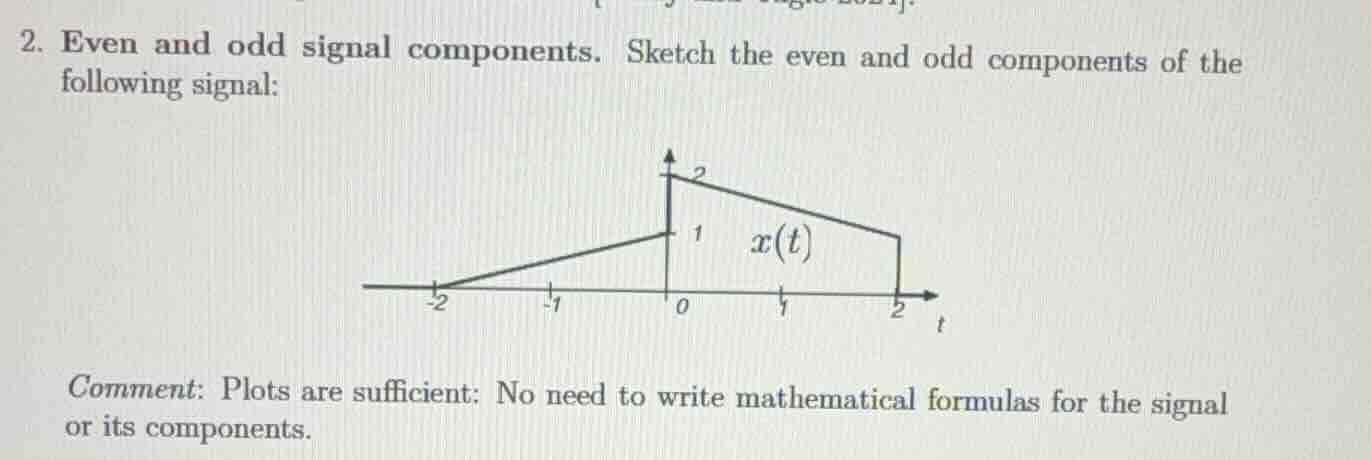
- even and odd signal components. sketch the even and odd components of the following signal:
comment: plots are sufficient: no need to write mathematical formulas for the signal or its components.
Step1: Recall even component formula
The even component of a signal $x(t)$ is given by:
$$x_e(t) = \frac{x(t) + x(-t)}{2}$$
Step2: Recall odd component formula
The odd component of a signal $x(t)$ is given by:
$$x_o(t) = \frac{x(t) - x(-t)}{2}$$
Step3: Generate $x(-t)$
Reflect $x(t)$ across the vertical axis ($t=0$):
- For $t \in [-2,0]$, $x(-t)$ is the mirror of $x(t)$ for $t \in [0,2]$: it starts at 1 when $t=-2$, rises linearly to 2 at $t=0$.
- For $t \in [0,2]$, $x(-t)$ is the mirror of $x(t)$ for $t \in [-2,0]$: it starts at 1 when $t=2$, rises linearly to 2 at $t=0$.
Step4: Compute $x_e(t)$
Average $x(t)$ and $x(-t)$:
- For $t \in [-2,0]$: $x_e(t)$ is the average of the rising line from 0 (at $t=-2$) to 1 (at $t=0$) and the falling line from 2 (at $t=0$) to 1 (at $t=-2$), resulting in a flat line at $\frac{0+1}{2}=0.5$ from $t=-2$ to $t=0$, rising linearly to $\frac{1+2}{2}=1.5$ at $t=0$.
- For $t \in [0,2]$: $x_e(t)$ is symmetric to the left side, a falling line from 1.5 (at $t=0$) to 0.5 (at $t=2$).
Step5: Compute $x_o(t)$
Subtract $x(-t)$ from $x(t)$, then divide by 2:
- For $t \in [-2,0]$: $x_o(t)$ is the difference of the rising line from 0 (at $t=-2$) to 1 (at $t=0$) and the falling line from 2 (at $t=0$) to 1 (at $t=-2$), divided by 2: a rising line from $\frac{0-1}{2}=-0.5$ (at $t=-2$) to $\frac{1-2}{2}=-0.5$? No, correction: at $t=-2$, $x(-2)=1$, $x(2)=1$, so $x_o(-2)=\frac{0-1}{2}=-0.5$; at $t=0$, $x(0)=1$, $x(-0)=1$, so $x_o(0)=\frac{1-1}{2}=0$. So it's a rising line from $-0.5$ (at $t=-2$) to $0$ (at $t=0$).
- For $t \in [0,2]$: $x_o(t)$ is symmetric to the left side, a falling line from $0$ (at $t=0$) to $0.5$ (at $t=2$)? No, correction: at $t=2$, $x(2)=1$, $x(-2)=0$, so $x_o(2)=\frac{1-0}{2}=0.5$; at $t=0$, $x_o(0)=0$. So it's a falling line from $0$ (at $t=0$) to $0.5$ (at $t=2$).

Snap & solve any problem in the app
Get step-by-step solutions on Sovi AI
Photo-based solutions with guided steps
Explore more problems and detailed explanations
Even Component ($x_e(t)$):
- A symmetric signal about $t=0$, starting at $0.5$ when $t=-2$, rising linearly to $1.5$ at $t=0$, then falling linearly back to $0.5$ at $t=2$.
Odd Component ($x_o(t)$):
- An antisymmetric signal about $t=0$, starting at $-0.5$ when $t=-2$, rising linearly to $0$ at $t=0$, then rising linearly to $0.5$ at $t=2$ (mirror of the left side across the origin).
(Note: The final answer is the sketched signals as described above, symmetric for the even component and antisymmetric for the odd component.)