QUESTION IMAGE
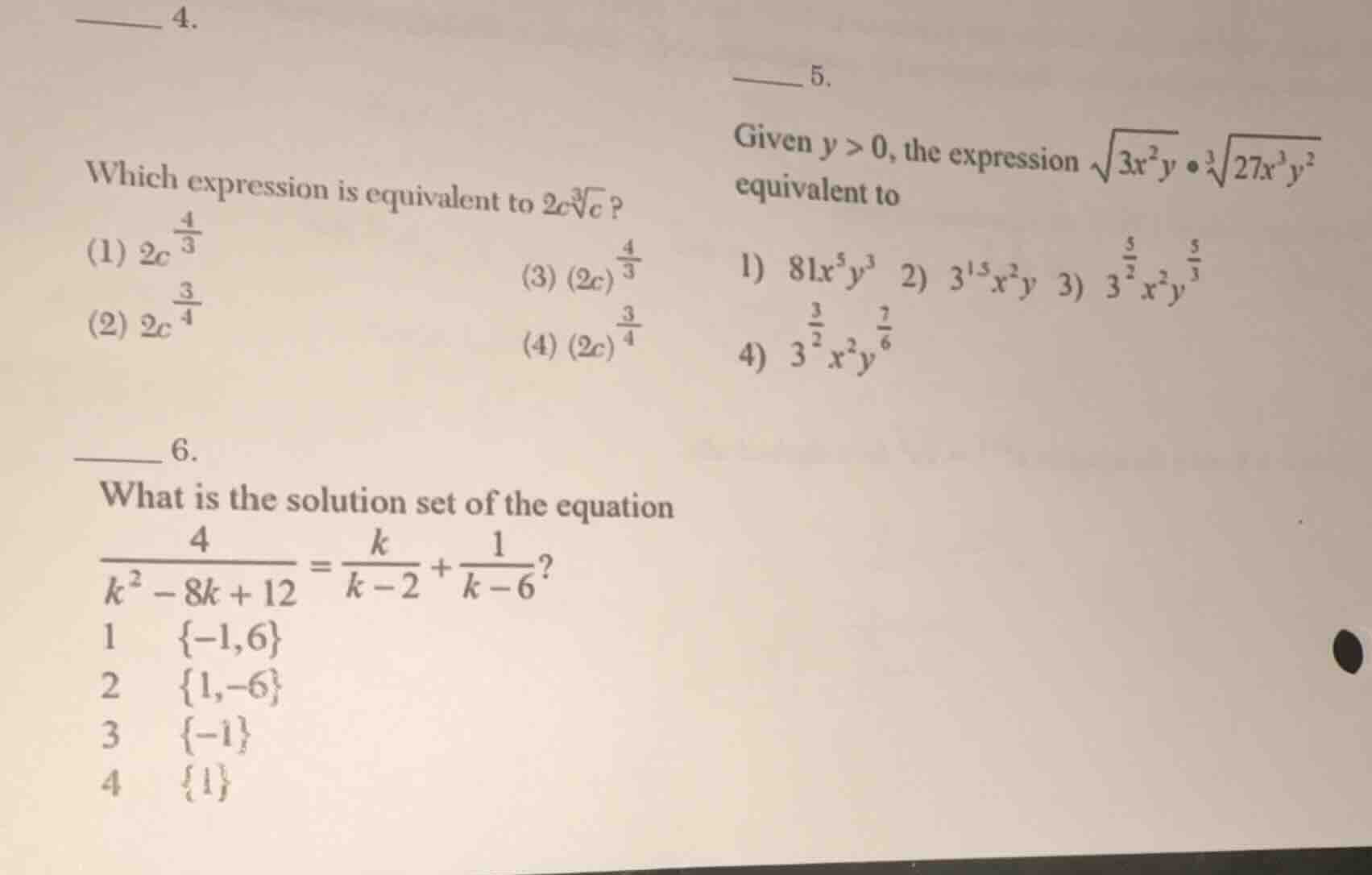
Question
4.\
ewline which expression is equivalent to $2c\sqrt3{c}$?\
ewline (1) $2c^{\frac{4}{3}}$\
ewline (2) $2c^{\frac{3}{4}}$\
ewline (3) $(2c)^{\frac{4}{3}}$\
ewline (4) $(2c)^{\frac{3}{4}}$\
ewline \
ewline 5.\
ewline given $y > 0$, the expression $\sqrt{3x^{2}y} \bullet \sqrt3{27x^{3}y^{2}}$ equivalent to\
ewline 1) $81x^{5}y^{3}$ 2) $3^{1.5}x^{2}y$ 3) $3^{\frac{5}{2}}x^{2}y^{\frac{5}{3}}$\
ewline 4) $3^{\frac{3}{2}}x^{2}y^{\frac{7}{6}}$\
ewline \
ewline 6.\
ewline what is the solution set of the equation\
ewline $\frac{4}{k^{2} - 8k + 12} = \frac{k}{k - 2} + \frac{1}{k - 6}$?\
ewline 1 \\{$-1, 6$\\}\
ewline 2 \\{$1, -6$\\}\
ewline 3 \\{$-1$\\}\
ewline 4 \\{$1$\\}
Question 4
Step1: Rewrite the radical as exponent
Recall that $\sqrt[n]{a}=a^{\frac{1}{n}}$. So $\sqrt[3]{c}=c^{\frac{1}{3}}$.
The given expression is $2c\sqrt[3]{c}=2c\times c^{\frac{1}{3}}$.
Step2: Use exponent rule $a^m\times a^n = a^{m + n}$
For the variable $c$, we have $c^1\times c^{\frac{1}{3}}=c^{1+\frac{1}{3}}=c^{\frac{4}{3}}$.
So the expression $2c\sqrt[3]{c}$ becomes $2c^{\frac{4}{3}}$.
Step1: Rewrite radicals as exponents
Recall that $\sqrt{a}=a^{\frac{1}{2}}$ and $\sqrt[3]{a}=a^{\frac{1}{3}}$.
So $\sqrt{3x^{2}y}=(3x^{2}y)^{\frac{1}{2}}$ and $\sqrt[3]{27x^{3}y^{2}}=(27x^{3}y^{2})^{\frac{1}{3}}$.
The given expression is $(3x^{2}y)^{\frac{1}{2}}\cdot(27x^{3}y^{2})^{\frac{1}{3}}$.
Step2: Simplify each term using exponent rules $(ab)^n=a^n b^n$ and $(a^m)^n=a^{mn}$
For $(3x^{2}y)^{\frac{1}{2}}$:
$3^{\frac{1}{2}}x^{2\times\frac{1}{2}}y^{\frac{1}{2}} = 3^{\frac{1}{2}}x^{1}y^{\frac{1}{2}}$
For $(27x^{3}y^{2})^{\frac{1}{3}}$:
Since $27 = 3^{3}$, we have $(3^{3})^{\frac{1}{3}}x^{3\times\frac{1}{3}}y^{2\times\frac{1}{3}}=3^{1}x^{1}y^{\frac{2}{3}}$
Step3: Multiply the two simplified terms
Multiply the coefficients, $x$ terms, and $y$ terms separately.
Coefficients: $3^{\frac{1}{2}}\times3^{1}=3^{\frac{1}{2}+1}=3^{\frac{3}{2}}$
$x$ terms: $x^{1}\times x^{1}=x^{1 + 1}=x^{2}$
$y$ terms: $y^{\frac{1}{2}}\times y^{\frac{2}{3}}=y^{\frac{1}{2}+\frac{2}{3}}=y^{\frac{3 + 4}{6}}=y^{\frac{7}{6}}$? Wait, no, wait: $\frac{1}{2}+\frac{2}{3}=\frac{3 + 4}{6}$? Wait, $\frac{1}{2}=\frac{3}{6}$ and $\frac{2}{3}=\frac{4}{6}$, so $\frac{3+4}{6}=\frac{7}{6}$? Wait, but let's check the options. Wait, option 4 is $3^{\frac{3}{2}}x^{2}y^{\frac{7}{6}}$. Wait, but let's re - check the steps.
Wait, original expression: $\sqrt{3x^{2}y}\cdot\sqrt[3]{27x^{3}y^{2}}$
First, $\sqrt{3x^{2}y}=3^{\frac{1}{2}}x^{2\times\frac{1}{2}}y^{\frac{1}{2}}=3^{\frac{1}{2}}x^{1}y^{\frac{1}{2}}$
Second, $\sqrt[3]{27x^{3}y^{2}}=(3^{3})^{\frac{1}{3}}x^{3\times\frac{1}{3}}y^{2\times\frac{1}{3}}=3^{1}x^{1}y^{\frac{2}{3}}$
Now, multiply the two:
$3^{\frac{1}{2}}\times3^{1}=3^{\frac{1}{2}+1}=3^{\frac{3}{2}}$
$x^{1}\times x^{1}=x^{2}$
$y^{\frac{1}{2}}\times y^{\frac{2}{3}}=y^{\frac{1}{2}+\frac{2}{3}}=y^{\frac{3 + 4}{6}}=y^{\frac{7}{6}}$
So the product is $3^{\frac{3}{2}}x^{2}y^{\frac{7}{6}}$, which is option 4.
Step1: Factor the denominator on the left - hand side
Factor $k^{2}-8k + 12$. We need two numbers that multiply to 12 and add to - 8. The numbers are - 2 and - 6. So $k^{2}-8k + 12=(k - 2)(k - 6)$
The equation is $\frac{4}{(k - 2)(k - 6)}=\frac{k}{k - 2}+\frac{1}{k - 6}$
Step2: Multiply each term by the least common denominator (LCD)
The LCD of $(k - 2)(k - 6)$, $(k - 2)$ and $(k - 6)$ is $(k - 2)(k - 6)$. Multiply each term by $(k - 2)(k - 6)$:
$4=k(k - 6)+1(k - 2)$
Step3: Expand and simplify the right - hand side
Expand $k(k - 6)+(k - 2)$: $k^{2}-6k + k-2=k^{2}-5k - 2$
So the equation becomes $4=k^{2}-5k - 2$
Step4: Rearrange the equation to standard quadratic form
Subtract 4 from both sides: $k^{2}-5k-6 = 0$
Step5: Factor the quadratic equation
Factor $k^{2}-5k - 6$. We need two numbers that multiply to - 6 and add to - 5. The numbers are - 6 and 1. So $(k - 6)(k + 1)=0$
Step6: Solve for k
Set each factor equal to zero:
$k - 6=0$ gives $k = 6$; $k+1=0$ gives $k=-1$
Step7: Check for extraneous solutions
We need to check if these solutions make the original denominators zero.
For $k = 6$: The denominators $(k - 2)(k - 6)$ and $(k - 6)$ become zero. So $k = 6$ is an extraneous solution.
For $k=-1$: The denominators $(k - 2)(k - 6)=(-1 - 2)(-1 - 6)=(-3)\times(-7)=21
eq0$, $(k - 2)=-3
eq0$, $(k - 6)=-7
eq0$. So $k=-1$ is a valid solution.
So the solution set is $\{-1\}$

Snap & solve any problem in the app
Get step-by-step solutions on Sovi AI
Photo-based solutions with guided steps
Explore more problems and detailed explanations
(1) $2c^{\frac{4}{3}}$