QUESTION IMAGE
Question
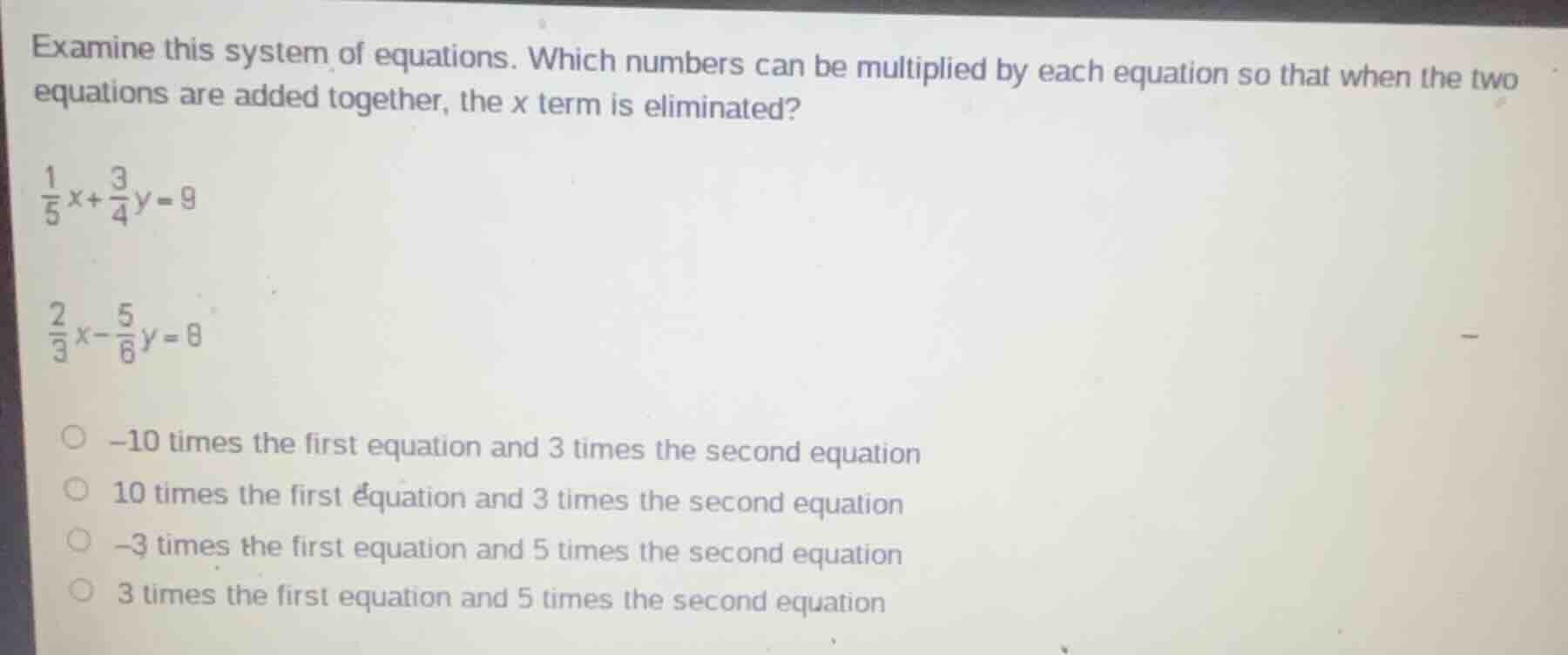
examine this system of equations. which numbers can be multiplied by each equation so that when the two equations are added together, the x term is eliminated?
\\(\frac{1}{5}x + \frac{3}{4}y = 9\\)
\\(\frac{2}{3}x - \frac{5}{6}y = 8\\)
\\(\circ\\) \\(-10\\) times the first equation and 3 times the second equation
\\(\circ\\) 10 times the first equation and 3 times the second equation
\\(\circ\\) \\(-3\\) times the first equation and 5 times the second equation
\\(\circ\\) 3 times the first equation and 5 times the second equation
Step1: Identify x coefficients
First equation x-term: $\frac{1}{5}$; Second equation x-term: $\frac{2}{3}$
Step2: Find opposite multiples
We need $k_1 \cdot \frac{1}{5} + k_2 \cdot \frac{2}{3} = 0$, so $k_1 \cdot \frac{1}{5} = -k_2 \cdot \frac{2}{3}$. Test option: $k_1=-10$, $k_2=3$:
$-10 \cdot \frac{1}{5} + 3 \cdot \frac{2}{3} = -2 + 2 = 0$
Step3: Verify elimination
Adding the modified equations eliminates x-term.

Snap & solve any problem in the app
Get step-by-step solutions on Sovi AI
Photo-based solutions with guided steps
Explore more problems and detailed explanations
-10 times the first equation and 3 times the second equation