QUESTION IMAGE
Question
example 2: determine whether each pair of figures is similar. if so, find the scale factor. explain your reasoning.
4.
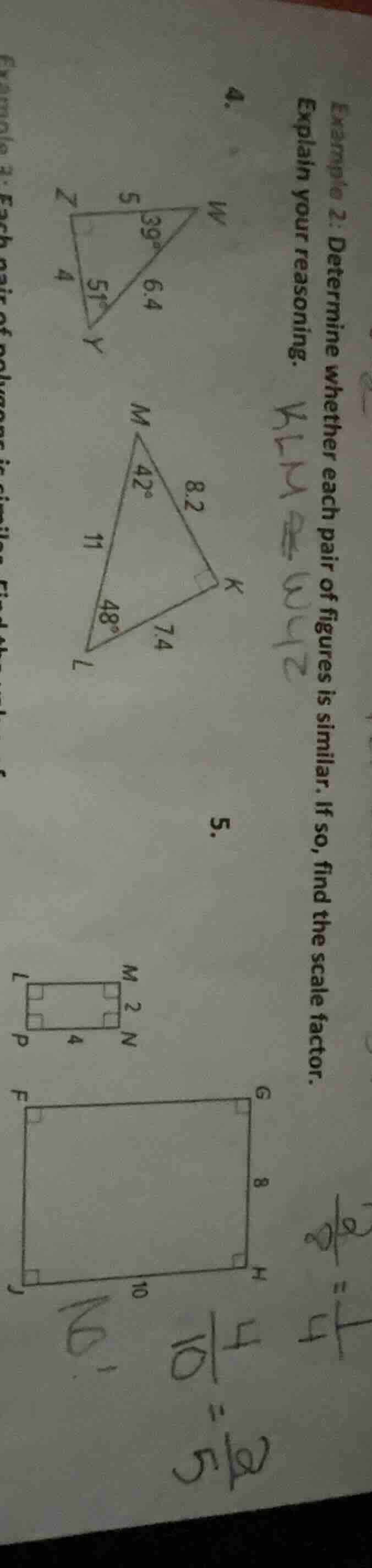
(first triangle: vertices w, z, y; sides wz=5, zy=4, wy=6.4; angles at w: 39°, at y: 51°; right angle at z?
second triangle: vertices m, k, l; right angle at k; sides mk=8.2, kl=7.4, ml=11; angles at m: 42°, at l: 48°)
5.
(first rectangle: vertices l, p, n, m; sides mn=2, pn=4;
second rectangle: vertices f, j, h, g; sides gh=8, hj=10;)
Problem 4: Triangles \( \triangle WYZ \) and \( \triangle KLM \) Similarity Check
Step 1: Analyze Angles in \( \triangle WYZ \)
In \( \triangle WYZ \), we know two angles: \( \angle W = 39^\circ \), \( \angle Y = 51^\circ \). The sum of angles in a triangle is \( 180^\circ \), so \( \angle Z = 180^\circ - 39^\circ - 51^\circ = 90^\circ \). So \( \triangle WYZ \) is a right triangle (right-angled at \( Z \)) with angles \( 39^\circ \), \( 51^\circ \), \( 90^\circ \).
Step 2: Analyze Angles in \( \triangle KLM \)
In \( \triangle KLM \), we know \( \angle M = 42^\circ \), \( \angle L = 48^\circ \). The sum of angles is \( 180^\circ \), so \( \angle K = 180^\circ - 42^\circ - 48^\circ = 90^\circ \). So \( \triangle KLM \) is a right triangle (right-angled at \( K \)) with angles \( 42^\circ \), \( 48^\circ \), \( 90^\circ \).
Step 3: Compare Angle Measures
For two triangles to be similar, their corresponding angles must be equal. Let's list the angles:
- \( \triangle WYZ \): \( 39^\circ \), \( 51^\circ \), \( 90^\circ \)
- \( \triangle KLM \): \( 42^\circ \), \( 48^\circ \), \( 90^\circ \)
The non-right angles are \( 39^\circ \) vs. \( 42^\circ \), and \( 51^\circ \) vs. \( 48^\circ \). These are not equal. So the angle measures do not match, meaning the triangles are not similar.
Problem 5: Rectangles (Quadrilaterals) Similarity Check
Step 1: Recall Similarity for Rectangles
Rectangles have all angles equal (all \( 90^\circ \)), so similarity depends on the ratios of corresponding sides being equal (since angles are already congruent, we just need proportional sides).
Step 2: Identify Side Lengths
Let's denote the first rectangle (smaller) as \( LMNP \) (from the diagram: \( MN = 2 \), \( NP = 4 \)) and the second rectangle (larger) as \( GHJF \) (from the diagram: \( GH = 8 \), \( HJ = 10 \))? Wait, wait—wait, looking at the diagram: the smaller rectangle has sides \( 2 \) (vertical) and \( 4 \) (horizontal). The larger rectangle has sides \( 8 \) (vertical) and \( 10 \) (horizontal)? Wait, no—wait, maybe I misread. Wait, the smaller rectangle: \( MN = 2 \), \( NP = 4 \). The larger rectangle: \( GH = 8 \), \( HJ = 10 \)? Wait, no, let's check the ratios.
Wait, actually, let's get the sides right. Let's assume the first rectangle (top) has length \( 4 \) and width \( 2 \) (so sides \( 2 \) and \( 4 \)). The second rectangle (bottom) has length \( 10 \) and width \( 8 \) (sides \( 8 \) and \( 10 \))? Wait, no—wait, the smaller rectangle: vertical side \( 2 \), horizontal side \( 4 \). The larger rectangle: vertical side \( 8 \), horizontal side \( 10 \). Wait, no, maybe the smaller is \( 2 \) (height) and \( 4 \) (length), larger is \( 8 \) (height) and \( 10 \) (length)? Wait, no, let's compute the ratios of corresponding sides.
Wait, actually, let's define the rectangles:
- Rectangle 1: Let’s say length \( l_1 = 4 \), width \( w_1 = 2 \) (so sides \( 2 \) and \( 4 \))
- Rectangle 2: length \( l_2 = 10 \), width \( w_2 = 8 \) (so sides \( 8 \) and \( 10 \))
Wait, no—wait, maybe the smaller rectangle has sides \( 2 \) (vertical) and \( 4 \) (horizontal), and the larger has sides \( 8 \) (vertical) and \( 10 \) (horizontal). Wait, no, let's check the ratios of length to width for each rectangle.
For Rectangle 1: \( \frac{\text{length}}{\text{width}} = \frac{4}{2} = 2 \)
For Rectangle 2: \( \frac{\text{length}}{\text{width}} = \frac{10}{8} = \frac{5}{4} = 1.25 \)
Wait, that can't be. Wait, maybe I mixed up the sides. Wait, maybe the smaller rectangle is \( 2 \) (vertical) and \( 4 \) (horizonta…

Snap & solve any problem in the app
Get step-by-step solutions on Sovi AI
Photo-based solutions with guided steps
Explore more problems and detailed explanations
Problem 4: Triangles \( \triangle WYZ \) and \( \triangle KLM \) Similarity Check
Step 1: Analyze Angles in \( \triangle WYZ \)
In \( \triangle WYZ \), we know two angles: \( \angle W = 39^\circ \), \( \angle Y = 51^\circ \). The sum of angles in a triangle is \( 180^\circ \), so \( \angle Z = 180^\circ - 39^\circ - 51^\circ = 90^\circ \). So \( \triangle WYZ \) is a right triangle (right-angled at \( Z \)) with angles \( 39^\circ \), \( 51^\circ \), \( 90^\circ \).
Step 2: Analyze Angles in \( \triangle KLM \)
In \( \triangle KLM \), we know \( \angle M = 42^\circ \), \( \angle L = 48^\circ \). The sum of angles is \( 180^\circ \), so \( \angle K = 180^\circ - 42^\circ - 48^\circ = 90^\circ \). So \( \triangle KLM \) is a right triangle (right-angled at \( K \)) with angles \( 42^\circ \), \( 48^\circ \), \( 90^\circ \).
Step 3: Compare Angle Measures
For two triangles to be similar, their corresponding angles must be equal. Let's list the angles:
- \( \triangle WYZ \): \( 39^\circ \), \( 51^\circ \), \( 90^\circ \)
- \( \triangle KLM \): \( 42^\circ \), \( 48^\circ \), \( 90^\circ \)
The non-right angles are \( 39^\circ \) vs. \( 42^\circ \), and \( 51^\circ \) vs. \( 48^\circ \). These are not equal. So the angle measures do not match, meaning the triangles are not similar.
Problem 5: Rectangles (Quadrilaterals) Similarity Check
Step 1: Recall Similarity for Rectangles
Rectangles have all angles equal (all \( 90^\circ \)), so similarity depends on the ratios of corresponding sides being equal (since angles are already congruent, we just need proportional sides).
Step 2: Identify Side Lengths
Let's denote the first rectangle (smaller) as \( LMNP \) (from the diagram: \( MN = 2 \), \( NP = 4 \)) and the second rectangle (larger) as \( GHJF \) (from the diagram: \( GH = 8 \), \( HJ = 10 \))? Wait, wait—wait, looking at the diagram: the smaller rectangle has sides \( 2 \) (vertical) and \( 4 \) (horizontal). The larger rectangle has sides \( 8 \) (vertical) and \( 10 \) (horizontal)? Wait, no—wait, maybe I misread. Wait, the smaller rectangle: \( MN = 2 \), \( NP = 4 \). The larger rectangle: \( GH = 8 \), \( HJ = 10 \)? Wait, no, let's check the ratios.
Wait, actually, let's get the sides right. Let's assume the first rectangle (top) has length \( 4 \) and width \( 2 \) (so sides \( 2 \) and \( 4 \)). The second rectangle (bottom) has length \( 10 \) and width \( 8 \) (sides \( 8 \) and \( 10 \))? Wait, no—wait, the smaller rectangle: vertical side \( 2 \), horizontal side \( 4 \). The larger rectangle: vertical side \( 8 \), horizontal side \( 10 \). Wait, no, maybe the smaller is \( 2 \) (height) and \( 4 \) (length), larger is \( 8 \) (height) and \( 10 \) (length)? Wait, no, let's compute the ratios of corresponding sides.
Wait, actually, let's define the rectangles:
- Rectangle 1: Let’s say length \( l_1 = 4 \), width \( w_1 = 2 \) (so sides \( 2 \) and \( 4 \))
- Rectangle 2: length \( l_2 = 10 \), width \( w_2 = 8 \) (so sides \( 8 \) and \( 10 \))
Wait, no—wait, maybe the smaller rectangle has sides \( 2 \) (vertical) and \( 4 \) (horizontal), and the larger has sides \( 8 \) (vertical) and \( 10 \) (horizontal). Wait, no, let's check the ratios of length to width for each rectangle.
For Rectangle 1: \( \frac{\text{length}}{\text{width}} = \frac{4}{2} = 2 \)
For Rectangle 2: \( \frac{\text{length}}{\text{width}} = \frac{10}{8} = \frac{5}{4} = 1.25 \)
Wait, that can't be. Wait, maybe I mixed up the sides. Wait, maybe the smaller rectangle is \( 2 \) (vertical) and \( 4 \) (horizontal), and the larger is \( 8 \) (vertical) and \( 10 \) (horizontal)? No, wait, maybe the smaller is \( 2 \) (height) and \( 4 \) (length), and the larger is \( 8 \) (height) and \( 10 \) (length)? Wait, no, let's check the other way: \( \frac{2}{8} = \frac{1}{4} \) and \( \frac{4}{10} = \frac{2}{5} \). These are not equal. Wait, maybe the sides are \( 2 \) and \( 4 \) for the first, and \( 8 \) and \( 10 \) for the second? Wait, no—wait, maybe the first rectangle has sides \( 2 \) (vertical) and \( 4 \) (horizontal), and the second has sides \( 8 \) (vertical) and \( 10 \) (horizontal). Wait, no, let's do it properly.
Wait, the first rectangle (top) has sides: let's say vertical side \( MN = 2 \), horizontal side \( NP = 4 \). The second rectangle (bottom) has vertical side \( GH = 8 \), horizontal side \( HJ = 10 \). Wait, no, maybe the first is \( 2 \) (height) and \( 4 \) (length), the second is \( 8 \) (height) and \( 10 \) (length). Wait, no, the ratio of height to length for first: \( 2/4 = 1/2 \). For second: \( 8/10 = 4/5 \). Not equal. Wait, maybe I got the sides wrong. Wait, maybe the first rectangle is \( 2 \) (length) and \( 4 \) (width), and the second is \( 10 \) (length) and \( 8 \) (width). Then ratio of length: \( 2/10 = 1/5 \), ratio of width: \( 4/8 = 1/2 \). Still not equal. Wait, maybe the problem is that the rectangles are not similar because the ratios of corresponding sides are not equal.
Wait, let's re-express:
- Smaller rectangle: sides \( 2 \) and \( 4 \) (so length \( 4 \), width \( 2 \))
- Larger rectangle: sides \( 10 \) and \( 8 \) (so length \( 10 \), width \( 8 \))
Compute the ratios of corresponding sides:
\( \frac{4}{10} = \frac{2}{5} \) (length ratio)
\( \frac{2}{8} = \frac{1}{4} \) (width ratio)
Since \( \frac{2}{5}
eq \frac{1}{4} \), the ratios are not equal. Therefore, the rectangles are not similar.
Final Answers
Problem 4:
The triangles \( \triangle WYZ \) and \( \triangle KLM \) are not similar because their corresponding angles are not equal (the non-right angles do not match: \( 39^\circ
eq 42^\circ \) and \( 51^\circ
eq 48^\circ \)).
Problem 5:
The rectangles are not similar because the ratios of their corresponding sides are not equal ( \( \frac{4}{10}
eq \frac{2}{8} \) or \( \frac{2}{10}
eq \frac{4}{8} \), depending on how sides are paired).