QUESTION IMAGE
Question
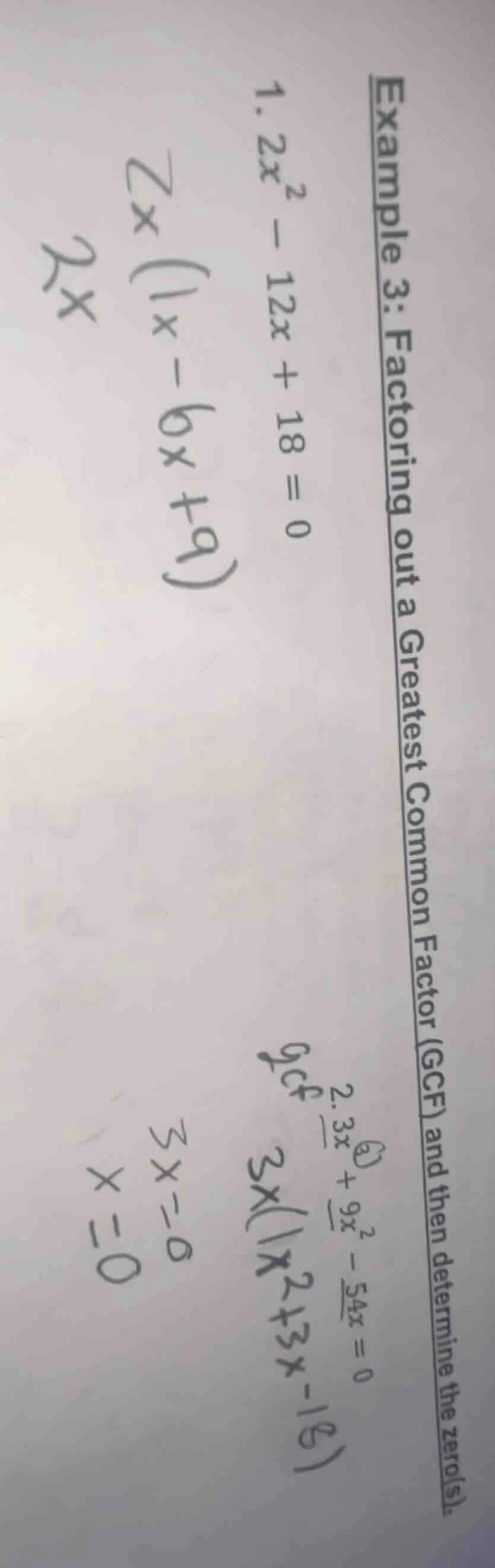
example 3: factoring out a greatest common factor (gcf) and then determine the zero(s).
- $2x^2 - 12x + 18 = 0$
$2x(1x - 6x + 9)$
$2x$
- $3x + 9x^2 - 54x = 0$
$3x(1x^2 + 3x - 18)$
$3x = 0$
$x = 0$
Problem 1: \( 2x^2 - 12x + 18 = 0 \)
Step 1: Factor out GCF
The GCF of \( 2x^2 \), \( -12x \), and \( 18 \) is \( 2 \). Factor out \( 2 \):
\( 2(x^2 - 6x + 9) = 0 \)
Step 2: Factor the quadratic
The quadratic \( x^2 - 6x + 9 \) is a perfect square: \( (x - 3)^2 \). So:
\( 2(x - 3)^2 = 0 \)
Step 3: Solve for \( x \)
Set each factor to zero:
\( 2
eq 0 \) (no solution), \( (x - 3)^2 = 0 \Rightarrow x - 3 = 0 \Rightarrow x = 3 \)
Problem 2: \( 3x + 9x^2 - 54x = 0 \)
Step 1: Simplify and factor GCF
First, combine like terms: \( 9x^2 - 51x = 0 \). The GCF of \( 9x^2 \) and \( -51x \) is \( 3x \). Factor out \( 3x \):
\( 3x(3x - 17) = 0 \)
Step 2: Solve for \( x \)
Set each factor to zero:
\( 3x = 0 \Rightarrow x = 0 \)
\( 3x - 17 = 0 \Rightarrow 3x = 17 \Rightarrow x = \frac{17}{3} \)

Snap & solve any problem in the app
Get step-by-step solutions on Sovi AI
Photo-based solutions with guided steps
Explore more problems and detailed explanations
s:
- \( x = 3 \)
- \( x = 0 \) or \( x = \frac{17}{3} \)