QUESTION IMAGE
Question
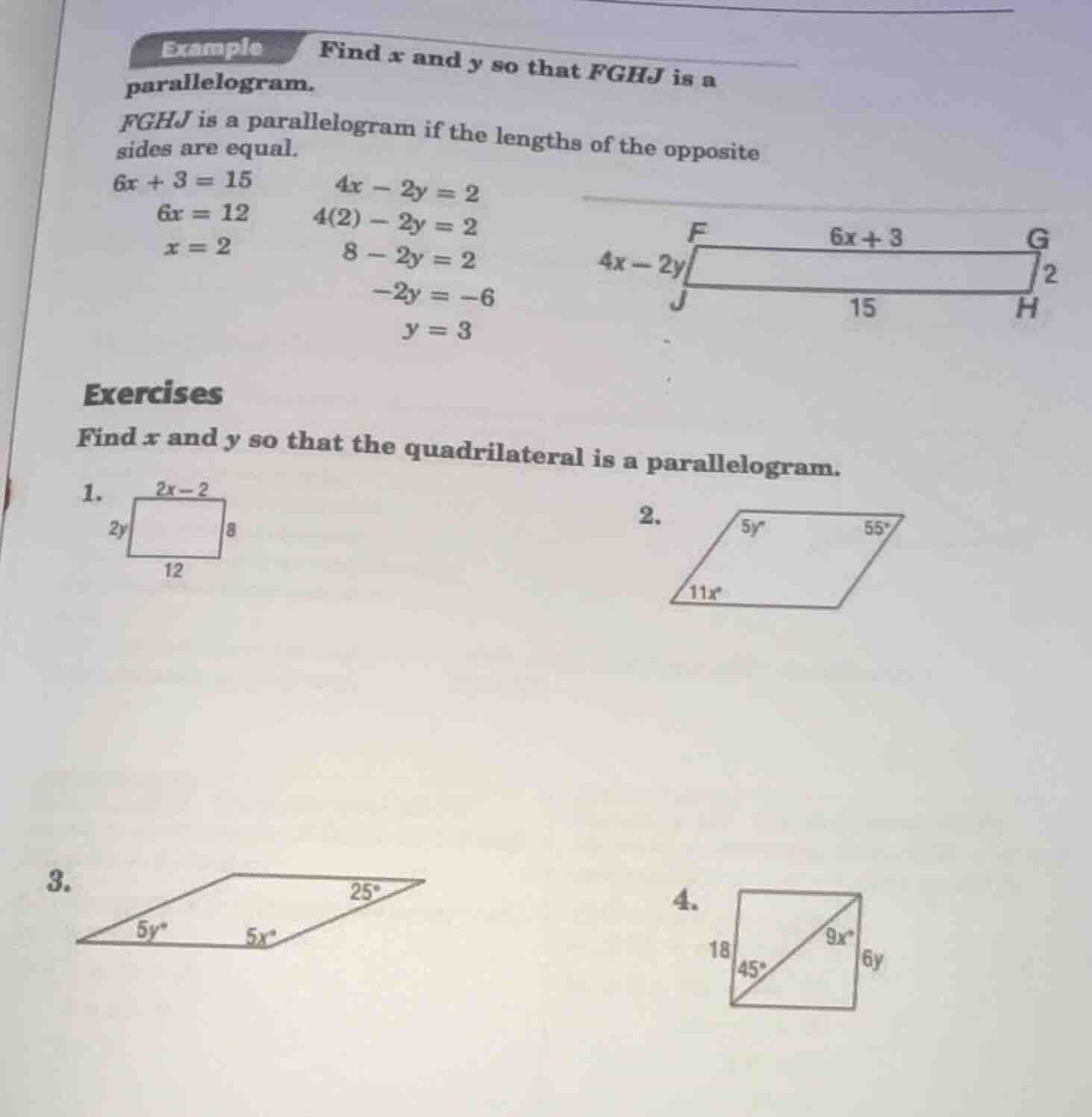
example find x and y so that fghj is a parallelogram. fghj is a parallelogram if the lengths of the opposite sides are equal. 6x + 3 = 15 4x - 2y = 2 6x = 12 4(2) - 2y = 2 x = 2 8 - 2y = 2 -2y = -6 y = 3 exercises find x and y so that the quadrilateral is a parallelogram. 1. diagram of a rectangle with top side 2x - 2, bottom side 12, left side 2y, right side 8 2. diagram of a parallelogram with angles 5y°, 55°, 11x° 3. diagram of a parallelogram with angles 5y°, 5x°, 25° 4. diagram of a rectangle with left side 18, right side 6y, bottom angle 45°, diagonal creating angle 9x°
Problem 1
Step1: Solve for \( x \) (opposite sides equal)
In a parallelogram, opposite sides are equal. So, \( 2x - 2 = 12 \)
\( 2x = 12 + 2 \)
\( 2x = 14 \)
\( x = 7 \)
Step2: Solve for \( y \) (opposite sides equal)
Also, \( 2y = 8 \)
\( y = \frac{8}{2} \)
\( y = 4 \)
Step1: Solve for \( y \) (opposite angles equal)
In a parallelogram, opposite angles are equal. So, \( 5y = 55 \)
\( y = \frac{55}{5} \)
\( y = 11 \)
Step2: Solve for \( x \) (consecutive angles supplementary)
Consecutive angles in a parallelogram are supplementary (sum to \( 180^\circ \)), but also opposite angles are equal, so \( 11x = 55 \) (since opposite angles are equal, or using supplementary with \( 55^\circ \) and \( 11x \) if we consider consecutive, but actually opposite angles: \( 11x = 55 \))
\( x = \frac{55}{11} \)
\( x = 5 \)
Step1: Solve for \( y \) (opposite angles equal)
In a parallelogram, opposite angles are equal. So, \( 5y = 25 \)
\( y = \frac{25}{5} \)
\( y = 5 \)
Step2: Solve for \( x \) (consecutive angles supplementary)
Consecutive angles in a parallelogram are supplementary (sum to \( 180^\circ \)). So, \( 5x + 25 = 180 \) (wait, no: consecutive angles: \( 5x \) and \( 25^\circ \) are consecutive? Wait, actually, in a parallelogram, adjacent angles are supplementary. So \( 5x + 25 = 180 \)? Wait, no, the angles: the angle \( 5y^\circ \) is opposite to \( 25^\circ \), so \( 5y = 25 \) (so \( y = 5 \)), and the angle \( 5x^\circ \) is adjacent to \( 25^\circ \), so \( 5x + 25 = 180 \)? Wait, no, in a parallelogram, opposite angles are equal, and consecutive angles are supplementary. So the angle \( 5x^\circ \) and \( 25^\circ \) are consecutive? Wait, the diagram: one angle is \( 5y^\circ \), opposite is \( 25^\circ \), so \( 5y = 25 \) (so \( y = 5 \)). Then the angle \( 5x^\circ \) is adjacent to \( 25^\circ \), so \( 5x + 25 = 180 \)? Wait, no, \( 5x \) and \( 5y \) are consecutive? Wait, maybe I misread. Wait, the parallelogram has angles \( 5y^\circ \), \( 5x^\circ \), \( 25^\circ \), and the fourth angle. So opposite angles: \( 5y = 25 \) (so \( y = 5 \)), and \( 5x \) is opposite to the angle adjacent to \( 25^\circ \). Wait, no, consecutive angles: \( 5y \) and \( 5x \) are consecutive, so \( 5y + 5x = 180 \). Since \( 5y = 25 \), then \( 25 + 5x = 180 \)
\( 5x = 180 - 25 \)
\( 5x = 155 \)
\( x = 31 \)
Wait, let's correct:
Step1: Opposite angles equal: \( 5y = 25 \)
\( y = 5 \)
Step2: Consecutive angles supplementary: \( 5y + 5x = 180 \)
Substitute \( y = 5 \): \( 25 + 5x = 180 \)
\( 5x = 155 \)
\( x = 31 \)

Snap & solve any problem in the app
Get step-by-step solutions on Sovi AI
Photo-based solutions with guided steps
Explore more problems and detailed explanations
\( x = 7 \), \( y = 4 \)