QUESTION IMAGE
Question
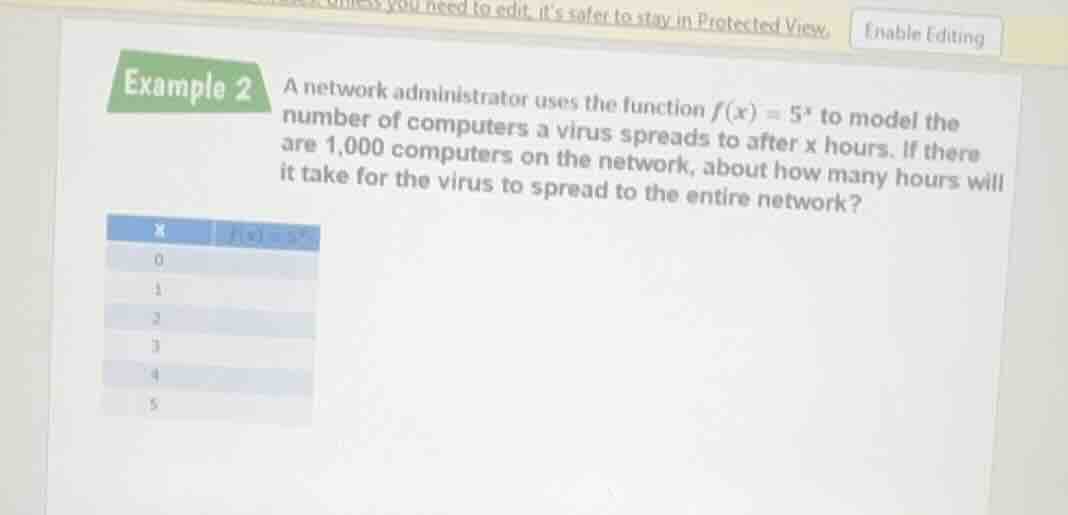
example 2 a network administrator uses the function $f(x) = 5^x$ to model the number of computers a virus spreads to after $x$ hours. if there are 1,000 computers on the network, about how many hours will it take for the virus to spread to the entire network? (with a chart having x values 0,1,2,3,4,5 and $f(x)=5^x$ column)
Step1: Set up the equation
We know the function is \( f(x)=5^x \), and we want to find \( x \) when \( f(x) = 1000 \). So we set up the equation \( 5^x=1000 \).
Step2: Solve for x using logarithms
Take the logarithm of both sides. Using the natural logarithm (we could also use common logarithm), we have \( \ln(5^x)=\ln(1000) \). By the logarithm power rule \( \ln(a^b)=b\ln(a) \), this becomes \( x\ln(5)=\ln(1000) \). Then, solve for \( x \): \( x = \frac{\ln(1000)}{\ln(5)} \).
Step3: Calculate the value
We know that \( \ln(1000)\approx6.9078 \) and \( \ln(5)\approx1.6094 \). So \( x=\frac{6.9078}{1.6094}\approx4.29 \). We can also check by plugging in integer values:
- For \( x = 4 \), \( 5^4 = 625 \) (less than 1000)
- For \( x = 5 \), \( 5^5 = 3125 \) (more than 1000)
So it will take about 4.3 hours, or we can say about 4 to 5 hours, but more precisely around 4.3 hours. If we consider the table, we can calculate \( f(x) \) for each \( x \):
- \( x = 0 \): \( 5^0 = 1 \)
- \( x = 1 \): \( 5^1 = 5 \)
- \( x = 2 \): \( 5^2 = 25 \)
- \( x = 3 \): \( 5^3 = 125 \)
- \( x = 4 \): \( 5^4 = 625 \)
- \( x = 5 \): \( 5^5 = 3125 \)
Since 625 < 1000 < 3125, and we calculated \( x\approx4.3 \), so it will take about 4.3 hours, or we can say about 4 to 5 hours, but the more accurate value from the logarithm is approximately 4.3.

Snap & solve any problem in the app
Get step-by-step solutions on Sovi AI
Photo-based solutions with guided steps
Explore more problems and detailed explanations
About \( \boldsymbol{4.3} \) hours (or we can say between 4 and 5 hours, with a more precise value around 4.3). If we consider the table and integer hours, since at \( x = 4 \) it's 625 and at \( x = 5 \) it's 3125, it will take about 4.3 hours to reach 1000, so approximately 4 hours (if we round to the nearest hour, but more accurately around 4.3).