QUESTION IMAGE
Question
example
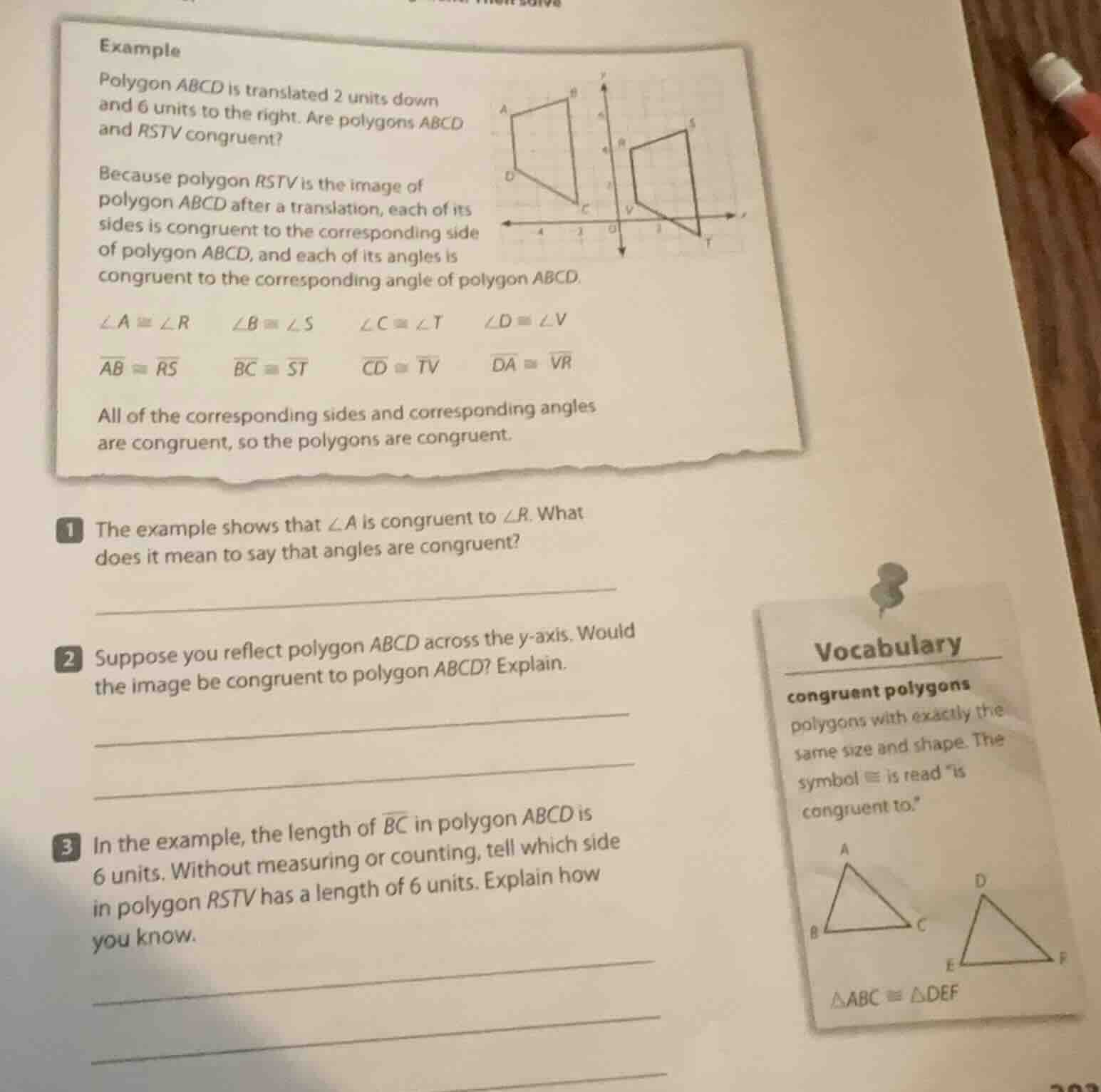
polygon abcd is translated 2 units down and 6 units to the right. are polygons abcd and rstv congruent?
because polygon rstv is the image of polygon abcd after a translation, each of its sides is congruent to the corresponding side of polygon abcd, and each of its angles is congruent to the corresponding angle of polygon abcd.
∠a ≅ ∠r ∠b ≅ ∠s ∠c ≅ ∠t ∠d ≅ ∠v
ab ≅ rs bc ≅ st cd ≅ tv da ≅ vr
all of the corresponding sides and corresponding angles are congruent, so the polygons are congruent.
1 the example shows that ∠a is congruent to ∠r. what does it mean to say that angles are congruent?
2 suppose you reflect polygon abcd across the y - axis. would the image be congruent to polygon abcd? explain.
3 in the example, the length of bc in polygon abcd is 6 units. without measuring or counting, tell which side in polygon rstv has a length of 6 units. explain how you know.
vocabulary
congruent polygons
polygons with exactly the same size and shape. the symbol ≅ is read \is congruent to.\
△abc ≅ △def
Question 1
To determine what congruent angles mean, we refer to the definition of congruent figures (including angles). Congruent angles are angles that have the exact same measure (in degrees or radians) and the same shape (since angles are defined by their opening, congruent angles have the same amount of "opening" between their sides). In the context of the polygon translation, since translation is a rigid transformation (it preserves size and shape), the corresponding angles of the original and translated polygon are congruent, meaning they have equal measures.
A reflection across the \( y \)-axis is a rigid transformation. Rigid transformations (translations, reflections, rotations) preserve the size and shape of a figure. This means that all corresponding sides and angles of the original polygon ( \( ABCD \)) and its image after reflection will be congruent. By the definition of congruent polygons (polygons with exactly the same size and shape), the image of \( ABCD \) after reflecting across the \( y \)-axis will be congruent to \( ABCD \).
In the example, polygon \( RSTV \) is the image of polygon \( ABCD \) after a translation. Translations are rigid transformations, which means they preserve the length of sides (and the measure of angles). From the example, we know that \( \overline{BC} \cong \overline{ST} \) (corresponding sides of congruent polygons are congruent). Since \( \overline{BC} \) has a length of 6 units, and \( \overline{ST} \) is congruent to \( \overline{BC} \), \( \overline{ST} \) must also have a length of 6 units.

Snap & solve any problem in the app
Get step-by-step solutions on Sovi AI
Photo-based solutions with guided steps
Explore more problems and detailed explanations
Two angles are congruent if they have the same measure (i.e., the same amount of rotation between their sides) and thus the same size and shape.