QUESTION IMAGE
Question
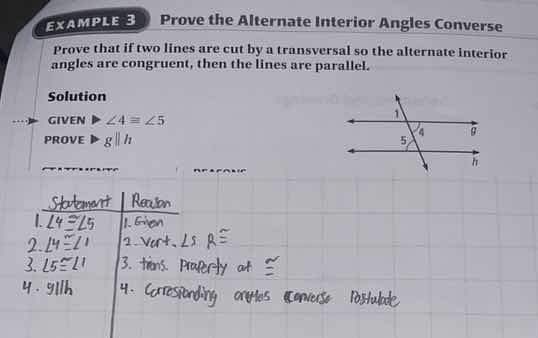
example 3 prove the alternate interior angles converse
prove that if two lines are cut by a transversal so the alternate interior
angles are congruent, then the lines are parallel.
solution
given ∠4 ≅ ∠5
prove g ∥ h
statement | reason
- ∠4 ≅ ∠5 | 1. given
- ∠4 ≅ ∠1 | 2. vert. ∠s ≅
- ∠5 ≅ ∠1 | 3. trans. property of ≅
- g ∥ h | 4. corresponding angles converse postulate
To properly prove the Alternate Interior Angles Converse, we can use a more precise and complete two - column proof:
Step 1: List the given information
We are given that $\angle4\cong\angle5$. In the two - column proof, we write:
| Statement | Reason |
|---|
Step 2: Use the Vertical Angles Theorem
Vertical angles are congruent. $\angle4$ and $\angle1$ are vertical angles. So we have:
| Statement | Reason |
|---|
Step 3: Use the Transitive Property of Congruence
We know that $\angle4\cong\angle5$ (from step 1) and $\angle4\cong\angle1$ (from step 2). By the transitive property of congruence, if $\angle A\cong\angle B$ and $\angle B\cong\angle C$, then $\angle A\cong\angle C$. So, $\angle5\cong\angle1$.
| Statement | Reason |
|---|
Step 4: Apply the Corresponding Angles Converse
The Corresponding Angles Converse states that if two lines are cut by a transversal and the corresponding angles are congruent, then the two lines are parallel. Here, $\angle1$ and $\angle5$ are corresponding angles (when we consider lines $g$ and $h$ cut by the transversal). Since $\angle5\cong\angle1$, by the Corresponding Angles Converse, we can conclude that $g\parallel h$.
| Statement | Reason |
|---|
So, through the use of the Vertical Angles Theorem, the Transitive Property of Congruence, and the Corresponding Angles Converse, we have proven that if two lines are cut by a transversal such that the alternate interior angles are congruent, then the lines are parallel.

Snap & solve any problem in the app
Get step-by-step solutions on Sovi AI
Photo-based solutions with guided steps
Explore more problems and detailed explanations
To properly prove the Alternate Interior Angles Converse, we can use a more precise and complete two - column proof:
Step 1: List the given information
We are given that $\angle4\cong\angle5$. In the two - column proof, we write:
| Statement | Reason |
|---|
Step 2: Use the Vertical Angles Theorem
Vertical angles are congruent. $\angle4$ and $\angle1$ are vertical angles. So we have:
| Statement | Reason |
|---|
Step 3: Use the Transitive Property of Congruence
We know that $\angle4\cong\angle5$ (from step 1) and $\angle4\cong\angle1$ (from step 2). By the transitive property of congruence, if $\angle A\cong\angle B$ and $\angle B\cong\angle C$, then $\angle A\cong\angle C$. So, $\angle5\cong\angle1$.
| Statement | Reason |
|---|
Step 4: Apply the Corresponding Angles Converse
The Corresponding Angles Converse states that if two lines are cut by a transversal and the corresponding angles are congruent, then the two lines are parallel. Here, $\angle1$ and $\angle5$ are corresponding angles (when we consider lines $g$ and $h$ cut by the transversal). Since $\angle5\cong\angle1$, by the Corresponding Angles Converse, we can conclude that $g\parallel h$.
| Statement | Reason |
|---|
So, through the use of the Vertical Angles Theorem, the Transitive Property of Congruence, and the Corresponding Angles Converse, we have proven that if two lines are cut by a transversal such that the alternate interior angles are congruent, then the lines are parallel.