QUESTION IMAGE
Question
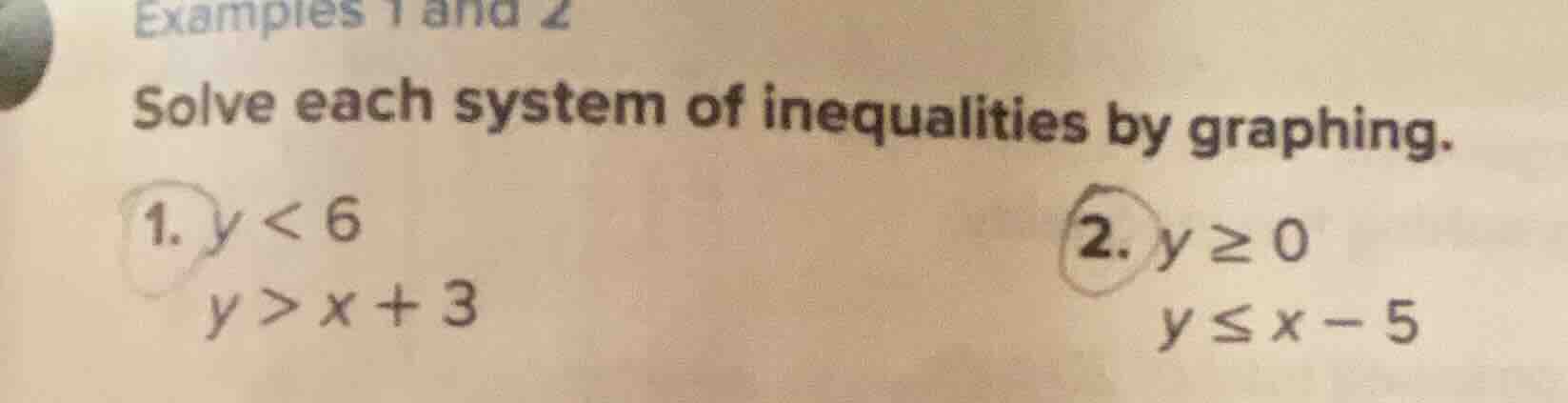
examples 1 and 2
solve each system of inequalities by graphing.
- $y < 6$
$y > x + 3$
- $y \geq 0$
$y \leq x - 5$
Problem 1: Solve \(
\) by Graphing
Step 1: Analyze \( y < 6 \)
The inequality \( y < 6 \) represents all the points below the horizontal line \( y = 6 \). Since the inequality is strict (\( < \)), the line \( y = 6 \) is dashed.
Step 2: Analyze \( y > x + 3 \)
The inequality \( y > x + 3 \) represents all the points above the line \( y = x + 3 \). The slope of this line is \( 1 \) and the \( y \)-intercept is \( 3 \). Since the inequality is strict (\( > \)), the line \( y = x + 3 \) is dashed.
Step 3: Find the Intersection Region
To find the solution to the system, we look for the region that is below \( y = 6 \) (dashed line) and above \( y = x + 3 \) (dashed line). This region is the area that satisfies both inequalities simultaneously.
Graph Description:
- Draw the dashed line \( y = 6 \) (horizontal line through \( (0, 6) \)). Shade the region below this line.
- Draw the dashed line \( y = x + 3 \) (line with slope \( 1 \), \( y \)-intercept \( 3 \)). Shade the region above this line.
- The solution is the overlapping shaded region (where both shadings overlap), bounded below by \( y = x + 3 \) (dashed) and above by \( y = 6 \) (dashed).
Problem 2: Solve \(
\) by Graphing
Step 1: Analyze \( y \geq 0 \)
The inequality \( y \geq 0 \) represents all the points on or above the horizontal line \( y = 0 \) (the \( x \)-axis). Since the inequality is non - strict (\( \geq \)), the line \( y = 0 \) is solid.
Step 2: Analyze \( y \leq x - 5 \)
The inequality \( y \leq x - 5 \) represents all the points on or below the line \( y = x - 5 \). The slope of this line is \( 1 \) and the \( y \)-intercept is \( - 5 \). Since the inequality is non - strict (\( \leq \)), the line \( y = x - 5 \) is solid.
Step 3: Find the Intersection Region
To find the solution to the system, we look for the region that is on or above \( y = 0 \) (solid line) and on or below \( y = x - 5 \) (solid line). We also need to check if there is an intersection between the two regions.
First, find the intersection point of \( y = 0 \) and \( y = x - 5 \). Set \( y = 0 \) in \( y = x - 5 \), we get \( 0=x - 5\), so \( x = 5 \). The intersection point is \( (5,0) \).
The line \( y = x - 5 \) has a slope of \( 1 \) and \( y \)-intercept \( - 5 \). For \( y\geq0 \), we are looking at the region above the \( x \)-axis. For \( y\leq x - 5 \), we are looking at the region below the line \( y = x - 5 \). The only region that satisfies both is the part of the line \( y = x - 5 \) starting from \( (5,0) \) and going upwards (since for \( x>5 \), \( y=x - 5>0 \)) and the region above the \( x \)-axis and below \( y = x - 5 \) (but we saw that the only intersection point is at \( (5,0) \), so the solution is the set of points on the line \( y = x - 5 \) where \( x\geq5 \) (because when \( x = 5 \), \( y = 0 \); when \( x>5 \), \( y=x - 5>0 \)) and also satisfying \( y\geq0 \)).
Graph Description:
- Draw the solid line \( y = 0 \) (the \( x \)-axis). Shade the region above this line.
- Draw the solid line \( y = x - 5 \) (line with slope \( 1 \), \( y \)-intercept \( - 5 \)). Shade the region below this line.
- The solution is the overlapping region, which is the part of the line \( y = x - 5 \) from the point \( (5,0) \) and extending to the right (where \( x\geq5 \)) and above the \( x \)-axis (since \( y\geq0 \) and \( y=x - 5\geq0 \) when \( x\geq5 \)).

Snap & solve any problem in the app
Get step-by-step solutions on Sovi AI
Photo-based solutions with guided steps
Explore more problems and detailed explanations
s:
- For \(
\): The solution is the region below the dashed line \( y = 6 \), above the dashed line \( y = x + 3 \), and between their intersection. (Visually, the overlapping shaded region of the two dashed - line - bounded regions)
- For \(
\): The solution is the set of points on the line segment (or ray) of \( y = x - 5 \) starting at \( (5,0) \) and going in the direction of increasing \( x \) (i.e., \( x\geq5 \)) and \( y=x - 5\) (since \( y\geq0 \) and \( y\leq x - 5 \) intersect only at and above \( (5,0) \) on \( y = x - 5 \))