QUESTION IMAGE
Question
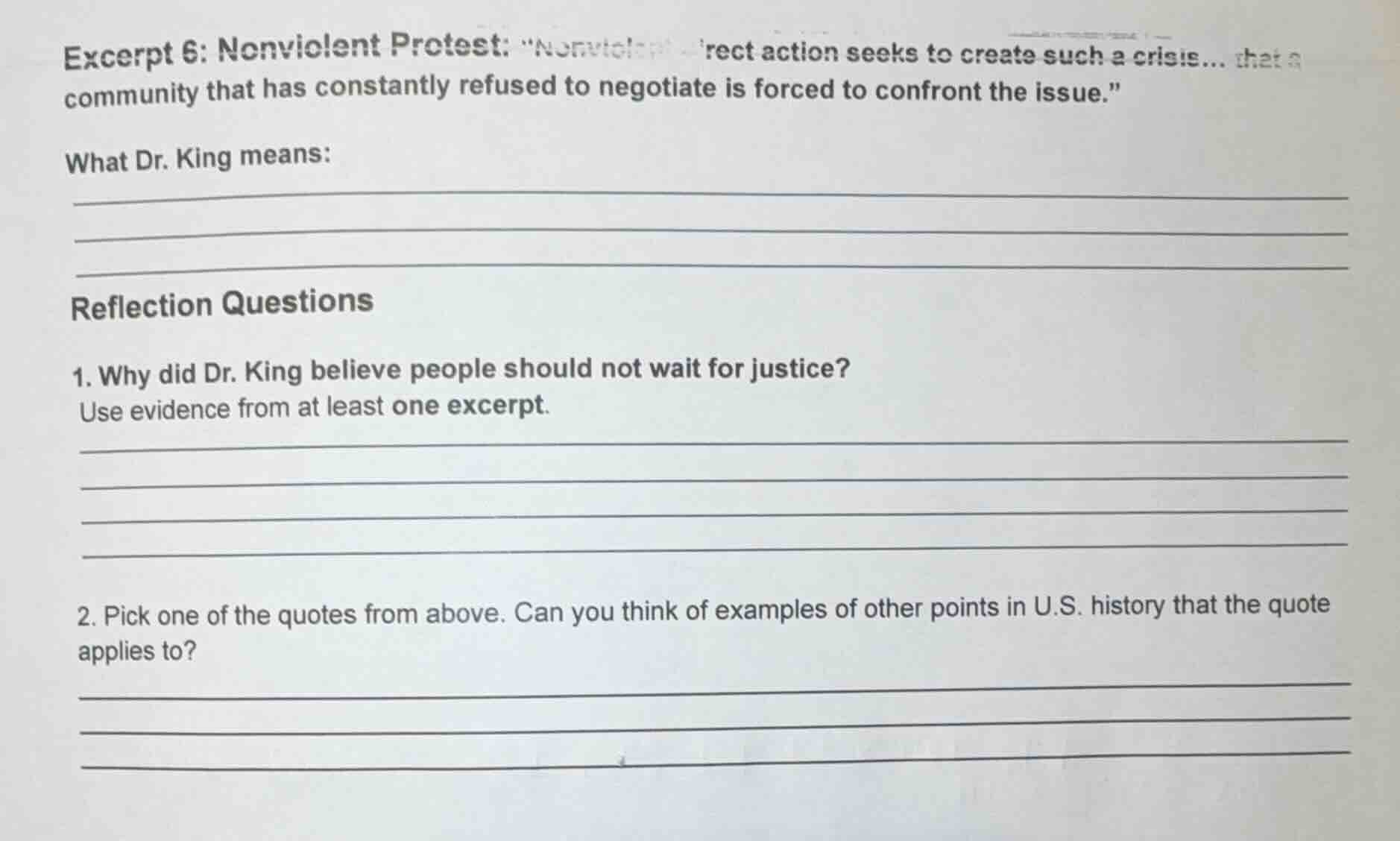
excerpt 6: nonviolent protest:
onviolent direct action seeks to create such a crisis... that a community that has constantly refused to negotiate is forced to confront the issue.\
what dr. king means:
___________________________________________________________________________
___________________________________________________________________________
___________________________________________________________________________
reflection questions
- why did dr. king believe people should not wait for justice?
use evidence from at least one excerpt.
___________________________________________________________________________
___________________________________________________________________________
___________________________________________________________________________
- pick one of the quotes from above. can you think of examples of other points in u.s. history that the quote applies to?
___________________________________________________________________________
___________________________________________________________________________
___________________________________________________________________________
What Dr. King means:
Nonviolent direct action is intended to generate a situation where a community that has persistently avoided negotiation is compelled to face the problem at hand. It implies that passive waiting won't bring about change, and proactive, nonviolent measures are needed to push for justice by making the issue unavoidable for those who have been uncooperative.
Reflection Question 1:
Dr. King believed people should not wait for justice because waiting would not prompt change from a community that refuses to negotiate. From the excerpt on nonviolent protest, it says nonviolent direct action “seeks to create such a crisis… that a community that has constantly refused to negotiate is forced to confront the issue.” This shows that without taking action (like nonviolent direct action), the uncooperative community would continue to avoid addressing the problem of injustice, so waiting would mean justice never comes.
Reflection Question 2:
Taking the nonviolent protest quote, an example from U.S. history is the Women's Suffrage Movement. Women used nonviolent direct actions like picketing the White House, organizing parades, and giving speeches. These actions created a “crisis” (in the sense of public attention and pressure) for society, which had long refused to negotiate about women's right to vote. The persistent nonviolent actions forced the nation to confront the issue of gender-based disenfranchisement, eventually leading to the 19th Amendment granting women the right to vote. Another example could be the Civil Rights Movement beyond Dr. King’s work, like the Montgomery Bus Boycott (which was also nonviolent). The boycott created a crisis for the city’s bus system and the community that had refused to negotiate on segregation, forcing them to confront the issue of racial inequality in public transportation.

Snap & solve any problem in the app
Get step-by-step solutions on Sovi AI
Photo-based solutions with guided steps
Explore more problems and detailed explanations
What Dr. King means:
Nonviolent direct action is intended to generate a situation where a community that has persistently avoided negotiation is compelled to face the problem at hand. It implies that passive waiting won't bring about change, and proactive, nonviolent measures are needed to push for justice by making the issue unavoidable for those who have been uncooperative.
Reflection Question 1:
Dr. King believed people should not wait for justice because waiting would not prompt change from a community that refuses to negotiate. From the excerpt on nonviolent protest, it says nonviolent direct action “seeks to create such a crisis… that a community that has constantly refused to negotiate is forced to confront the issue.” This shows that without taking action (like nonviolent direct action), the uncooperative community would continue to avoid addressing the problem of injustice, so waiting would mean justice never comes.
Reflection Question 2:
Taking the nonviolent protest quote, an example from U.S. history is the Women's Suffrage Movement. Women used nonviolent direct actions like picketing the White House, organizing parades, and giving speeches. These actions created a “crisis” (in the sense of public attention and pressure) for society, which had long refused to negotiate about women's right to vote. The persistent nonviolent actions forced the nation to confront the issue of gender-based disenfranchisement, eventually leading to the 19th Amendment granting women the right to vote. Another example could be the Civil Rights Movement beyond Dr. King’s work, like the Montgomery Bus Boycott (which was also nonviolent). The boycott created a crisis for the city’s bus system and the community that had refused to negotiate on segregation, forcing them to confront the issue of racial inequality in public transportation.