QUESTION IMAGE
Question
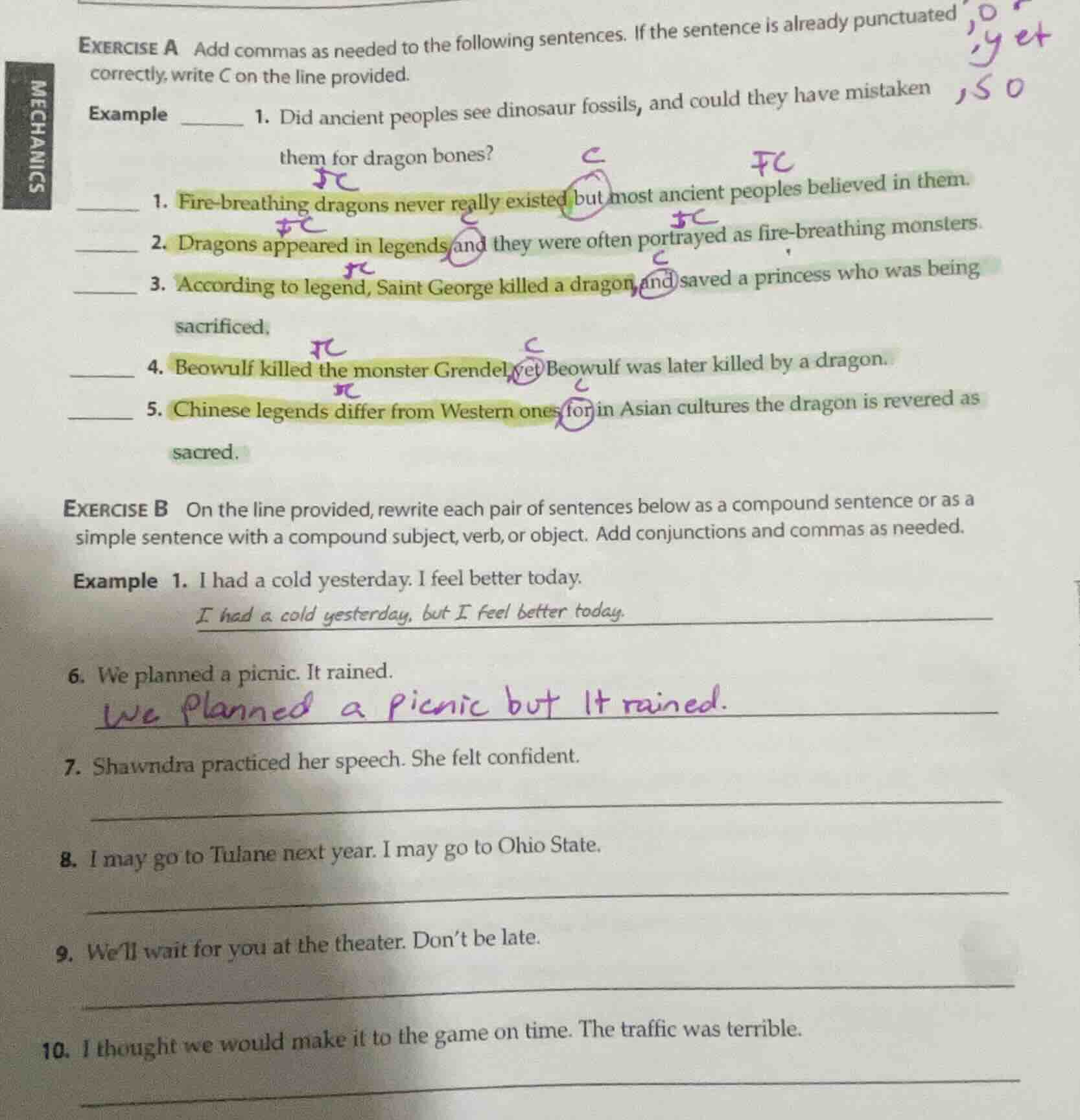
exercise a add commas as needed to the following sentences. if the sentence is already punctuated correctly, write c on the line provided.
example ______ 1. did ancient peoples see dinosaur fossils, and could they have mistaken them for dragon bones?
______ 1. fire - breathing dragons never really existed but most ancient peoples believed in them.
______ 2. dragons appeared in legends and they were often portrayed as fire - breathing monsters.
______ 3. according to legend, saint george killed a dragon and saved a princess who was being sacrificed.
______ 4. beowulf killed the monster grendel yet beowulf was later killed by a dragon.
______ 5. chinese legends differ from western ones for in asian cultures the dragon is revered as sacred.
exercise b on the line provided, rewrite each pair of sentences below as a compound sentence or as a simple sentence with a compound subject, verb, or object. add conjunctions and commas as needed.
example 1. i had a cold yesterday. i feel better today.
i had a cold yesterday, but i feel better today.
- we planned a picnic. it rained.
we planned a picnic but it rained.
- shawndra practiced her speech. she felt confident.
_____________________________________
- i may go to tulane next year. i may go to ohio state.
_____________________________________
- well wait for you at the theater. dont be late.
_____________________________________
- i thought we would make it to the game on time. the traffic was terrible.
_____________________________________
Exercise A (Adding Commas)
- Sentence: Fire - breathing dragons never really existed, but most ancient peoples believed in them.
- Explanation: The two independent clauses “Fire - breathing dragons never really existed” and “most ancient peoples believed in them” are joined by the conjunction “but”, so a comma is needed before “but”.
- Answer: (Comma added before “but”) Fire - breathing dragons never really existed, but most ancient peoples believed in them. (Mark: Add comma, so the line should have a comma before “but” and the sentence is punctuated correctly now, but if the task is to write “C” if correct or add comma, here after adding comma it's correct, but the original had a mark “FC” maybe a mistake, the correct punctuation is with a comma before “but”.)
- Sentence: Dragons appeared in legends, and they were often portrayed as fire - breathing monsters.
- Explanation: The two independent clauses “Dragons appeared in legends” and “they were often portrayed as fire - breathing monsters” are joined by “and”, so a comma is needed before “and”.
- Answer: (Comma added before “and”) Dragons appeared in legends, and they were often portrayed as fire - breathing monsters.
- Sentence: According to legend, Saint George killed a dragon, and saved a princess who was being sacrificed.
- Explanation: “killed a dragon” and “saved a princess...” are not independent clauses (they share the subject “Saint George”), so no comma before “and” here. The original with a comma is incorrect; remove the comma before “and”.
- Answer: According to legend, Saint George killed a dragon and saved a princess who was being sacrificed.
- Sentence: Beowulf killed the monster Grendel, yet Beowulf was later killed by a dragon.
- Explanation: The two independent clauses are joined by “yet”, so a comma is needed before “yet”.
- Answer: (Comma added before “yet”) Beowulf killed the monster Grendel, yet Beowulf was later killed by a dragon.
- Sentence: Chinese legends differ from Western ones, for in Asian cultures the dragon is revered as sacred.
- Explanation: The two independent clauses are joined by “for” (a coordinating conjunction), so a comma is needed before “for”.
- Answer: (Comma added before “for”) Chinese legends differ from Western ones, for in Asian cultures the dragon is revered as sacred.
Exercise B (Rewriting as Compound/Simple Sentences)
- Sentences: We planned a picnic. It rained.
- Explanation: To make a compound sentence, use the conjunction “but” (showing contrast) and add a comma before “but”.
- Answer: We planned a picnic, but it rained.
- Sentences: Shawndra practiced her speech. She felt confident.
- Explanation: Use the conjunction “so” (showing cause - effect) or “and” (showing sequence). Using “so” with a comma before it.
- Answer: Shawndra practiced her speech, so she felt confident. (Or “Shawndra practiced her speech and felt confident.” as a simple sentence with compound verb)
- Sentences: I may go to Tulane next year. I may go to Ohio State.
- Explanation: Use the conjunction “or” (showing a choice) and combine into a compound sentence with a comma before “or” (or make a simple sentence with compound object: “I may go to Tulane or Ohio State next year.”).
- Answer: I may go to Tulane next year, or I may go to Ohio State. (Or simple: I may go to Tulane or Ohio State next year.)
- Sentences: We’ll wait for you at the theater. Don’t be late.
- Explanation: Use the conjunction “but” (showing a request with a condition) or “so” (showing…

Snap & solve any problem in the app
Get step-by-step solutions on Sovi AI
Photo-based solutions with guided steps
Explore more problems and detailed explanations
Exercise A (Adding Commas)
- Sentence: Fire - breathing dragons never really existed, but most ancient peoples believed in them.
- Explanation: The two independent clauses “Fire - breathing dragons never really existed” and “most ancient peoples believed in them” are joined by the conjunction “but”, so a comma is needed before “but”.
- Answer: (Comma added before “but”) Fire - breathing dragons never really existed, but most ancient peoples believed in them. (Mark: Add comma, so the line should have a comma before “but” and the sentence is punctuated correctly now, but if the task is to write “C” if correct or add comma, here after adding comma it's correct, but the original had a mark “FC” maybe a mistake, the correct punctuation is with a comma before “but”.)
- Sentence: Dragons appeared in legends, and they were often portrayed as fire - breathing monsters.
- Explanation: The two independent clauses “Dragons appeared in legends” and “they were often portrayed as fire - breathing monsters” are joined by “and”, so a comma is needed before “and”.
- Answer: (Comma added before “and”) Dragons appeared in legends, and they were often portrayed as fire - breathing monsters.
- Sentence: According to legend, Saint George killed a dragon, and saved a princess who was being sacrificed.
- Explanation: “killed a dragon” and “saved a princess...” are not independent clauses (they share the subject “Saint George”), so no comma before “and” here. The original with a comma is incorrect; remove the comma before “and”.
- Answer: According to legend, Saint George killed a dragon and saved a princess who was being sacrificed.
- Sentence: Beowulf killed the monster Grendel, yet Beowulf was later killed by a dragon.
- Explanation: The two independent clauses are joined by “yet”, so a comma is needed before “yet”.
- Answer: (Comma added before “yet”) Beowulf killed the monster Grendel, yet Beowulf was later killed by a dragon.
- Sentence: Chinese legends differ from Western ones, for in Asian cultures the dragon is revered as sacred.
- Explanation: The two independent clauses are joined by “for” (a coordinating conjunction), so a comma is needed before “for”.
- Answer: (Comma added before “for”) Chinese legends differ from Western ones, for in Asian cultures the dragon is revered as sacred.
Exercise B (Rewriting as Compound/Simple Sentences)
- Sentences: We planned a picnic. It rained.
- Explanation: To make a compound sentence, use the conjunction “but” (showing contrast) and add a comma before “but”.
- Answer: We planned a picnic, but it rained.
- Sentences: Shawndra practiced her speech. She felt confident.
- Explanation: Use the conjunction “so” (showing cause - effect) or “and” (showing sequence). Using “so” with a comma before it.
- Answer: Shawndra practiced her speech, so she felt confident. (Or “Shawndra practiced her speech and felt confident.” as a simple sentence with compound verb)
- Sentences: I may go to Tulane next year. I may go to Ohio State.
- Explanation: Use the conjunction “or” (showing a choice) and combine into a compound sentence with a comma before “or” (or make a simple sentence with compound object: “I may go to Tulane or Ohio State next year.”).
- Answer: I may go to Tulane next year, or I may go to Ohio State. (Or simple: I may go to Tulane or Ohio State next year.)
- Sentences: We’ll wait for you at the theater. Don’t be late.
- Explanation: Use the conjunction “but” (showing a request with a condition) or “so” (showing cause - effect). Using “but” with a comma before it.
- Answer: We’ll wait for you at the theater, but don’t be late.
- Sentences: I thought we would make it to the game on time. The traffic was terrible.
- Explanation: Use the conjunction “but” (showing contrast) with a comma before “but”.
- Answer: I thought we would make it to the game on time, but the traffic was terrible.
(Note: For Exercise A, the original markings in the image might have some errors, the above are the correct comma placements based on compound sentence rules. For Exercise B, multiple correct rewrites are possible based on the type of compound/simple sentence required.)