QUESTION IMAGE
Question
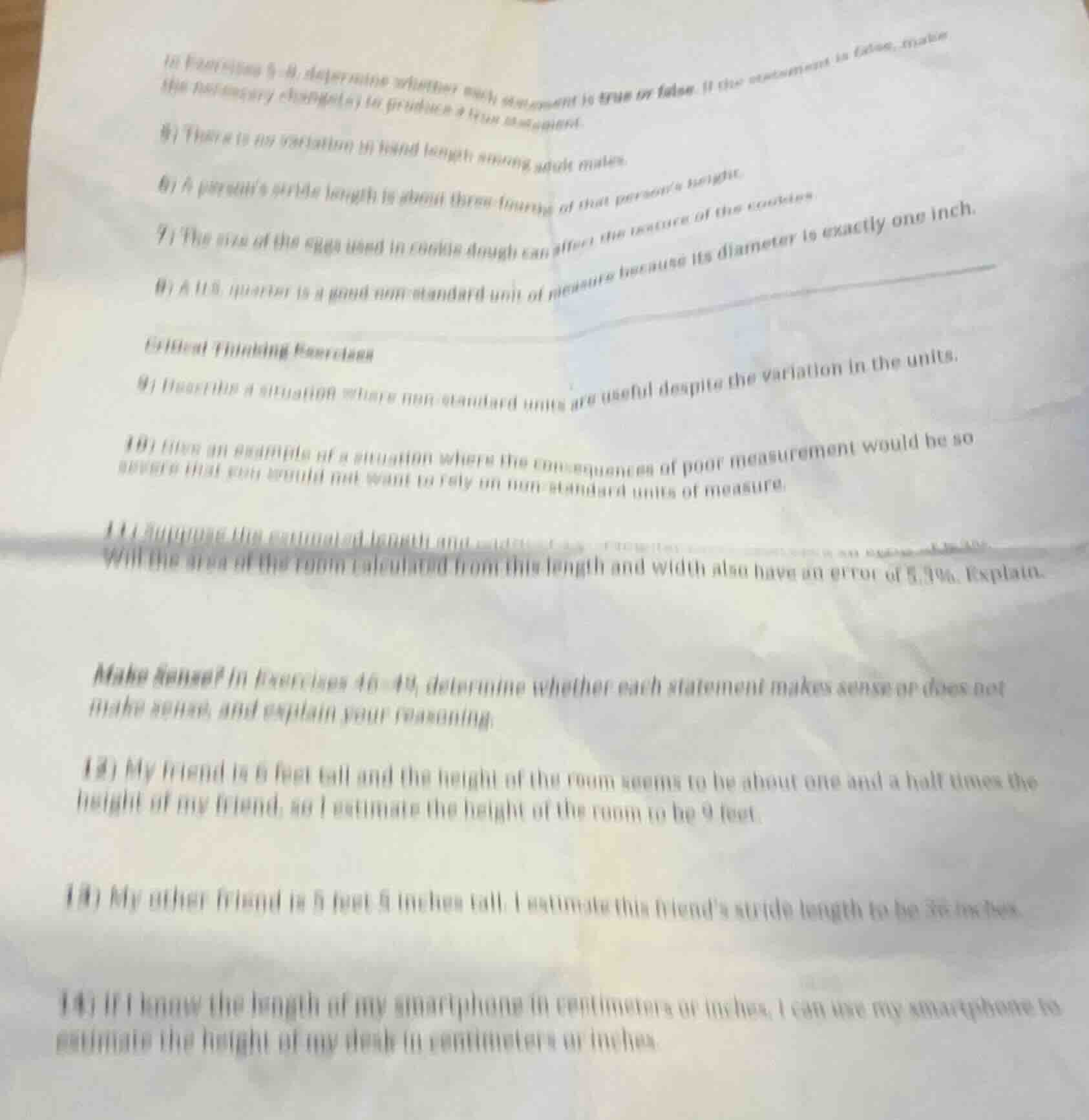
in exercises 5–8, determine whether each statement is true or false. if the statement is false, make the necessary change(s) to produce a true statement. 5) there is no variation in hand length among adult males. 6) a person’s stride length is about three - fourths of that person’s height. 7) the size of the eggs used in cookie dough can affect the texture of the cookies. 8) a u.s. quarter is a good non - standard unit of measure because its diameter is exactly one inch. critical thinking exercises 9) describe a situation where non - standard units are useful despite the variation in the units. 10) give an example of a situation where the consequences of poor measurement would be so severe that you would not want to rely on non - standard units of measure. 11) suppose the estimated length and width of a room have an error of 5.19%. will the area of the room calculated from this length and width also have an error of 5.19%? explain. make sense? in exercises 46–49, determine whether each statement makes sense or does not make sense, and explain your reasoning. 12) my friend is 6 feet tall and the height of the room seems to be about one and a half times the height of my friend, so i estimate the height of the room to be 9 feet. 13) my other friend is 5 foot 5 inches tall. i estimate this friend’s stride length to be 36 inches. 14) if i know the length of my smartphone in centimeters or inches, i can use my smartphone to estimate the height of my desk in centimeters or inches.
Step1: Evaluate statement 5
False. Adult males have varying hand lengths.
Corrected: There is variation in hand length among adult males.
Step2: Evaluate statement 6
True. A person's stride length is roughly $\frac{3}{4}$ of their height.
Step3: Evaluate statement 7
True. Larger eggs add more moisture, altering cookie texture.
Step4: Evaluate statement 8
False. A U.S. quarter has a fixed diameter, so it is a standard non-custom unit.
Corrected: A U.S. quarter is a good standard non-custom unit of measure because its diameter is exactly one inch.
Step5: Answer exercise 9
Non-standard units (like hand spans) are useful for quick, approximate measurements when a standard tool is unavailable, e.g., estimating the width of a bookshelf using your hand span when you don’t have a ruler.
Step6: Answer exercise 10
When measuring medication dosages for a patient: poor measurement could lead to overdose or underdose, causing severe harm or death, so non-standard units (like "a handful") are unsafe and unreliable.
Step7: Evaluate exercise 11
Let the actual length be $L$ and width be $W$. The estimated length is $L(1\pm0.054)$ and estimated width is $W(1\pm0.054)$.
Actual area: $A = L \times W$
Estimated area: $A_{est} = L(1\pm0.054) \times W(1\pm0.054) = LW(1\pm0.054)^2 = A(1\pm0.108 + 0.002916)$
The maximum error is ~10.8%, not 5.4%. So no, the area error is larger.
Step8: Evaluate statement 12
Makes sense. Calculate $6 \times 1.5 = 9$ feet, which is a valid estimation using a known reference.
Step9: Evaluate statement 13
Makes sense. A 5'5" person (65 inches) has an expected stride length of ~$\frac{3}{4} \times 65 = 48.75$ inches; 50 inches is a reasonable close estimate.
Step10: Evaluate statement 14
Makes sense. If you know your smartphone's fixed length, you can use it as a non-standard measuring tool to count how many times it fits against the desk height, then calculate the total height.

Snap & solve any problem in the app
Get step-by-step solutions on Sovi AI
Photo-based solutions with guided steps
Explore more problems and detailed explanations
- False. Corrected: There is variation in hand length among adult males.
- True
- True
- False. Corrected: A U.S. quarter is a good standard non-custom unit of measure because its diameter is exactly one inch.
- Example: Estimating the width of a window using your hand span when you don't have a ruler.
- Example: Measuring the dosage of a critical, narrow-range medication for a patient.
- No, the area will not have a 5.4% error. The area error is approximately 10.8% because errors in length and width compound when multiplied.
- Makes sense. The estimation uses a known height reference and simple multiplication.
- Makes sense. The estimate is close to the expected stride length (3/4 of height).
- Makes sense. The smartphone's known length acts as a portable measuring reference.