QUESTION IMAGE
Question
exit slip
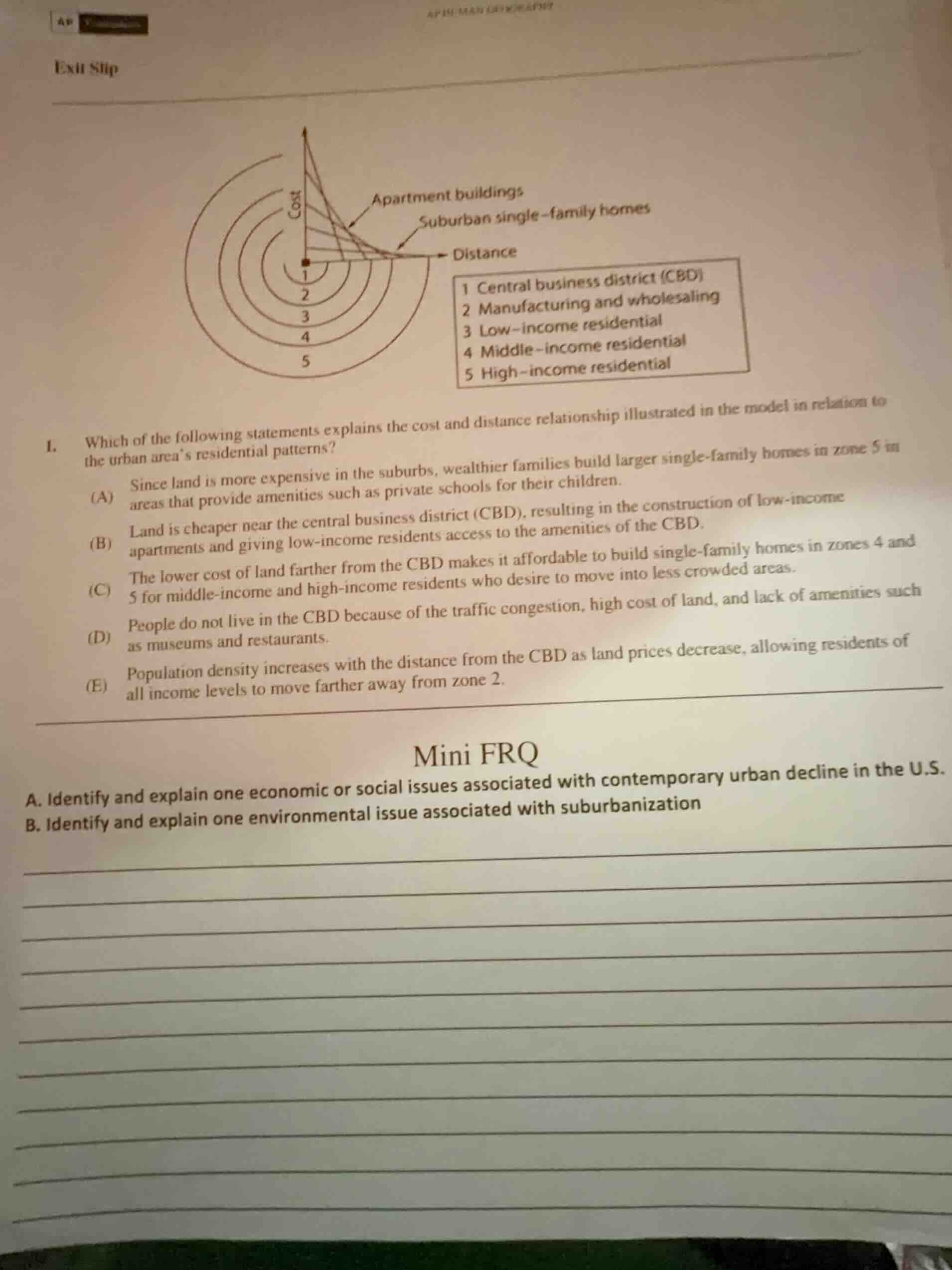
1 central business district (cbd)
2 manufacturing and wholesaling
3 low-income residential
4 middle-income residential
5 high-income residential
- which of the following statements explains the cost and distance relationship illustrated in the model in relation to the urban areas residential patterns?
(a) since land is more expensive in the suburbs, wealthier families build larger single-family homes in zone 5 in areas that provide amenities such as private schools for their children.
(b) land is cheaper near the central business district (cbd), resulting in the construction of low-income apartments and giving low-income residents access to the amenities of the cbd.
(c) the lower cost of land farther from the cbd makes it affordable to build single-family homes in zones 4 and 5 for middle-income and high-income residents who desire to move into less crowded areas.
(d) people do not live in the cbd because of the traffic congestion, high cost of land, and lack of amenities such as museums and restaurants.
(e) population density increases with the distance from the cbd as land prices decrease, allowing residents of all income levels to move farther away from zone 2.
mini frq
a. identify and explain one economic or social issues associated with contemporary urban decline in the u.s.
b. identify and explain one environmental issue associated with suburbanization
For Multiple Choice Question 1:
The model is the concentric zone model, where land cost decreases with distance from the CBD. Option A is incorrect because land is cheaper in suburbs. Option B is incorrect as land near CBD is more expensive, so low-income residents use dense apartments there due to cost, not cheap land. Option D is incorrect because the CBD has amenities like museums and restaurants. Option E is incorrect because population density decreases with distance from the CBD. Option C correctly matches the model: cheaper land farther from CBD allows middle/upper-income groups to build single-family homes in outer zones.
For Mini FRQ Part A:
Urban decline often brings about economic disinvestment. As middle and upper-income residents move to suburbs, businesses in urban areas lose their customer base, leading to closures and reduced property values. This creates a cycle where tax revenues drop, so cities cannot fund public services like schools and infrastructure, worsening the decline.
For Mini FRQ Part B:
Suburbanization increases automobile dependency, as most suburban residents rely on cars for commuting, shopping, and other needs. This leads to increased greenhouse gas emissions from vehicle exhaust, contributing to air pollution and climate change. Additionally, the spread of suburbs requires clearing natural land for housing and roads, destroying wildlife habitats and reducing green space that helps absorb carbon dioxide.

Snap & solve any problem in the app
Get step-by-step solutions on Sovi AI
Photo-based solutions with guided steps
Explore more problems and detailed explanations
- C. The lower cost of land farther from the CBD makes it affordable to build single-family homes in zones 4 and 5 for middle-income and high-income residents who desire to move into less crowded areas.
Mini FRQ Answers:
A. Economic Issue: Urban Disinvestment - When residents move to suburbs, urban businesses lose revenue and close, lowering property values and tax income. This reduces city funds for public services, creating a cycle of urban decline.
B. Environmental Issue: Increased Automobile Emissions - Suburban living relies heavily on cars for transportation. More vehicle use leads to higher greenhouse gas and pollutant emissions, worsening air quality and contributing to climate change.