QUESTION IMAGE
Question
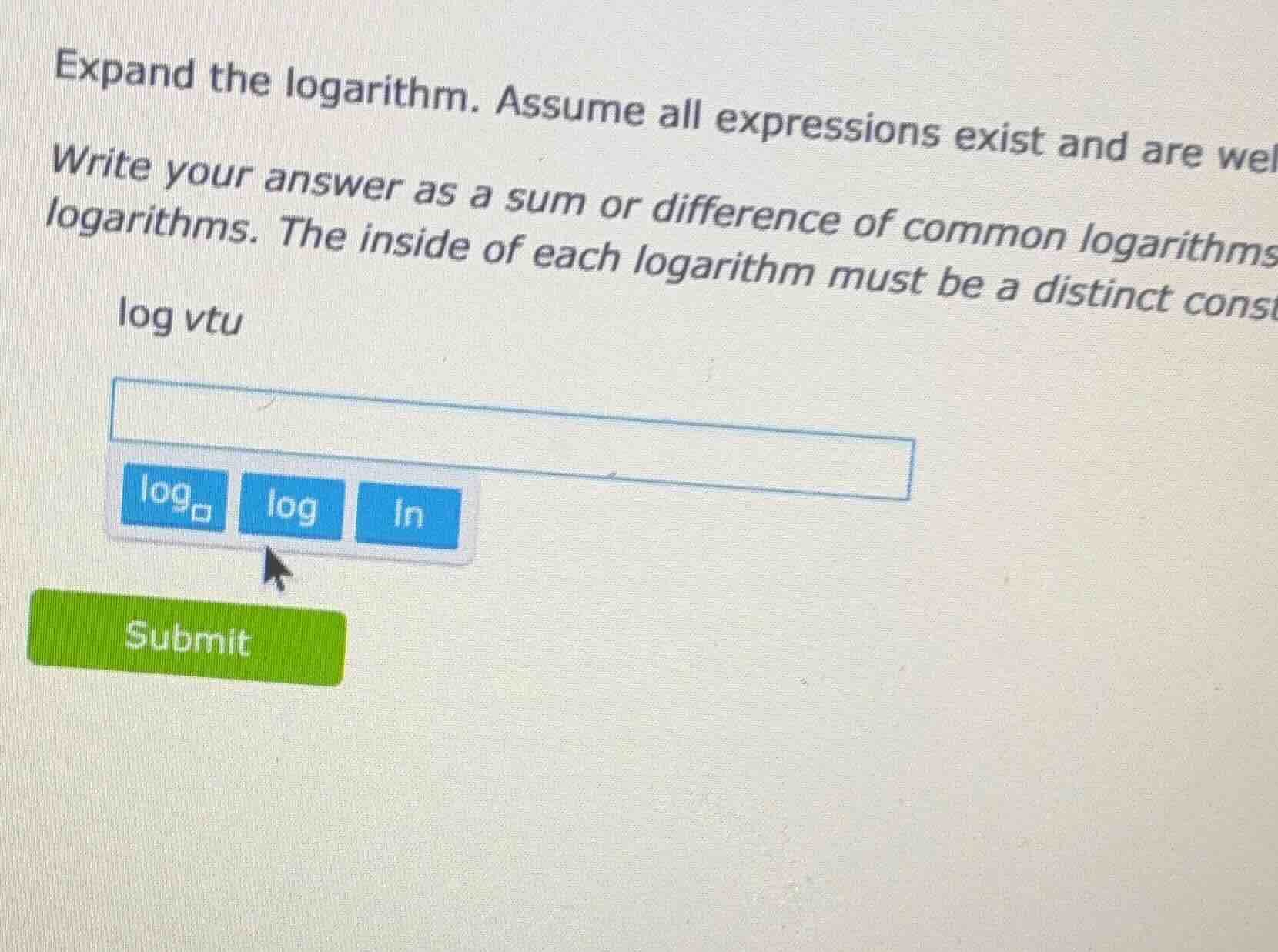
expand the logarithm. assume all expressions exist and are wel write your answer as a sum or difference of common logarithms. the inside of each logarithm must be a distinct const log vtu
Step1: Recall the product rule for logarithms
The product rule for logarithms states that \(\log(ab)=\log(a)+\log(b)\) for any positive real numbers \(a\) and \(b\) (and the base of the logarithm is the same, here it is common logarithm with base 10, but the rule holds for any base).
Step2: Apply the product rule to \(\log(vtu)\)
We can consider \(vtu\) as the product of three numbers \(v\), \(t\), and \(u\). So, using the product rule of logarithms, we can expand \(\log(vtu)\) as the sum of the logarithms of each factor.
First, we can group \(v\) and \(tu\) (or any order). Let's first consider \(vtu = v\times(tu)\). Then by the product rule \(\log(v\times(tu))=\log(v)+\log(tu)\).
Now, we apply the product rule again to \(\log(tu)\). Since \(tu = t\times u\), by the product rule \(\log(tu)=\log(t)+\log(u)\).
Substituting back, we get \(\log(vtu)=\log(v)+\log(t)+\log(u)\).

Snap & solve any problem in the app
Get step-by-step solutions on Sovi AI
Photo-based solutions with guided steps
Explore more problems and detailed explanations
\(\log(v)+\log(t)+\log(u)\)