QUESTION IMAGE
Question
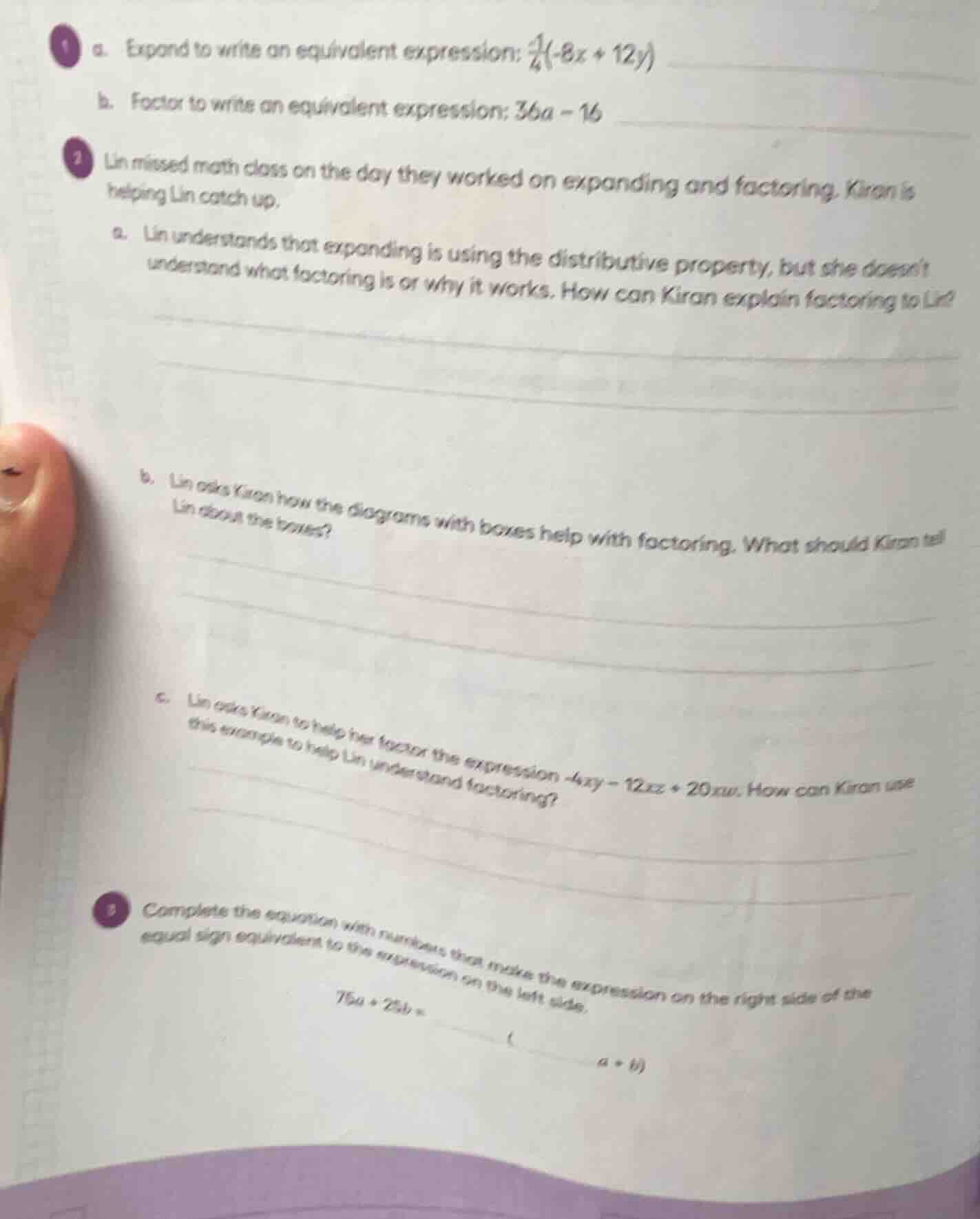
1 a. expand to write an equivalent expression: \\(\frac{1}{4}(-8x + 12y)\\)\
b. factor to write an equivalent expression: \\(36a - 16\\)\
2 lin missed math class on the day they worked on expanding and factoring. kiran is helping lin catch up.\
a. lin understands that expanding is using the distributive property, but she doesnt understand what factoring is or why it works. how can kiran explain factoring to lin?\
b. lin asks kiran how the diagrams with boxes help with factoring. what should kiran tell lin about the boxes?\
c. lin asks kiran to help her factor the expression \\(-4xy - 12xz + 20xw\\). how can kiran use this example to help lin understand factoring?\
3 complete the equation with numbers that make the expression on the right side of the equal sign equivalent to the expression on the left side.\
\\(75a + 25b = \\) \\((\\) \\(a + b)\\)
Step1: Distribute $\frac{1}{4}$ to each term
$\frac{1}{4}(-8x) + \frac{1}{4}(12y)$
Step2: Calculate each product
$-2x + 3y$
Step3: Find GCF of 36a and 16
$\text{GCF}(36,16) = 4$
Step4: Factor out the GCF
$4(9a - 4)$
2a:
Factoring is the reverse of expanding (distributive property). Instead of multiplying a term into parentheses, you find the greatest common factor (GCF) of all terms, then write the expression as the GCF multiplied by the remaining parts of each term. It works to rewrite expressions in a simpler, factored form that shows common components.
2b:
Box diagrams represent each term as a rectangle, where the side lengths correspond to factors. The shared side length of all rectangles is the GCF, and the other sides are the remaining parts of each term. This visualizes how the GCF is common to all terms, making it easier to see what to factor out.
2c:
First, identify the GCF of $-4xy$, $-12xz$, and $20xw$: the GCF is $-4x$. Then, divide each term by $-4x$ to get the remaining parts: $y$, $3z$, $-5w$. Write the expression as $-4x(y + 3z - 5w)$. Walk Lin through finding the GCF first, then showing how dividing each term by the GCF gives the inside of the parentheses, reversing the distributive property.
Step5: Find GCF of 75a and 25b
$\text{GCF}(75,25) = 25$
Step6: Divide terms by GCF to fill blanks
$75a \div 25 = 3$, $25b \div 25 = 1$
$25(3a + b)$

Snap & solve any problem in the app
Get step-by-step solutions on Sovi AI
Photo-based solutions with guided steps
Explore more problems and detailed explanations
1a. $-2x + 3y$
1b. $4(9a - 4)$
2a. Factoring reverses the distributive property: find the GCF of all terms, then write the expression as the GCF multiplied by the quotient of each term divided by the GCF, simplifying the expression by highlighting common factors.
2b. Box diagrams use rectangles for each term, where a shared side length is the GCF. The other sides are the remaining parts of each term, visually showing the common factor to factor out.
2c. First find the GCF of $-4xy$, $-12xz$, $20xw$ which is $-4x$. Then divide each term by $-4x$: $\frac{-4xy}{-4x}=y$, $\frac{-12xz}{-4x}=3z$, $\frac{20xw}{-4x}=-5w$. Write the factored form as $-4x(y + 3z - 5w)$, explaining this reverses expanding.
- $25(3a + b)$