QUESTION IMAGE
Question
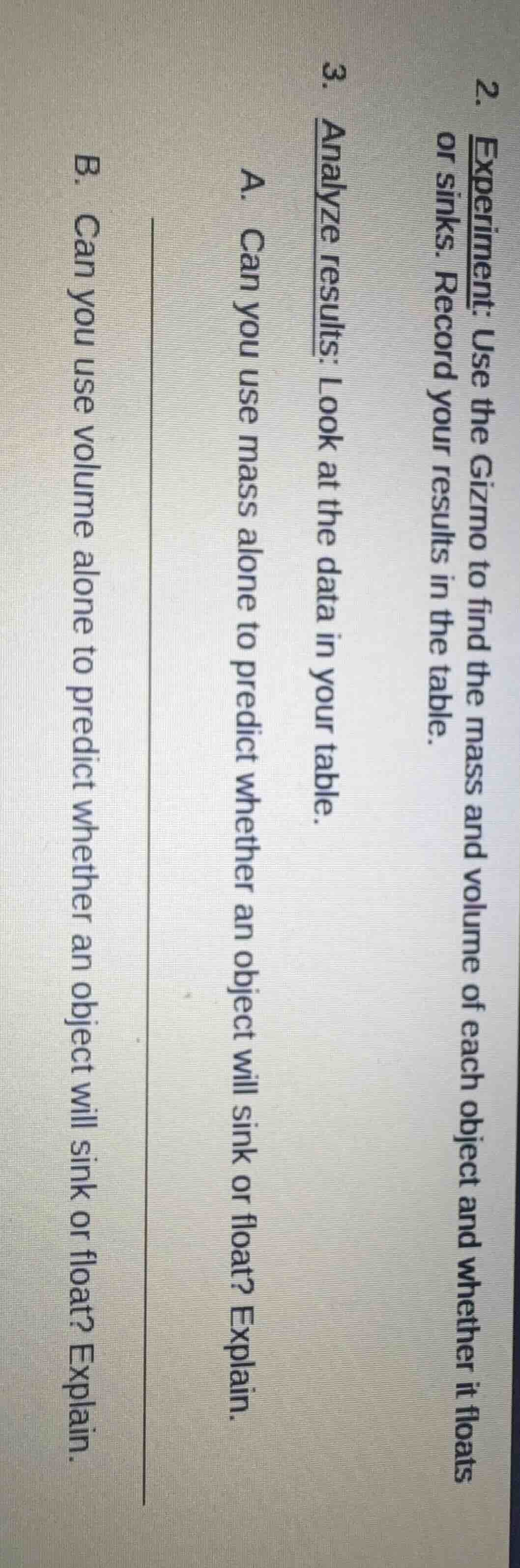
- experiment: use the gizmo to find the mass and volume of each object and whether it floats or sinks. record your results in the table. 3. analyze results: look at the data in your table. a. can you use mass alone to predict whether an object will sink or float? explain. b. can you use volume alone to predict whether an object will sink or float? explain.
Part A
To determine if an object sinks or floats, we need to consider density ($
ho=\frac{m}{V}$), not just mass. For example, a large - mass object with a very large volume (low density, like a big beach ball) can float, while a small - mass object with a very small volume (high density, like a small lead weight) can sink. So mass alone doesn't account for the space the object occupies (volume), so we can't predict floating/sinking with mass alone.
Floating and sinking depend on density ($
ho=\frac{m}{V}$), which is a combination of mass and volume. For example, a large - volume object with a very large mass (high density, like a large lead block) can sink, while a large - volume object with a small mass (low density, like a large inflatable raft) can float. So volume alone doesn't account for the amount of matter (mass), so we can't predict floating/sinking with volume alone.

Snap & solve any problem in the app
Get step-by-step solutions on Sovi AI
Photo-based solutions with guided steps
Explore more problems and detailed explanations
No. Because whether an object sinks or floats depends on density (mass per unit volume, $
ho = \frac{m}{V}$), not just mass. A high - mass object with a large volume (low density) can float, and a low - mass object with a small volume (high density) can sink.