QUESTION IMAGE
Question
explain it!
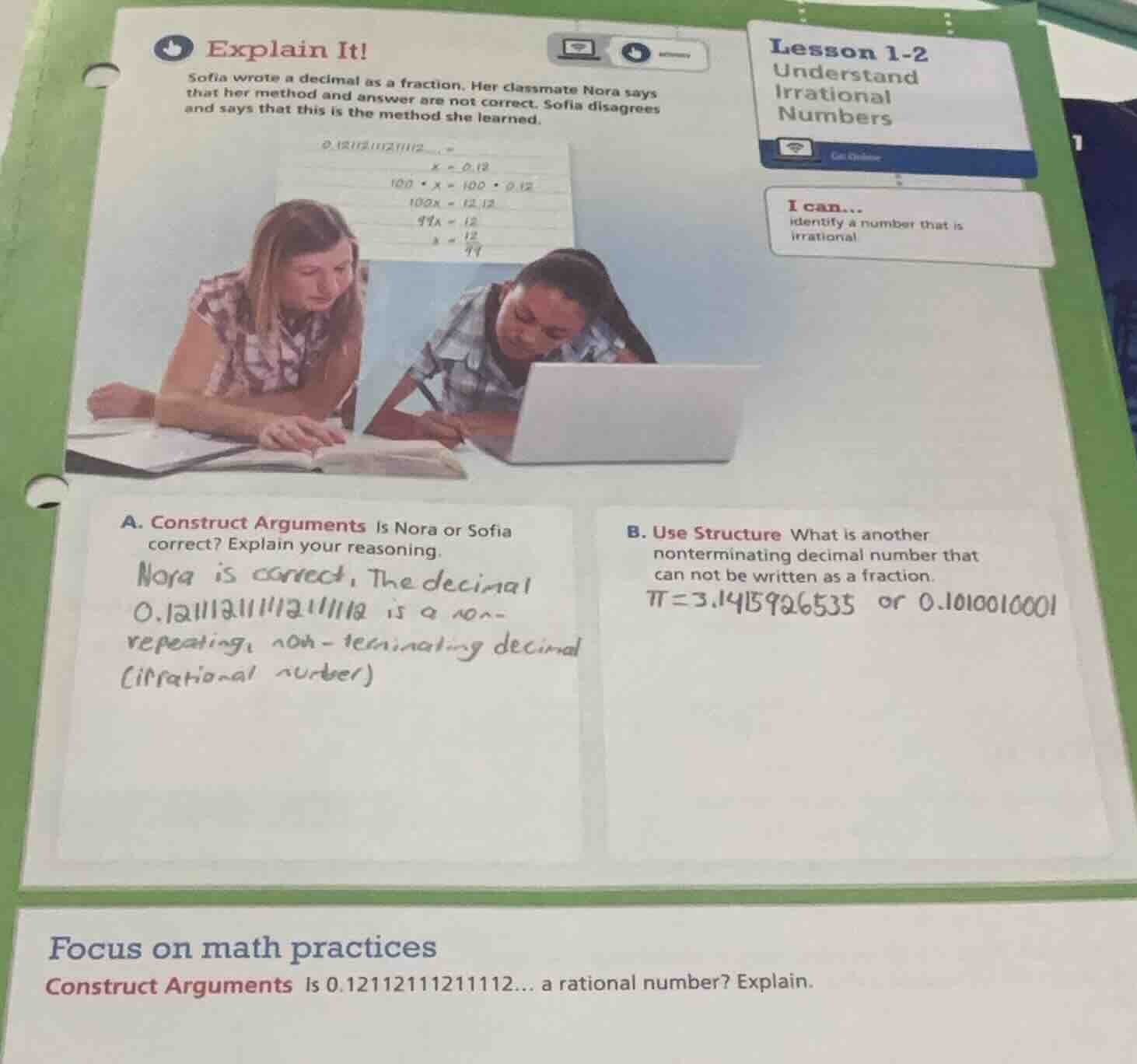
sofia wrote a decimal as a fraction. her classmate nora says that her method and answer are not correct. sofia disagrees and says that this is the method she learned.
$0.12112111211112... =$
$x = 0.12$
$100 \cdot x = 100 \cdot 0.12$
$100x = 12.12$
$99x = 12$
$x = \frac{12}{99}$
lesson 1-2
understand
irrational
numbers
i can...
identify a number that is irrational
a. construct arguments is nora or sofia correct? explain your reasoning.
nora is correct, the decimal 0.12111211112111112 is a non-repeating, non-terminating decimal (irrational number)
b. use structure what is another nonterminating decimal number that can not be written as a fraction.
$\pi=3.1415926535$ or 0.1010010001
focus on math practices
construct arguments is 0.12112111211112... a rational number? explain.
For Part A:
Nora is correct. The decimal 0.12112111211112... is non-terminating and does not have a repeating, fixed pattern of digits. Rational numbers must be either terminating decimals or non-terminating repeating decimals, and Sofia's method only works for repeating decimals, not this non-repeating one.
For Part B:
Any non-terminating, non-repeating decimal fits this description. These are irrational numbers, which cannot be written as a fraction of two integers.
For Focus on Math Practices:
0.12112111211112... is not a rational number. It is non-terminating and has no consistent repeating digit sequence, which violates the requirement for a number to be rational (rational numbers can be expressed as $\frac{a}{b}$ where $a,b$ are integers, $b
eq0$, and correspond to terminating or repeating decimals).

Snap & solve any problem in the app
Get step-by-step solutions on Sovi AI
Photo-based solutions with guided steps
Explore more problems and detailed explanations
A. Nora is correct. The decimal 0.12112111211112... is a non-terminating, non-repeating (irrational) number, so it cannot be written as a fraction, making Sofia's method invalid.
B. Example: $\sqrt{2} \approx 1.41421356...$ (or $\pi \approx 3.14159265...$, or 0.1010010001...)
Focus on Math Practices: No, 0.12112111211112... is not a rational number. It is non-terminating and non-repeating, so it cannot be expressed as a ratio of two integers.