QUESTION IMAGE
Question
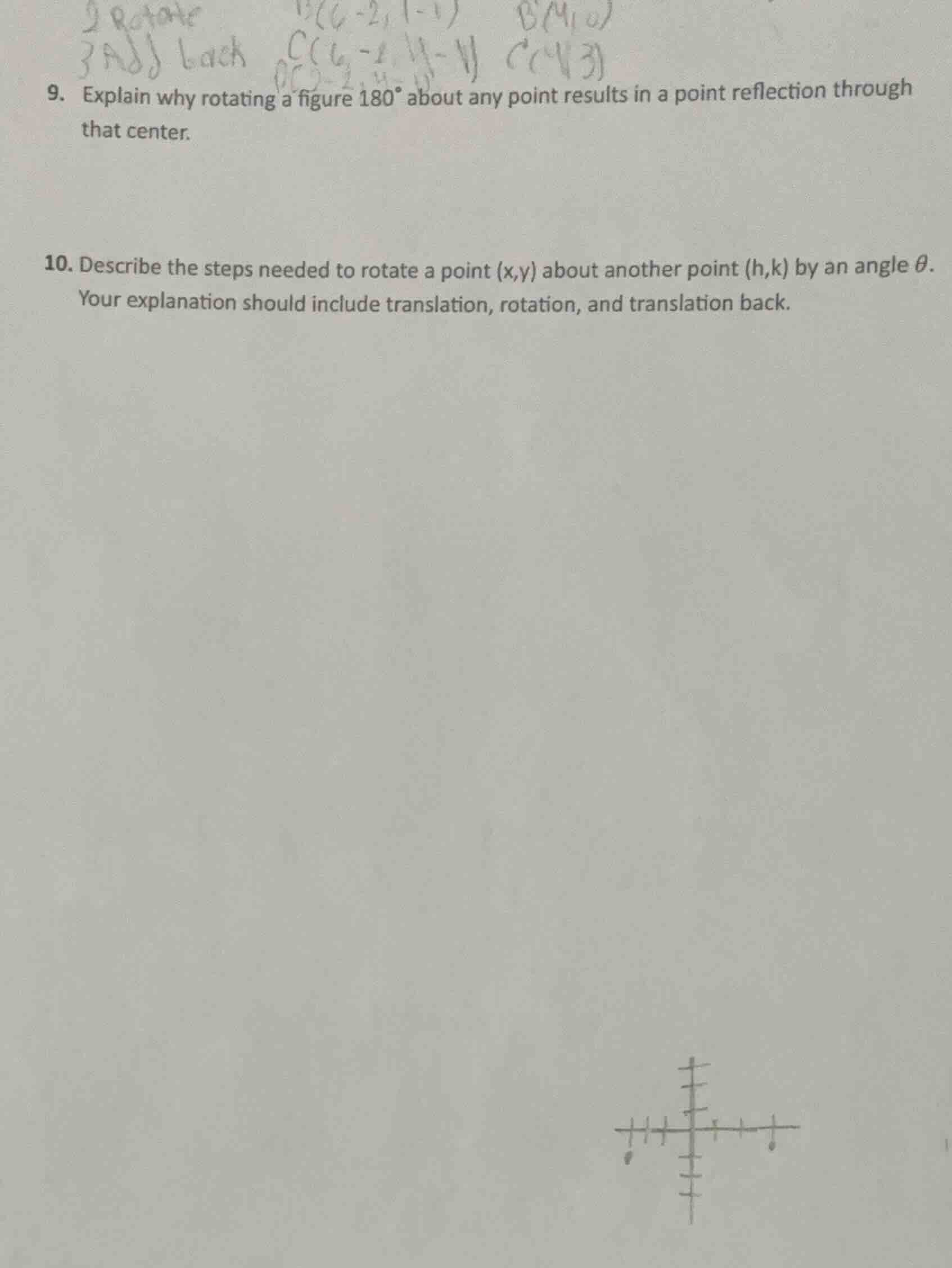
- explain why rotating a figure 180° about any point results in a point reflection through that center.
- describe the steps needed to rotate a point (x,y) about another point (h,k) by an angle θ. your explanation should include translation, rotation, and translation back.
Question 9
A \(180^\circ\) rotation about a center \(O\) for a point \(P\) means the angle \(\angle POP'\) (where \(P'\) is the image) is \(180^\circ\), so \(O\) lies on the line segment \(PP'\) and \(OP = OP'\). By definition, a point reflection through \(O\) maps \(P\) to \(P'\) such that \(O\) is the midpoint of \(PP'\). Since \(180^\circ\) rotation gives \(OP = OP'\) and collinearity of \(P\), \(O\), \(P'\), it satisfies the point - reflection definition. For a figure, since every point in the figure follows this, the entire figure's \(180^\circ\) rotation about \(O\) is a point reflection through \(O\).
- Translation: Translate the coordinate system so that the center of rotation \((h,k)\) becomes the origin. This is done by subtracting \((h,k)\) from the point \((x,y)\). The new coordinates of the point are \((x - h,y - k)\).
- Rotation: Rotate the translated point \((x - h,y - k)\) about the origin (which was the original center \((h,k)\)) by an angle \(\theta\). Using the rotation formula \(x'=x\cos\theta - y\sin\theta\) and \(y'=x\sin\theta + y\cos\theta\) (where \(x=x - h\) and \(y = y - k\) in this translated system), the rotated coordinates are \(((x - h)\cos\theta-(y - k)\sin\theta,(x - h)\sin\theta+(y - k)\cos\theta)\).
- Translation Back: Translate the coordinate system back to its original position by adding \((h,k)\) to the rotated coordinates. The final coordinates of the rotated point are \((h+(x - h)\cos\theta-(y - k)\sin\theta,k+(x - h)\sin\theta+(y - k)\cos\theta)\).

Snap & solve any problem in the app
Get step-by-step solutions on Sovi AI
Photo-based solutions with guided steps
Explore more problems and detailed explanations
A \(180^\circ\) rotation about a center \(O\) for any point \(P\) in the figure creates an image \(P'\) such that \(O\) is the midpoint of \(\overline{PP'}\) (as \(\angle POP' = 180^\circ\) implies collinearity and \(OP=OP'\)), which matches the definition of a point reflection through \(O\). Thus, rotating a figure \(180^\circ\) about \(O\) is a point reflection through \(O\).