QUESTION IMAGE
Question
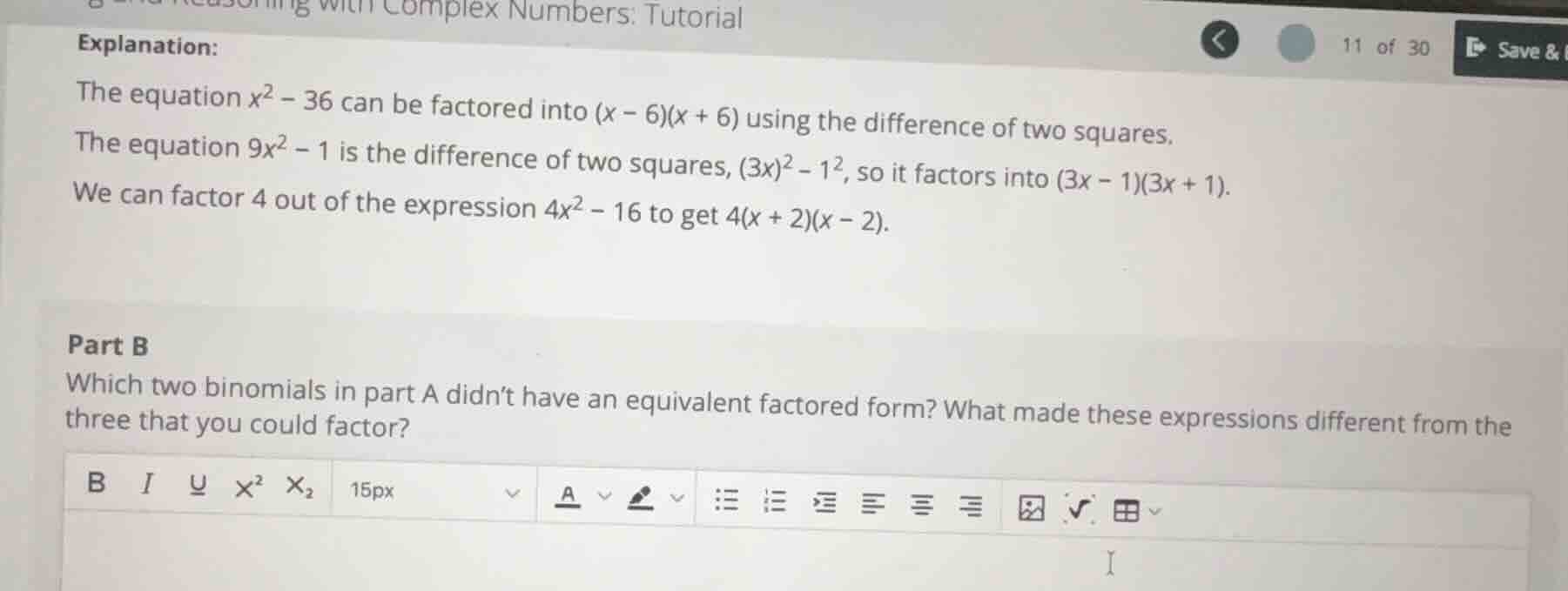
explanation: the equation $x^2 - 36$ can be factored into $(x - 6)(x + 6)$ using the difference of two squares. the equation $9x^2 - 1$ is the difference of two squares, $(3x)^2 - 1^2$, so it factors into $(3x - 1)(3x + 1)$. we can factor 4 out of the expression $4x^2 - 16$ to get $4(x + 2)(x - 2)$. part b which two binomials in part a didnt have an equivalent factored form? what made these expressions different from the three that you could factor?
Assuming part A had binomials (maybe like non - difference - of - squares ones, e.g., if there were binomials like \(x^{2}+36\) or \(9x^{2}+1\) or non - factorable quadratics). The non - factorable binomials (in difference - of - squares context) would be those that are sum of squares (since \(a^{2}+b^{2}\) doesn't factor over real numbers, unlike \(a^{2}-b^{2}=(a - b)(a + b)\)). For example, if part A had \(x^{2}+36\) (which is \(x^{2}+6^{2}\)) and \(9x^{2}+1=(3x)^{2}+1^{2}\), these can't be factored as difference of squares (they are sum of squares). The factorable ones were difference of squares (like \(x^{2}-36=(x - 6)(x + 6)\), \(9x^{2}-1=(3x - 1)(3x + 1)\), \(4x^{2}-16 = 4(x^{2}-4)=4(x - 2)(x + 2)\)) because they are in the form \(a^{2}-b^{2}\), while the non - factorable ones are in \(a^{2}+b^{2}\) (no real - valued binomial factors).

Snap & solve any problem in the app
Get step-by-step solutions on Sovi AI
Photo-based solutions with guided steps
Explore more problems and detailed explanations
(Assuming typical non - factorable binomials in such context, e.g.) The binomials \(x^{2}+36\) and \(9x^{2}+1\) (or other sum - of - squares binomials) didn't have an equivalent factored form (over real numbers). These expressions are sums of squares (\(a^{2}+b^{2}\)) while the factorable ones were differences of squares (\(a^{2}-b^{2}\)), and \(a^{2}+b^{2}\) cannot be factored into real - valued binomial factors (unlike \(a^{2}-b^{2}=(a - b)(a + b)\)).