QUESTION IMAGE
Question
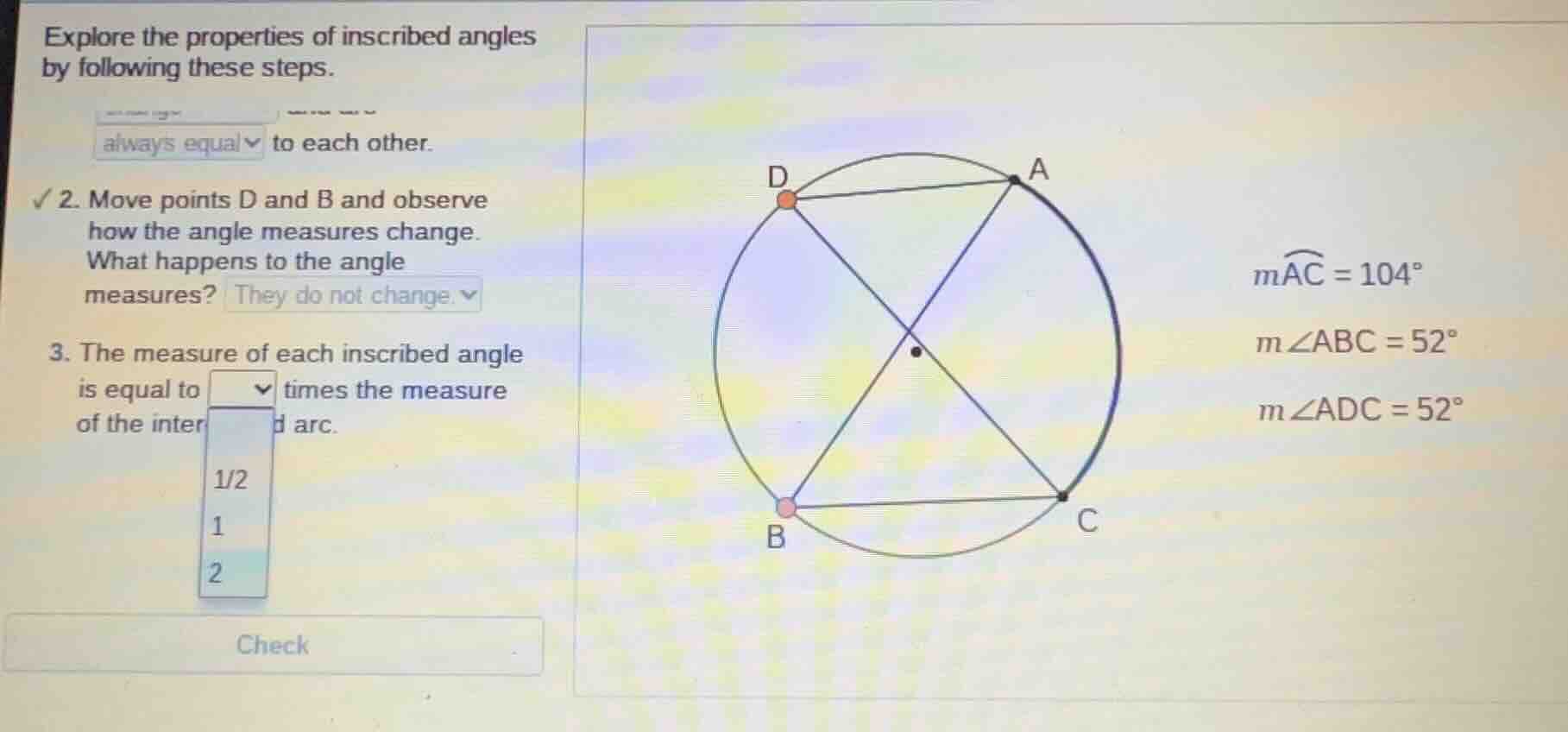
explore the properties of inscribed angles by following these steps. always equal to each other. 2. move points d and b and observe how the angle measures change. what happens to the angle measures? they do not change. 3. the measure of each inscribed angle is equal to dropdown times the measure of the intercepted arc. options: 1/2, 1, 2. check. image of a circle with points a, b, c, d; m⌢ac = 104°, m∠abc = 52°, m∠adc = 52°
Step1: Recall the Inscribed Angle Theorem
The Inscribed Angle Theorem states that an inscribed angle is half the measure of its intercepted arc.
Step2: Analyze the Given Values
We are given \( m\widehat{AC} = 104^\circ \), \( m\angle ABC = 52^\circ \), and \( m\angle ADC = 52^\circ \). Let's check the relationship between the inscribed angle and the intercepted arc.
For \( \angle ABC \) (inscribed angle) intercepting arc \( AC \) (measure \( 104^\circ \)):
\( \frac{1}{2} \times 104^\circ = 52^\circ \), which matches \( m\angle ABC \).
Similarly, for \( \angle ADC \) (inscribed angle) intercepting arc \( AC \):
\( \frac{1}{2} \times 104^\circ = 52^\circ \), which matches \( m\angle ADC \).
So the measure of each inscribed angle is equal to \( \frac{1}{2} \) times the measure of the intercepted arc.

Snap & solve any problem in the app
Get step-by-step solutions on Sovi AI
Photo-based solutions with guided steps
Explore more problems and detailed explanations
\( \frac{1}{2} \) (or 1/2)