QUESTION IMAGE
Question
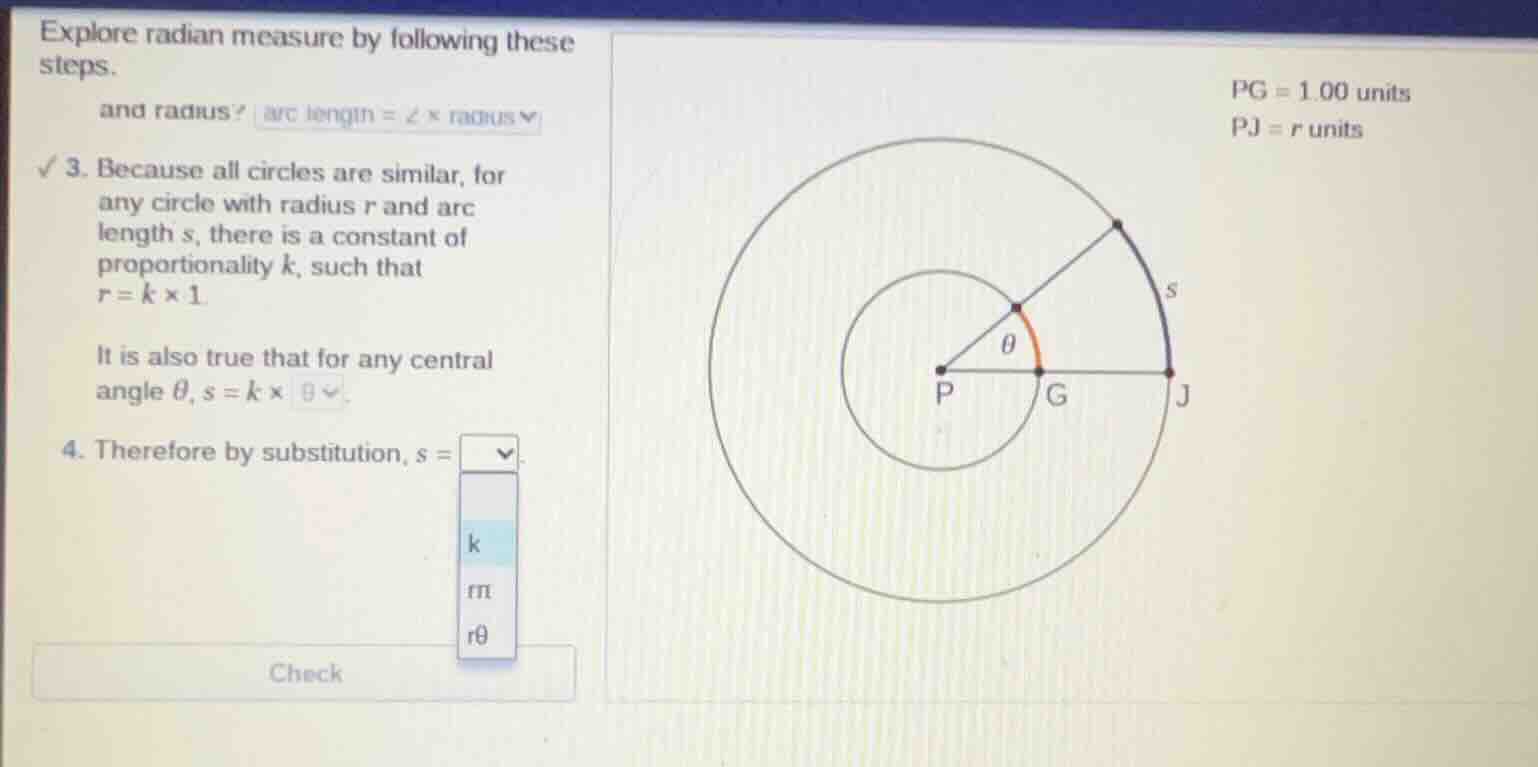
explore radian measure by following these steps.
and radius? arc length = ∠ × radius
- because all circles are similar, for
any circle with radius r and arc
length s, there is a constant of
proportionality k, such that
r = k × 1.
it is also true that for any central
angle θ, s = k × θ
- therefore by substitution, s =
options: k, m, rθ
pg = 1.00 units
pj = r units
Step 1: Analyze the given relationships
We know that for the smaller circle with radius \( PG = 1 \) unit, \( r=k\times1 \), so \( k = r \) (when the radius of the smaller circle is 1, the constant of proportionality \( k \) is equal to the radius of the larger circle? Wait, no, let's re - examine. The formula for arc length is \( s=\theta\times r \) (in radians). From the first part, \( r = k\times1 \), so \( k=r \). Then for the arc length \( s \) and central angle \( \theta \), we have \( s=k\times\theta \). But since \( k = r \) (because \( r = k\times1 \)), substituting \( k \) with \( r \) in \( s = k\times\theta \), we get \( s=r\theta \).
Step 2: Substitute the value of \( k \)
We found that \( k = r \) (from \( r=k\times1 \)). And we have the formula for arc length \( s = k\times\theta \). Substituting \( k=r \) into \( s = k\times\theta \), we get \( s=r\theta \).

Snap & solve any problem in the app
Get step-by-step solutions on Sovi AI
Photo-based solutions with guided steps
Explore more problems and detailed explanations
\( r\theta \)